A practical 2026 guide to crypto loan collateral: which assets work, how collateral quality drives max LTV across BTC, ETH, LSTs, stablecoins and alts.
 Arkadii Kaminskyi
Arkadii Kaminskyi
Head of Operations at Sats Terminal
Head of Operations at Sats Terminal with 5 years of experience in crypto. Specializes in DeFi, yield farming, and borrowing — has reviewed 50+ crypto products.
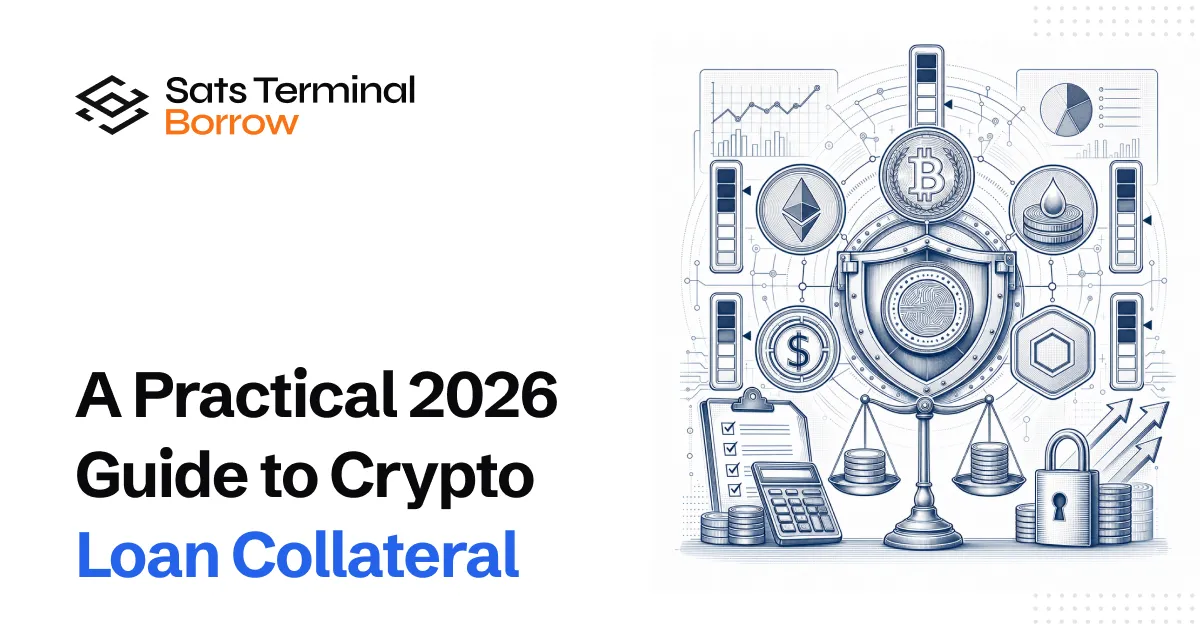
Not all crypto is created equal when a lender is sizing up your loan. The asset you pledge determines how much you can borrow, what interest rate you pay, and how close you sit to a margin call — which is why understanding crypto loan collateral is the single highest-leverage decision a borrower makes before signing anything. Two people can deposit the same dollar value, yet one walks away with a comfortable 70% loan and the other gets capped at 35% because their asset is thinner, more volatile, or less trusted by the protocol's risk engine. This guide breaks down exactly which assets work as collateral in 2026, why some earn far better terms than others, and how to choose the right one for what you actually want to do.
We will stay tightly focused on the asset selection question — what makes good collateral, the main categories and how they behave, how maximum loan-to-value scales with collateral quality, the difference between isolated and shared collateral, Aave's E-Mode, and how DeFi and CeFi diverge on what they accept. By the end you should be able to look at your portfolio and know which holdings are loan-grade, which are borderline, and which you should never put up against a loan. This is educational content, not financial or tax advice; protocol parameters change constantly, so confirm current terms before you commit funds.
Before listing specific tokens, it helps to understand the lens a lender uses. Whether it is an automated smart contract on Aave or a risk committee at a CeFi desk, the underwriting question is identical: if the borrower stops paying and we have to sell this asset in a hurry, will we recover the loan? Everything about collateral quality flows from that one question. Four properties dominate the answer.
Rule of thumb: the best collateral is boring. Deep liquidity, low volatility, a battle-tested oracle, and wide acceptance beat a higher headline yield every time. If you have to explain why an asset should qualify, the lender has probably already discounted it.
There is a fifth, softer factor for CeFi specifically: custody and counterparty arrangements. Some desks rehypothecate collateral (lend it out to generate yield), while others keep it segregated. That does not change whether an asset can be collateral, but it changes the risk you take by posting it — a topic we return to in the CeFi-vs-DeFi section. For the mechanics of how collateral protects the lender in the first place, our explainer on how collateral protects lenders and borrowers goes deeper than we can here.
The clearest way to see collateral quality in action is the maximum loan-to-value ratio each asset is granted. LTV is simply your loan divided by your collateral value. A lender sets a ceiling on it, and that ceiling is the lender's verdict on your asset. Higher-quality collateral earns a higher ceiling because the lender needs less buffer to cover a fire-sale.
As of early 2026, the rough tiers on mature DeFi protocols look like this — these are typical ranges, not guarantees, and they shift with governance votes, so always check the live parameter before you borrow:
Notice the pattern: volatility drives the ceiling down. The math is intuitive. If an asset can plausibly fall 30% in a day, a lender starting you at 90% LTV would be underwater before liquidators could act. Starting you at 50% gives the system room to liquidate at, say, 60-65% and still recover the debt plus the liquidation bonus paid to keepers. Lower LTV is not the protocol being stingy — it is the protocol pricing the speed at which your collateral could evaporate. For a structured walk-through of choosing your operating LTV, see our guide to optimizing your LTV ratio.
Max LTV is the ceiling, not the target. Borrowing at the maximum leaves zero buffer and a health factor barely above 1.0. Most disciplined borrowers operate well below the cap — often 40-55% on volatile collateral — precisely so a normal price dip does not trigger liquidation.
Bitcoin is the deepest, most liquid asset in crypto, which makes it ideal collateral — but Bitcoin lives on its own chain. To use it inside Ethereum-based DeFi (Aave, Morpho), you need a tokenized representation, a wrapped Bitcoin token that tracks BTC 1:1. The three you will encounter most are wBTC, cbBTC, and tBTC, and they differ chiefly in who you are trusting to hold the underlying BTC.
Whichever you pick, the on-chain collateral is the wrapper, not native BTC — so you also inherit the wrapper's custody and bridge risk on top of Bitcoin's price risk. If you want the full comparison of trust models, mint/redeem mechanics, and which to use for borrowing, our dedicated post on wBTC vs cbBTC vs tBTC for borrowing covers it end to end, and our learn module on bridging and wrapping Bitcoin explains the underlying flow.
One practical note: many CeFi lenders let you post native BTC directly — no wrapping required — because they custody the coin themselves. That is one of the cleaner reasons a Bitcoin-only borrower might choose a CeFi desk over DeFi, a trade-off we unpack below.
Ether is the second pillar of crypto collateral and the native asset of the chain where most lending happens. Its market is deep, its oracle is rock-solid, and it earns high LTV almost everywhere. If you hold ETH and want dollars without selling, our walkthrough of ETH-backed loans in 2026 covers the full process.
Where ETH gets interesting is its staked derivatives. Liquid staking tokens (LSTs) — wstETH, stETH, rETH, cbETH — represent staked ETH that is still earning consensus-layer rewards. Posting an LST as collateral is, in a sense, the most capital-efficient move in DeFi because the collateral keeps working while it secures your loan. The staking yield (roughly 2.5-3.5% as of early 2026, though it drifts with network activity) offsets part or all of your borrowing cost.
Consider the yield-offset dynamic. Suppose your wstETH earns ~3% staking yield and you borrow stablecoins against it at a 5% interest rate. Your effective net carrying cost is closer to 2%, because the collateral subsidizes the loan. In a correlated E-Mode where you borrow ETH itself against wstETH, the staking yield can fully cover — or even exceed — a low ETH borrow rate, which is the basis of the popular LST "looping" strategy. That same correlation is why protocols grant LSTs such high LTV in E-Mode: the collateral and the debt move together, so the lender needs almost no volatility buffer.
Warning: LSTs are nearly pegged to ETH, not perfectly. In a sharp deleveraging event the LST can trade at a temporary discount (a "depeg") to ETH. Looped positions that assume a perfect peg are the ones that blow up first when that discount appears, because liquidation prices everything at the discounted oracle value.
So LSTs are excellent collateral with a specific caveat: respect the peg risk, keep your health factor comfortable, and do not stack leverage assuming the discount can never widen. For most borrowers, a single conservative LST-backed loan is a clean way to borrow against ETH exposure you were going to hold anyway.
It sounds paradoxical to borrow against dollars, but posting stablecoins as collateral is one of the most common DeFi moves — and it earns the highest LTV of any asset class precisely because a dollar peg barely moves. The two reasons people do it:
The flip side — borrowing stablecoins against volatile collateral like BTC — is the classic "cash without selling" loan. That direction is covered thoroughly in our explainer on stablecoin loans against Bitcoin. Either way, understand the asset's own risks: pegs can break, issuers can freeze addresses, and not all "stable" coins are equally collateralized. Our primer on stablecoin risks is worth reading before you treat any of them as risk-free. USDT and USDC dominate acceptance, but newer yield-bearing dollar tokens are increasingly listed too — often at slightly lower LTV given their different risk profile.
Beyond BTC, ETH, and stablecoins, a handful of large-cap altcoins are accepted as collateral on multiple venues — but at a clear discount. SOL and LINK are the most common examples. They have deep enough markets and reliable oracles to qualify, yet their higher volatility means lenders cap LTV well below the BTC/ETH tier, frequently in the 40-65% range depending on the venue and current risk settings.
Solana borrowing has matured considerably. You can borrow against SOL on Solana-native lending markets as well as via wrapped SOL on Ethereum, and CeFi desks frequently accept it. If SOL is your core holding, our dedicated guide to borrowing against Solana walks through where and how. The trade-off is structural: a SOL-backed loan gives you less cash per dollar of collateral and a tighter liquidation band than a BTC-backed loan, because the asset can move farther, faster.
LINK and a few other established large-caps behave similarly — accepted, but conservative. The deeper you go down the market-cap ladder, the more likely an asset is either confined to isolation mode (borrow only stablecoins, with a hard debt ceiling) or simply not listed. The chain you choose also matters for which alts are available and how cheaply you can manage the position; our comparison of the best blockchain for crypto loans breaks down Ethereum, Base, Arbitrum, and Solana for borrowers.
Knowing what not to pledge is as valuable as knowing what works. Several categories are either dangerous or flatly rejected:
The honest framing: acceptance is not endorsement. A CeFi platform that brags about taking "100+ assets" is taking concentration risk it offsets with low LTV and aggressive liquidation. Just because a venue will lend against a token does not mean doing so is wise for you.
How your collateral is structured matters as much as which asset it is. Three models dominate in 2026.
Cross / shared collateral. In a pooled protocol like Aave's main market, all your supplied assets back all your borrows together. Your total borrowing power is the sum of each asset's value times its LTV. This is flexible and capital-efficient — a dip in one collateral can be offset by strength in another — but it also means a problem with any one asset can affect the whole position.
Isolated collateral. Aave's isolation mode and Morpho Blue's entire design take the opposite approach. In Aave isolation mode, a newly listed or riskier asset can only be used alone as collateral, you can borrow only approved stablecoins against it, and there is a protocol-wide debt ceiling. On Morpho, every market is isolated by construction: one collateral asset, one borrow asset, one fixed liquidation LTV (LLTV), with no contagion between markets. Isolation trades some flexibility for containment — a blow-up in one market cannot drain the others. Our comparison of Aave, Morpho, and CeFi digs into how these architectures change your risk, and the Morpho Blue guide shows the isolated-market workflow in practice.
Aave E-Mode (Efficiency Mode). This is the standout feature for correlated collateral. When your collateral and your debt are highly correlated — two stablecoins, or ETH and its liquid staking tokens — the lender can safely allow much higher LTV because the two sides move together. As of early 2026, Aave's correlated E-Modes commonly enable borrowing ETH against wstETH/rETH at roughly 90%+ LTV, and stablecoin-against-stablecoin loops in the mid-90s. The catch: in E-Mode you can only borrow assets within that correlation category. It is a precision tool for specific strategies (looping, LST leverage), not a general-purpose "more leverage" button.
Tip: E-Mode's high LTV is safe only while the correlation holds. The moment an LST depegs or a stablecoin wobbles, the assumption underpinning that 90%+ ceiling breaks — and that is exactly when E-Mode positions liquidate fastest. Use it for genuinely correlated pairs, not as a leverage cheat code.
What counts as acceptable collateral diverges sharply between decentralized protocols and centralized lenders, and the difference comes down to custody.
DeFi (Aave, Morpho). Collateral must be an on-chain token with a robust oracle, so DeFi accepts a relatively curated set: wrapped BTC variants, ETH and LSTs, major stablecoins, and a tier of vetted large-cap alts. You keep self-custody in the sense that a smart contract — not a company — holds the collateral, and the rules are transparent and immutable. The trade-off is wrapping requirements for Bitcoin and exposure to smart-contract risk.
CeFi (Coinbase, Nexo, Ledn, and similar desks). Because the lender custodies your coins directly, it can accept native BTC with no wrapping and often a far longer list of assets — some desks tout 100+ accepted tokens. The price for that breadth is counterparty risk: you are trusting a company to hold your collateral, and some desks rehypothecate it. Conservative CeFi lenders run lower max LTV (Bitcoin-only desks often cap around 50%) and segregate collateral; aggressive ones offer higher LTV but reuse your coins. Our breakdown of DeFi vs CeFi lending and the blog comparison on CeFi vs DeFi pros and cons lay out the full trade-offs.
Practical takeaway: if you hold native Bitcoin and want to avoid wrapping, a reputable CeFi desk with segregated custody is a legitimate path — just scrutinize whether it rehypothecates. If you hold ETH, LSTs, or stablecoins and value transparency and self-custody of the contract, DeFi usually offers better terms and no company to trust. An aggregator that scans both worlds lets you compare without manually checking each venue.
The table below summarizes how the main collateral categories behave as of early 2026. Treat the LTV figures as typical ranges across major venues, not fixed quotes — every number here can and does change with governance and market conditions, so verify the live parameter before borrowing.
| Asset / Category | Typical Max LTV | Market Liquidity | Volatility | Notes |
|---|---|---|---|---|
| Stablecoins (USDC, USDT) | ~85-90% (mid-90s in E-Mode) | Very deep | Minimal (peg) | Best LTV; watch peg & issuer freeze risk |
| Wrapped BTC (wBTC, cbBTC) | ~70-80% | Very deep | Moderate | Inherits wrapper custody/bridge risk |
| tBTC | ~60-75% | Moderate | Moderate | More decentralized wrap; thinner liquidity |
| Native BTC (CeFi only) | ~40-60% | Very deep | Moderate | No wrapping; counterparty/custody risk |
| ETH (WETH) | ~75-83% | Very deep | Moderate-high | Core DeFi collateral; strong oracle |
| Liquid staking (wstETH, rETH) | ~70-80% (~90%+ ETH E-Mode) | Deep | Moderate-high | Staking yield offsets borrow cost; peg risk |
| SOL | ~40-65% | Deep | High | Accepted widely; tighter liquidation band |
| LINK & blue-chip alts | ~40-60% | Moderate-deep | High | Conservative caps; sometimes isolation mode |
| Long-tail alts | 0-40% or rejected | Thin | Very high | Isolation mode or not listed; slippage risk |
For the underlying definitions behind these numbers, the glossary entries on collateral, over-collateralization, and liquidation are useful companions, and our learn module on understanding collateral and LTV ties it all together.
The single most important consequence of collateral choice is how fast you can be liquidated. Volatile collateral does not just earn lower LTV — it pushes the liquidation price uncomfortably close to spot, so a routine market wobble can end your position. Let us run real numbers. (Prices are illustrative for 2026 and move constantly; substitute current values when you model your own loan.)
Scenario A — Bitcoin collateral. You hold 1 wBTC at a reference price of $100,000. The market allows 75% max LTV with an 80% liquidation threshold. You borrow conservatively: $50,000 in USDC, a 50% starting LTV.
Scenario B — Volatile alt collateral, same dollars. Now you post $100,000 of a high-beta altcoin at a reference price of $180 (say, ~556 tokens). The market caps it at 50% max LTV with a 60% liquidation threshold, and you again borrow $50,000 — but that is now the maximum 50% LTV.
Same borrower, same $50,000 loan, wildly different safety. The Bitcoin position survives a 37% drawdown; the alt position dies on a 17% dip that volatile tokens print routinely. Worse, when the alt is liquidated, its thinner market means more slippage and a bigger liquidation penalty eating into your remaining collateral. This is the entire argument for high-quality collateral compressed into one example. To go deeper on staying solvent, see managing liquidation risk and our blog on how LTV ratios affect your position.
If you must borrow against a volatile asset, halve the LTV you would use on Bitcoin and watch the position daily. A 50% Bitcoin loan and a 50% altcoin loan are not the same risk — the altcoin's liquidation price is far closer to spot, and its fire-sale recovery is worse.
Pulling it together, here is how to reason through which asset to pledge. Start with what you hold and what you are trying to accomplish, then let collateral quality set your terms.
| Your situation | Best collateral choice | Why |
|---|---|---|
| Long-term Bitcoin holder wanting cash without selling | wBTC/cbBTC (DeFi) or native BTC (CeFi) | Deepest market, high LTV, widest acceptance |
| ETH holder who also wants to keep earning yield | wstETH / rETH via E-Mode | Staking yield offsets borrow cost; high correlated LTV |
| Stablecoin holder running a yield or looping strategy | USDC / USDT in stablecoin E-Mode | Highest LTV; minimal volatility buffer needed |
| SOL-centric portfolio | SOL on a Solana market or wrapped SOL | Accepted but use conservative LTV for the volatility |
| Holder of small-cap or project tokens | Generally avoid as collateral | Low/zero LTV, harsh liquidation, oracle/slippage risk |
A four-step checklist before you commit:
If you want to compare what different venues will actually lend against your chosen collateral — and at what rate — an aggregator does the legwork. Rather than opening Aave, several Morpho markets, and a handful of CeFi desks one by one, you can see competing offers for the same collateral side by side. Our overview of how lending aggregators find the best rates explains the mechanism, and for the bigger-picture decision of whether to borrow at all, our sibling post on selling vs borrowing against your Bitcoin is a useful companion.
Common Questions
The most widely accepted collateral is Bitcoin (as native BTC on CeFi or wrapped wBTC/cbBTC/tBTC in DeFi), Ether and its liquid staking tokens like wstETH and rETH, and major stablecoins such as USDC and USDT. Blue-chip alts like SOL and LINK are accepted at lower LTV on several venues. Smaller, illiquid, or highly volatile tokens are often rejected or confined to isolation mode.

