

A balanced 2026 framework for whether to sell or borrow bitcoin: real tax math, a break-even analysis, a scenario matrix, the partial-sell hybrid, and when each wins.
 Arkadii Kaminskyi
Arkadii Kaminskyi
Head of Operations at Sats Terminal
Head of Operations at Sats Terminal with 5 years of experience in crypto. Specializes in DeFi, yield farming, and borrowing — has reviewed 50+ crypto products.
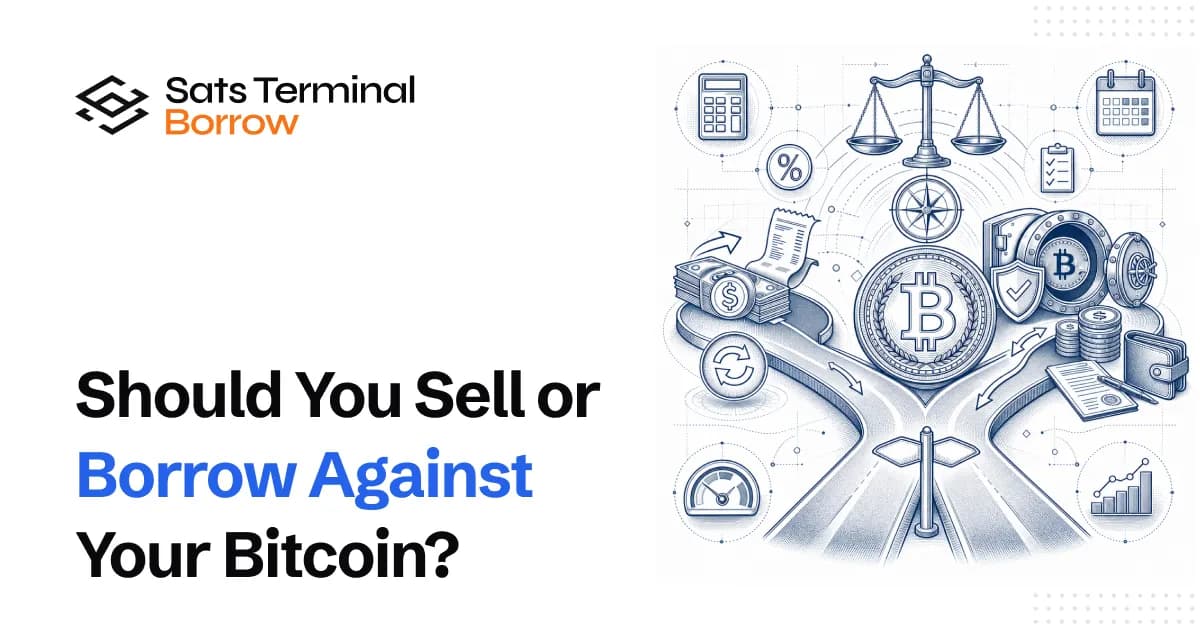
The single most consequential money decision a long-term holder faces is deceptively simple: when you need cash, should you sell or borrow bitcoin? Selling is clean and final, but it locks in a tax bill and hands away every dollar of future upside. Borrowing keeps your stack and your exposure intact, yet it stacks interest cost and liquidation risk on top of your position. There is no universally correct answer here, and anyone who tells you "never sell" or "always borrow" is selling a slogan, not a strategy. This guide is a balanced 2026 decision framework: real tax math, a scenario matrix, a break-even analysis, and an honest accounting of the cases where cashing out is genuinely the smarter move.
By the end you will be able to run the numbers for your own situation in a few minutes, recognize the behavioral traps on both sides, and decide whether selling, borrowing, or a partial-sell hybrid fits your time horizon, conviction, and tax bracket. None of this is financial or tax advice; parameters and rates referenced are early-to-mid-2026 snapshots that change constantly, so confirm current terms before you act.
Strip away the noise and the sell or borrow question reduces to a single comparison: the cost of realizing your gains versus the cost of renting liquidity against them. Both have a price. The mistake most people make is comparing the visible cost of one path against the invisible cost of the other.
When you sell, you incur three distinct costs. First, a capital-gains tax bill on the appreciated portion of what you sell. Second, the loss of all future upside on the bitcoin you no longer own. Third, the friction of buying back later if you change your mind, including the wash-sale-adjacent timing risk and a fresh cost basis. The tax and the surrendered upside are real money even though no statement line item ever says "lost upside."
When you borrow, you keep the asset and its upside, and you avoid triggering a taxable event entirely. But you pay interest for the life of the loan, you accept liquidation risk if bitcoin drops sharply, and you tie up your collateral so it cannot be moved or sold without first repaying. You are, in effect, paying a premium to defer the tax decision and to stay long. Whether that premium is worth it depends almost entirely on how long you borrow, at what rate, and what bitcoin does next.
Rule of thumb: selling is a one-time cost that grows with your gain; borrowing is a recurring cost that grows with time. The longer your horizon and the larger your unrealized gain, the more the math tilts toward borrowing — up to the point where liquidation risk or compounding interest overwhelms the tax saved.
The asymmetry that makes borrowing attractive to long-term holders is that pledging collateral is not a disposal of property under current U.S. tax principles. You retain ownership; you simply encumber the asset. That single fact is the engine behind the entire "borrow, don't sell" thesis — but as we will see, it is a tool with sharp edges, not a magic wand.
The IRS continues to treat cryptocurrency as property, so selling bitcoin is a taxable disposition and borrowing against it is not. Taking out a bitcoin-backed loan is generally not a taxable event because a loan must be repaid — the proceeds are not income, and pledging collateral is not a sale. That is the bedrock principle, and it is not unique to crypto; it is the same reason a homeowner can take a HELOC without triggering tax on their home equity.
Holding period matters enormously. Sell bitcoin you have held one year or less and the gain is short-term, taxed at ordinary income rates up to 37%. Hold longer than a year and you qualify for long-term rates of 0%, 15%, or 20%. For 2026, the long-term thresholds (per the IRS inflation adjustments) look roughly like this:
| 2026 Long-Term Rate | Single Filer Taxable Income | Married Filing Jointly |
|---|---|---|
| 0% | Up to ~$49,450 | Up to ~$98,900 |
| 15% | ~$49,451 – $545,500 | ~$98,901 – $613,700 |
| 20% | Above ~$545,500 | Above ~$613,700 |
On top of those rates, high earners face the 3.8% Net Investment Income Tax (NIIT) once modified adjusted gross income crosses ~$200,000 single or ~$250,000 joint, pushing the real top federal rate on investment gains toward 23.8% — and that is before any state tax. Always verify the current year's brackets; these move with inflation and legislation.
The critical word for borrowers is defer, not avoid. A loan does not erase your embedded gain; it postpones the reckoning. When you eventually sell to repay, or if your collateral is liquidated, the tax comes due. There are two non-obvious traps here:
Warning: "borrow to defer tax forever" only works if you never need to unwind the position and never get liquidated. The strategy that whales use — borrow, hold, and pass the asset to heirs with a stepped-up basis — assumes a multi-decade horizon and the financial cushion to survive a 70% drawdown without selling. Most borrowers do not have that profile, so plan for the loan to be repaid, not held to infinity.
For a deeper treatment of the deduction nuances — when interest might be deductible as investment or business interest under IRC §163 — see our companion piece on whether borrowing against bitcoin is a taxable event and the broader tax implications of crypto borrowing. Personal-use interest is generally not deductible, so do not assume the headline rate is tax-advantaged for you.
Abstract principles are useless without numbers, so let's run a concrete case. You need $50,000 in cash. You hold 2 BTC, currently worth roughly $100,000 each (a $200,000 position), which you bought years ago at an average cost basis of $20,000 per coin. Bitcoin's price is volatile — in mid-2026 it has swung dramatically — so treat $100,000 as a reference, not a promise. You are a married-filing-jointly household comfortably in the 15% long-term bracket.
At ~$100,000 per BTC, you need to sell 0.5 BTC to net $50,000 before tax — but you actually have to sell more than that, because you owe tax on the gain. Each coin carries an $80,000 long-term gain ($100,000 − $20,000), so 80% of every dollar you sell is taxable gain. To clear $50,000 after a 15% tax on the gain portion, the math works out like this:
You walk away with $50,000, a clean balance sheet, no liquidation risk, and a smaller bitcoin position. If you are bearish or simply want to de-risk, that is a feature, not a bug.
Instead, you pledge your 2 BTC as collateral and borrow $50,000 in stablecoins. With $200,000 of collateral, a $50,000 loan is a 25% loan-to-value ratio — conservative, which is exactly where you want to be. (For how LTV drives everything from your borrowing limit to your liquidation price, see how LTV ratios affect your position and the loan-to-value ratio glossary entry.)
| Factor | Sell 0.565 BTC | Borrow $50,000 at ~8% |
|---|---|---|
| Cash in hand | $50,000 | $50,000 |
| Tax due now | ~$6,800 (15% bracket) | $0 (deferred) |
| Ongoing cost | None | ~$4,000/yr interest |
| BTC still owned | ~1.44 BTC | 2.0 BTC |
| Liquidation risk | None | Yes (≈ -65% buffer) |
| Future tax owed | Settled on sold portion | Still owed on full stack |
Notice what the table reveals: in year one, selling costs ~$6,800 once, while borrowing costs ~$4,000 in interest. If you can repay the loan within roughly 20 months, borrowing is cheaper on a pure cost basis — and you keep the full upside the whole time. Push the loan past that point, and the recurring interest eventually exceeds the one-time tax. That crossover is the heart of the break-even analysis below.
The cleanest way to decide is to find the holding period at which cumulative interest equals the tax you would have paid by selling. Below that period, borrowing wins on cost; above it, selling wins. The formula is intuitive: break-even months ≈ (tax cost ÷ annual interest) × 12, ignoring compounding for a first approximation.
Using our example — ~$6,800 tax avoided, ~$4,000/year interest — the simple break-even is about 20 months. But the rate you pay swings this dramatically. The table below shows the break-even holding period for a $50,000 loan against the ~$6,800 tax cost, at different interest rates:
| Borrow APR | Annual Interest on $50k | Approx. Break-Even Period |
|---|---|---|
| 4% | $2,000 | ~41 months (3.4 yrs) |
| 6% | $3,000 | ~27 months (2.3 yrs) |
| 8% | $4,000 | ~20 months (1.7 yrs) |
| 10% | $5,000 | ~16 months (1.4 yrs) |
| 12% | $6,000 | ~14 months (1.1 yrs) |
Three insights fall out of this:
Tip: the 0% long-term bracket is borrowing's kryptonite. If your taxable income is low enough in a given year that you can sell appreciated bitcoin at the 0% federal rate, selling can be effectively free — and paying 8% interest to avoid a 0% tax makes no sense. Tax-gain harvesting in a low-income year often beats any loan. See tax-efficient rebalancing for the flip side of this strategy.
Cost alone never decides this; your situation does. The following matrix maps common real-world scenarios to the path that usually fits best. Treat it as a starting point, not gospel — your conviction, bracket, and risk tolerance can override any single row.
| Scenario | Leans Toward | Why |
|---|---|---|
| Short-term cash need (weeks to months) | Borrow | Little interest accrues; you avoid a tax event for a temporary gap. |
| Large one-off purchase (home, business) | Depends on horizon | Long repayment + high rate favors selling; short + cheap favors borrowing. |
| Low-income / 0% cap-gains year | Sell | Realizing gains may be tax-free; no reason to pay interest. |
| High income + large embedded gain | Borrow | Tax avoided is large; deferral is most valuable here. |
| Strong long-term bull conviction | Borrow | Keeps full upside; interest is the price of staying long. |
| Bearish or want to de-risk | Sell | No reason to keep exposure or carry liquidation risk. |
| Unstable / variable income | Sell or borrow small | Liquidation + interest obligations are dangerous without reliable cash flow. |
| Need money permanently (won't rebuy) | Sell | If you're truly exiting the position, a loan just adds cost. |
Walk through each dimension deliberately:
The binary framing — sell everything or borrow everything — is a false choice. The most disciplined holders frequently do both, and the hybrid often dominates either extreme.
A partial-sell hybrid means realizing just enough bitcoin to cover the tax-efficient portion of your need (especially if some of your stack qualifies for the 0% or 15% bracket, or has a high cost basis and thus a small gain), then borrowing the remainder against what you keep. This caps your liquidation exposure, reduces the loan size and therefore the interest, and lets you harvest gains strategically.
The hybrid also addresses the biggest psychological objection to selling — that you "missed out" — by keeping most of your exposure while still de-risking the loan. If your goal is to diversify without fully selling your BTC, a measured partial-sell-plus-borrow is frequently the cleanest route.
Rule of thumb: if a 100% loan would put you above ~40% LTV or stretch your ability to service interest, sell a slice first. The marginal tax on a partial sale is almost always cheaper than the marginal liquidation risk of an over-leveraged loan.
Interest is a predictable cost; liquidation is a tail risk, and it is the single most underestimated downside of choosing to borrow. When you sell, your worst case is "bitcoin went up afterward and I feel bad." When you borrow, your worst case is "bitcoin crashed, my collateral was force-sold at the bottom, I owe tax on that forced sale, and I lost both my coins and my upside." Those are not symmetric.
Liquidation happens when your LTV breaches the protocol's liquidation threshold — the point at which the lender sells your collateral to protect itself, typically with a penalty. The mechanics in DeFi are unforgiving: liquidation engines act the instant your threshold is crossed, often selling more collateral than strictly necessary and applying a liquidation bonus to the liquidator. There is no grace period, no phone call, no human discretion.
Your defense is structural, decided the day you borrow:
This is the asymmetry that should give every borrower pause: selling caps your regret at "missed gains," while borrowing exposes you to a compounding worst case. If you cannot actively monitor your position or cannot survive a deep drawdown without forced selling, the honest answer is often to sell. For a fuller treatment of what happens at the edge, our sibling post on default and liquidation is essential reading.
The math is only half the decision. Human behavior breaks more loan strategies than interest rates ever will, and it cuts both ways.
On the selling side, the dominant biases are loss aversion and anticipated regret. Holders systematically overvalue coins they already own (the endowment effect) and dread the scenario where they sell and bitcoin moons. This emotional weight pushes people toward borrowing even when selling is objectively cheaper — they pay a real interest premium to avoid an imagined regret. Recognizing this lets you discount it: the regret of a missed 2x feels enormous in advance and is usually survivable in reality.
On the borrowing side, the danger is the opposite. A loan can feel like "free money" because no asset left your wallet, which tempts people to over-borrow, to chase yield with the proceeds, or to treat a high-LTV loan as casually as a low-LTV one. Borrowing also requires ongoing discipline — watching your health factor, servicing interest, keeping a repayment plan — that many people simply do not maintain over months and years. A strategy that demands active management will fail the person who sets it and forgets it.
Tip: be honest about which kind of person you are. If you check prices ten times a day and have a repayment plan in writing, borrowing rewards your engagement. If you want to make one decision and never think about it again, selling (or a partial sale) is the path that matches your actual behavior — and the right strategy is the one you'll actually execute, not the one that's optimal on paper.
A useful framing: hodl vs. sell is a portfolio question, while sell crypto or borrow against it is a liquidity question. Conflating them is how people end up over-leveraged. Decide your target bitcoin exposure first (the hodl question), then decide how to raise cash without violating that target (the borrow-vs-sell question). When they're untangled, the answer usually clarifies itself.
Your read on where bitcoin is headed should weight the decision heavily, because it directly determines the value of the upside you're either keeping or surrendering.
If you're a long-term bull: borrowing is the natural fit. Every coin you sell is a coin you'll likely want to rebuy higher, paying a fresh spread and resetting your basis. Interest becomes the cost of maintaining a position you believe will appreciate past the loan cost. The break-even table works in your favor because the upside you retain can dwarf the interest you pay. This is the classic borrow-without-selling thesis, and it is genuinely sound for high-conviction, long-horizon holders who borrow conservatively.
If you're neutral or bearish, or simply want to reduce risk: borrowing makes far less sense. You'd be paying interest and carrying liquidation risk to maintain exposure you don't actually want. Selling de-risks you, raises cash, and removes the chance of a margin event in the exact environment (falling prices) where margin events happen. In a bear market, the holder who sold sleeps better than the holder who borrowed at 60% LTV and is now watching the liquidation price approach.
There is a subtle trap here worth naming: borrowing in a bull market is psychologically easy and mechanically safe (rising collateral lowers your LTV automatically), while borrowing in a bear market is psychologically tempting ("I don't want to sell at the bottom") but mechanically dangerous (falling collateral raises your LTV toward liquidation). The time you most want to borrow instead of sell — a price crash — is the time borrowing is riskiest. Respect that inversion.
Here is the decision distilled. If most of the items in one column describe you, you have your answer. If you're split, the partial-sell hybrid is usually where you land.
| Choose Selling If… | Choose Borrowing If… |
|---|---|
| You qualify for the 0% cap-gains bracket this year | You're in the 15–23.8% bracket with a large embedded gain |
| You're neutral, bearish, or want to de-risk | You have strong long-term bull conviction |
| You need the money permanently and won't rebuy | The cash need is temporary or short-horizon |
| Your income is unstable or you can't actively manage a position | You have stable income and will monitor your health factor |
| You'd be forced above ~40% LTV to cover the need | You can borrow at a low, comfortable LTV with a buffer |
| You can repay only by selling bitcoin anyway | You have a clear, non-collateral repayment plan |
| Your bitcoin has a high cost basis (small taxable gain) | Your bitcoin has a low cost basis (large taxable gain) |
| You want simplicity and zero ongoing obligations | You can shop rates and the cheapest loan beats the tax cost |
And the meta-rule that sits above the table: run the break-even before you decide. Estimate your tax cost of selling, estimate the all-in interest cost of borrowing over your realistic holding period, and compare them honestly — then layer in liquidation risk and your own behavioral profile. A decision made on those four inputs (tax, interest, risk, discipline) will be right far more often than one made on gut feel or a slogan.
If the framework points you toward borrowing, the execution details determine whether the strategy actually delivers. A few principles that separate durable loans from doomed ones:
None of this changes the core decision; it just ensures that if you chose to borrow, you borrow in a way that survives bitcoin being bitcoin.
Common Questions
It depends on four inputs: your tax bracket, the loan rate, your holding horizon, and your risk tolerance. Borrowing usually wins when you have a large embedded gain, strong long-term conviction, and can repay within the break-even period. Selling usually wins when you qualify for the 0% bracket, are bearish, need the money permanently, or can't actively manage liquidation risk. Run the break-even math for your own numbers.
Generally no. Under current U.S. tax principles, taking a loan against your bitcoin is not a taxable event because pledging collateral isn't a sale and loan proceeds aren't income. However, if your collateral is liquidated to repay the loan, that forced sale is a taxable disposition. Repaying with appreciated crypto can also be taxable. This isn't tax advice — confirm your situation with a professional.
If you held longer than a year, you pay long-term capital gains of 0%, 15%, or 20% on your gain, depending on taxable income, plus a possible 3.8% NIIT for high earners and any state tax. Held a year or less, the gain is taxed at ordinary income rates up to 37%. Only the gain over your cost basis is taxed, not the full sale amount.
When cumulative interest exceeds the tax you'd have paid by selling. As a quick estimate, divide your tax cost by the annual interest and multiply by 12 to get the break-even in months. In our $50,000 example at ~8% with a ~$6,800 tax cost, that's about 20 months. A lower rate or higher tax bracket pushes the break-even further out, favoring borrowing.
It means selling just part of your bitcoin — ideally high-cost-basis lots or enough to fill your 0% tax bracket — and borrowing against the rest. This caps your liquidation exposure, shrinks the loan and its interest, and lets you harvest gains tax-efficiently while keeping most of your upside. For many holders it's the best of both worlds and frequently beats going all-in on either selling or borrowing.
As bitcoin falls, your loan-to-value ratio rises. If it breaches the liquidation threshold, the lender sells your collateral to repay the loan, usually with a penalty — and that forced sale is taxable. Borrowing conservatively (a low starting LTV), monitoring your health factor, and keeping cash to add collateral or repay are your defenses. A 30–40% drawdown is normal for bitcoin, so size your loan to survive one.
If you have strong long-term bull conviction, selling means surrendering upside you'll likely want to rebuy higher, paying a fresh spread and resetting your basis. Borrowing lets you keep full exposure while raising cash, with interest as the cost of staying long. Just borrow conservatively — the temptation to over-leverage in a bull market is real, and a leveraged position is far more dangerous if the trend reverses.
It depends on what you use the proceeds for. Interest on a loan used for personal consumption is generally not deductible. Interest may be deductible if the proceeds fund investment or business activity, subject to limitations under IRC §163. Don't assume the headline rate is tax-advantaged — the deductibility rules are nuanced and worth reviewing with a tax professional before you rely on them. The honest answer to "should I sell or borrow against my bitcoin?" is that it's a math problem wearing an emotional costume. Strip away the tribal slogans, run the break-even on tax versus interest, weigh your conviction and your ability to manage risk, and the right path usually becomes obvious — and surprisingly often, it's a partial sell plus a conservative loan rather than an all-or-nothing bet. If you land on borrowing, the rate you pay is the variable that most determines whether the strategy works, which is exactly why it's worth comparing offers across DeFi protocols and CeFi lenders before you commit. Borrow by Sats Terminal aggregates BTC-backed loan offers across venues so you can see the real cost of keeping your bitcoin side by side with the cost of selling it — and make the call with numbers, not vibes.