

Learn how to repay a crypto loan in 2026: full vs partial repayment, step-by-step DeFi and CeFi flows, reclaiming your Bitcoin, smart strategy, and taxes.
 Arkadii Kaminskyi
Arkadii Kaminskyi
Head of Operations at Sats Terminal
Head of Operations at Sats Terminal with 5 years of experience in crypto. Specializes in DeFi, yield farming, and borrowing — has reviewed 50+ crypto products.
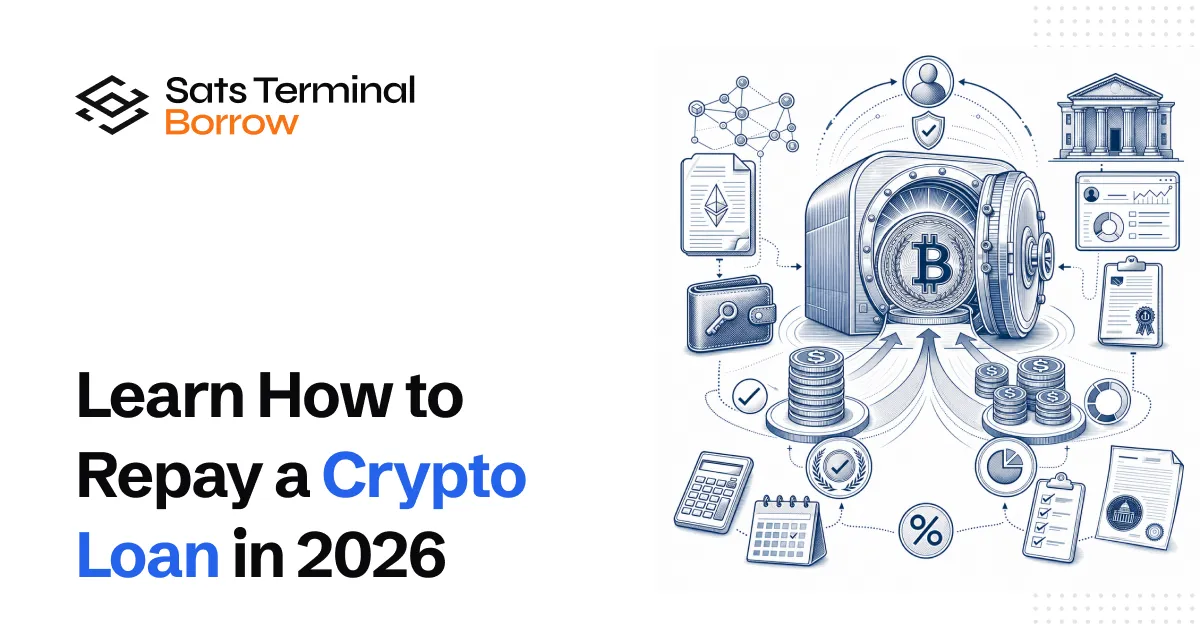
Most guides obsess over how to take out a loan. Far fewer explain the part that actually puts your coins back in your wallet. Knowing how to repay a crypto loan is what separates a borrower who treats a Bitcoin-backed loan as a flexible financial tool from one who is quietly hostage to it. The good news is that, on modern open-term loans, repayment is almost always simpler than borrowing was. There is no payment book, no minimum monthly bill, and no prepayment penalty. You decide when and how much to pay back, you settle whatever interest has accrued, and your collateral is released. This guide walks the full repayment lifecycle, on both DeFi and CeFi rails, and then goes a step further into the strategy of repayment, because when and how you pay back can matter as much as the headline rate you borrowed at.
Throughout, we will use a Bitcoin reference price near $100,000, plus ETH around $3,500 and SOL around $190, purely to make the math concrete. Those prices move constantly, so treat every figure as illustrative and check live numbers before you act. This is an educational walkthrough, not financial or tax advice.
The single most important thing to understand about a modern crypto-backed loan is that it is usually open-term. Unlike a car loan or a mortgage, there is no fixed amortization schedule, no due date that triggers a missed-payment mark, and no requirement to chip away at principal every month. The loan simply sits open, fully collateralized, while interest accrues continuously in the background. As long as your position stays over-collateralized and healthy, the protocol or lender is content to let it ride indefinitely.
That design has a direct consequence for repayment: you repay whenever you choose. You can hold a loan for three days or three years. You can pay it off in one shot, dribble it down in pieces, or never touch the principal and instead let rising collateral value do the de-risking for you. The flexibility is real, but it shifts responsibility onto you. Nobody sends you a statement. The interest meter never stops, and the only person watching your loan-to-value ratio by default is, well, you.
Because interest compounds continuously rather than being billed in tidy monthly chunks, the amount you owe is a moving target measured to the second. On DeFi protocols, your debt balance is represented by an on-chain debt token whose balance literally ticks upward block by block. On CeFi platforms, interest typically accrues daily and is added to your payoff figure. Either way, the "payoff number" you see at 9:00 a.m. is slightly smaller than the one you will see at 9:00 p.m. We will come back to why this matters for the dreaded "leftover dust" problem.
Rule of thumb: an open-term loan has no deadline, but it does have a meter. The clock on interest never stops, so the longer you wait, the more you eventually repay to reclaim the same collateral. "Repay whenever you want" is a feature, not an excuse to forget.
Every repayment falls into one of two buckets, and they serve different goals.
Partial repayment is the underrated power move, and it is worth understanding exactly why. Your loan-to-value ratio is debt divided by collateral value. When you make a partial repayment, the numerator (debt) shrinks while the denominator (collateral) stays the same, so your LTV falls and your health factor rises. A lower LTV means a lower liquidation price, which means Bitcoin has to fall further before your position is in danger. You are buying yourself breathing room without giving up any collateral.
Partial repayment also cuts your interest bill going forward, because interest accrues on the outstanding balance. Knock 30% off your principal and, roughly speaking, you knock about 30% off your daily interest accrual from that moment on. On a variable-rate DeFi market where the variable rate can spike when utilization climbs, trimming your balance is one of the few levers you control directly.
| Dimension | Full Repayment | Partial Repayment |
|---|---|---|
| Primary goal | Exit the loan and reclaim all collateral | De-risk and/or cut interest while staying open |
| Effect on LTV | Goes to 0% (no debt) | Decreases proportionally to amount repaid |
| Effect on health factor | Effectively infinite (no debt) | Improves meaningfully |
| Collateral released? | Yes, all of it | None automatically; can free a slice for separate withdrawal |
| Interest going forward | Stops entirely | Accrues on the smaller remaining balance |
| Typical use case | You no longer need the cash, or are refinancing | Bitcoin dipped and you want to defend the position |
On a non-custodial protocol, repayment is a sequence of on-chain transactions you sign yourself. The mechanics are similar across Aave and Morpho, with small differences worth knowing. Here is the canonical flow for a typical setup where you borrowed a stablecoin against wrapped Bitcoin collateral.
One genuinely useful DeFi feature deserves a callout: repay with collateral. Aave's interface (and similar tooling on other protocols) lets you close a position in a single transaction by using a flash loan to swap a portion of your collateral into the debt asset, repay, and hand you back the remainder. Before this existed, you had to manually withdraw collateral, sell it for the stablecoin, then repay, which meant four or more transactions across multiple apps. The catch is that "repay with collateral" sells part of your Bitcoin to do it, which is a taxable disposal and defeats the purpose if your whole point was to keep your BTC. Use it when you want to exit cleanly and do not mind parting with some collateral; avoid it when reclaiming every satoshi is the goal.
Warning: repaying is two actions, not one. On DeFi, clearing your debt and withdrawing your collateral are separate transactions. Plenty of people repay, see "0 debt," close the tab, and forget that their Bitcoin is still sitting in the protocol earning them nothing. Always complete the withdrawal.
Repayment usually involves two to three on-chain transactions: an approval, the repay, and the collateral withdrawal. On Ethereum mainnet, doing this when the network is congested can cost real money in gas. On Layer 2s like Base and Arbitrum, the same operations typically cost cents rather than dollars after the EIP-4844 blob upgrade slashed L2 data costs. If your loan lives on mainnet and you are not in a hurry, repaying during a quiet, low-gas window can save you a meaningful amount versus repaying at peak. If your position is anywhere near liquidation, however, never wait for cheaper gas. Safety beats a few dollars of savings every time. For more on watching your position, see our guide to monitoring your crypto loan health.
On a centralized platform such as a regulated Bitcoin-backed lender, you are not signing smart contract calls; you are interacting with a company's dashboard. The flow is friendlier but less transparent, and the details vary by provider, so always confirm your specific lender's terms.
The big structural difference: on DeFi, your collateral is held by code and released the instant your debt hits zero, with no one's permission required. On CeFi, your collateral was held by a counterparty, and you are trusting that counterparty to return it promptly and in full. That introduces counterparty risk that simply does not exist on a non-custodial protocol. Some lenders mitigate it with proof of reserves and segregated, non-rehypothecated collateral; others reserve the right to lend your coins out, which is worth knowing before you ever deposit.
| Step | DeFi (Aave / Morpho) | CeFi (regulated lender) |
|---|---|---|
| Who you interact with | Smart contract you sign directly | Company dashboard / support |
| Interest accrual | Per block, continuous | Typically daily |
| Repayment asset | The exact debt token (e.g., USDC) on the loan's chain | Stablecoin, fiat transfer, or collateral sale |
| Collateral release | Automatic on zero debt; you withdraw yourself | Platform authorizes release, can take time |
| Permission needed | None; code enforces it | Yes; you rely on the counterparty |
| Cost to repay | Gas (cents on L2, more on mainnet) | Usually free, but check for back-end fees |
Repayment is not just a clerical task. The smartest borrowers treat it as an active decision with several distinct playbooks. Here is how to think about each one. For a deeper treatment, our learn module on repaying crypto loans strategically goes further.
If Bitcoin falls and your LTV climbs uncomfortably close to the liquidation threshold, a partial repayment is the cleanest defense. It directly lowers LTV, pushes your liquidation price further away, and costs you nothing but the cash you put in (which you weren't paying interest on anyway). The alternative defense is adding more collateral, which also lowers LTV but ties up more Bitcoin. Which to choose depends on whether you have spare stablecoins or spare BTC handy. Our guide to managing Bitcoin collateral during volatility covers both maneuvers.
Here is the elegant part of a collateralized loan: you can lower your LTV without paying a cent of principal if your collateral simply rises in value. Recall LTV is debt divided by collateral value. If Bitcoin rallies, the denominator grows, your LTV falls, and your position de-risks itself automatically. A borrower who took a 50% LTV loan at $80,000 BTC is sitting at roughly 40% LTV if BTC reaches $100,000, with the same debt. This is precisely why long-term holders use these loans: they expect the collateral to appreciate and the loan to become safer over time. The trade-off is that interest keeps accruing the whole time, so appreciation has to outpace your borrowing cost for this to be a net win. This passive de-risking is also why some borrowers are in no rush to repay at all.
If rates have moved or a better venue exists, repaying one loan to open a cheaper one can save real money. As of early 2026, DeFi markets like Morpho frequently price stablecoin borrows in the low-to-mid single digits when utilization is moderate, while many CeFi Bitcoin-backed loans sit closer to 9-12% APR before origination fees. If you are paying double digits on a CeFi loan and a comparable DeFi position would cost half that, the interest savings can dwarf the gas and friction of refinancing. The mechanics are: open the new, cheaper loan; use those proceeds (or external cash) to repay the old one; reclaim collateral from the old venue; redeposit on the new one. A rate-comparison aggregator is genuinely useful here because hunting for the cheapest venue manually across DeFi and CeFi is tedious. Just remember the comparison is total cost, not headline APR; a 10.35% rate with a 1.49% origination fee is closer to 11.8% all-in.
Where the repayment money comes from changes the tax and strategy picture entirely.
Strategy tip: the cheapest dollar to repay with is one that does not trigger a tax bill. Repaying from external income keeps your collateral whole and creates no taxable event. Repaying by selling appreciated crypto realizes a capital gain. Same loan, very different after-tax outcome.
When you close a loan, you reclaim your collateral minus nothing from the collateral side; the collateral itself is returned in full. What you "lose" is the interest you paid in the debt asset over the life of the loan. Put plainly: you deposited, say, 1 BTC; you get 1 BTC back; the cost of the loan was the cumulative interest you paid in stablecoins (or fiat), plus any origination fee you paid up front and any gas/bridge fees along the way.
This is a crucial mental model. The interest does not come out of your Bitcoin in a healthy, voluntarily repaid loan. Your collateral is only ever reduced if you are liquidated or if you explicitly choose "repay with collateral." So the question "do I get all my Bitcoin back?" has a clean answer: yes, provided you repay the debt in the debt asset and you were never liquidated. The only exception to watch for is a CeFi lender that bundles fees against the collateral, which a transparent lender will spell out in the agreement.
Let's make this concrete with numbers. Suppose in January you deposited 1 BTC as collateral when Bitcoin was at $100,000, and you borrowed $45,000 USDC against it. That is a starting LTV of 45% ($45,000 / $100,000).
You borrowed on a DeFi market at a variable rate that averaged 6% APR over the period. You hold the loan for exactly six months and then decide to repay in full.
Now suppose Bitcoin rose to $120,000 during those six months. Notice what happened to your risk along the way: at $120,000, your $45,000 debt represented an LTV of only 37.5%, so your position got safer while you held it, even before you paid a dime. When you repay the $46,350, your debt hits zero and you withdraw your full 1 BTC back. That single Bitcoin is now worth $120,000 instead of the $100,000 it was worth when you deposited it. You captured the entire $20,000 of appreciation, paid $1,350 in interest for the privilege of accessing $45,000 of liquidity for six months, and never sold a satoshi.
Compare that to the alternative of selling 0.45 BTC back in January to raise the same $45,000: you would have realized a taxable gain and owned only 0.55 BTC at the end, worth $66,000, versus the full 1 BTC worth $120,000 you kept by borrowing. The $1,350 interest cost bought you roughly $54,000 of retained upside in this scenario. Of course, had Bitcoin fallen instead, the loan would have grown riskier and you might have needed to repay or add collateral sooner. That asymmetry is the whole game, and our sibling piece on whether to sell or borrow against your Bitcoin works through both sides.
| Moment | BTC price | Debt + interest | LTV | Collateral value |
|---|---|---|---|---|
| January (open) | $100,000 | $45,000 | 45.0% | $100,000 |
| March (BTC rallies) | $115,000 | ~$45,680 | ~39.7% | $115,000 |
| June (repay) | $120,000 | ~$46,350 | 0% after repay | $120,000 returned |
If you want to model your own scenario before borrowing, our walkthrough on using a crypto loan calculator to estimate borrowing costs shows how to project interest and liquidation prices.
Tax treatment is where a lot of borrowers get tripped up, so let's separate the clear from the uncertain. None of this is tax advice, and rules differ by country; consult a professional and check current guidance from your tax authority (in the U.S., IRS.gov).
For the broader picture, see our learn module on the tax implications of crypto borrowing and the related blog post on crypto loan taxes in 2026.
Repayment is forgiving, but a handful of avoidable errors cost people money and stress. Here are the ones we see most often.
The dust trap, restated: a loan with $0.04 of debt is not a closed loan. Your collateral stays locked until that last sliver is gone. "Repay max" exists precisely to solve this, on both DeFi front ends and most CeFi dashboards. Use it.
It helps to zoom out and see where repayment sits in the arc of a healthy loan. You open the position (deposit collateral, borrow), you monitor it (watch LTV and health factor, top up or pay down as needed), and you close it (repay, withdraw, optionally unwrap). Repayment is the exit ramp, and like any exit ramp, it is smoothest when you have been paying attention the whole drive.
Borrowers who set up the loan thoughtfully at the start, choosing a conservative LTV, picking a venue with sane rates, and keeping a stablecoin buffer ready, find repayment almost boring, which is exactly what you want from a financial transaction. Borrowers who max out their LTV and stop watching are the ones who end up repaying in a panic or, worse, getting liquidated. If you are still at the planning stage, our step-by-step guide to borrowing against your Bitcoin sets up the position so the exit is clean later, and the FAQ on repaying a loan on Borrow covers the platform-specific clicks.
A few habits make every future repayment easier:
Common Questions
Usually no. Most Bitcoin-backed and crypto-backed loans in 2026 are open-term, meaning there is no monthly payment and no maturity date. Interest accrues continuously, and you repay whenever you choose, in full or in part, with no prepayment penalty. The only hard deadline is the one the market imposes: if your collateral falls and your LTV breaches the liquidation threshold, the position is closed for you. Always confirm your specific lender's terms.
On DeFi, once you fully repay your debt (use "repay max" to clear the last dust), the lien is released automatically and you submit a separate transaction to withdraw your collateral, then unwrap wrapped Bitcoin if you want native BTC. On CeFi, the platform marks the loan settled and releases your collateral, after which you withdraw it to your own wallet. Repaying and withdrawing are two distinct steps; do not forget the second.
Yes. Interest accrues on your outstanding balance, so a partial repayment reduces both your loan-to-value ratio and your ongoing interest cost from that moment forward. Pay down 40% of your principal and your daily interest drops roughly 40% too. Partial repayment is the main lever for de-risking a position without selling collateral or adding more, and it improves your health factor immediately.
Repaying principal plus interest to reclaim your collateral is generally not a taxable event, even if your Bitcoin appreciated while locked up, because nothing was sold. The exceptions: repaying by selling or swapping appreciated crypto can realize a capital gain, and a forced liquidation is treated as a taxable disposal. Unwrapping wrapped Bitcoin back to native BTC is an unsettled gray area. This is not tax advice; consult a professional.
Even a few cents of leftover "dust" debt keeps your loan technically open and your collateral locked, and it continues to accrue interest. This usually happens when you repay a fixed number instead of using "repay max," because interest ticks up between clicking and confirming. The fix is to always use the "repay all" or "repay max" option for a full close, which sweeps the residual balance to zero.
Yes, via a "repay with collateral" feature on protocols like Aave, which uses a flash loan to swap part of your collateral into the debt asset and repay in one transaction. It is convenient for a clean exit, but it sells some of your Bitcoin, which is a taxable disposal and the opposite of reclaiming all your coins. Use it only when you have decided you no longer want to hold that portion of collateral.
If your goal is purely to lower risk and Bitcoin is appreciating, you may not need to repay at all; rising collateral value lowers your LTV automatically. But interest keeps accruing the whole time, so appreciation must outpace your borrowing cost for waiting to pay off. If you need your specific coins back, want to stop paying interest, or your position is near liquidation, repaying is the right move. There is no universal answer; it depends on your rate, your risk tolerance, and your price outlook.
Often yes, especially moving from a double-digit CeFi rate to a low single-digit DeFi rate. To refinance, open the cheaper loan, use the proceeds or external cash to repay the old one, reclaim and redeposit collateral. Weigh the interest savings against gas, bridge, and origination fees, and compare total effective cost rather than headline APR. A rate-comparison aggregator makes finding the cheapest current venue far less tedious. Repayment is where a crypto loan proves whether it was a smart tool or a slow-motion mistake, and the borrowers who treat it as an active, planned decision almost always come out ahead. Whether you are paying down to de-risk, refinancing to a cheaper rate, or closing out to reclaim every satoshi of your Bitcoin, the mechanics are learnable and the strategy is yours to control. When the time comes to shop for a cheaper rate to refinance into, or to set up your next loan with a clean exit in mind, Borrow by Sats Terminal compares BTC-backed loan offers across DeFi protocols and CeFi lenders in one place, so you can see the true cost of borrowing before you ever sign a transaction.