

A borrower's deep-dive into wrapped Bitcoin in 2026: how wBTC, cbBTC, and tBTC differ on custody, peg, liquidity, and LTV, plus FBTC, LBTC, and cirBTC.
 Arkadii Kaminskyi
Arkadii Kaminskyi
Head of Operations at Sats Terminal
Head of Operations at Sats Terminal with 5 years of experience in crypto. Specializes in DeFi, yield farming, and borrowing — has reviewed 50+ crypto products.
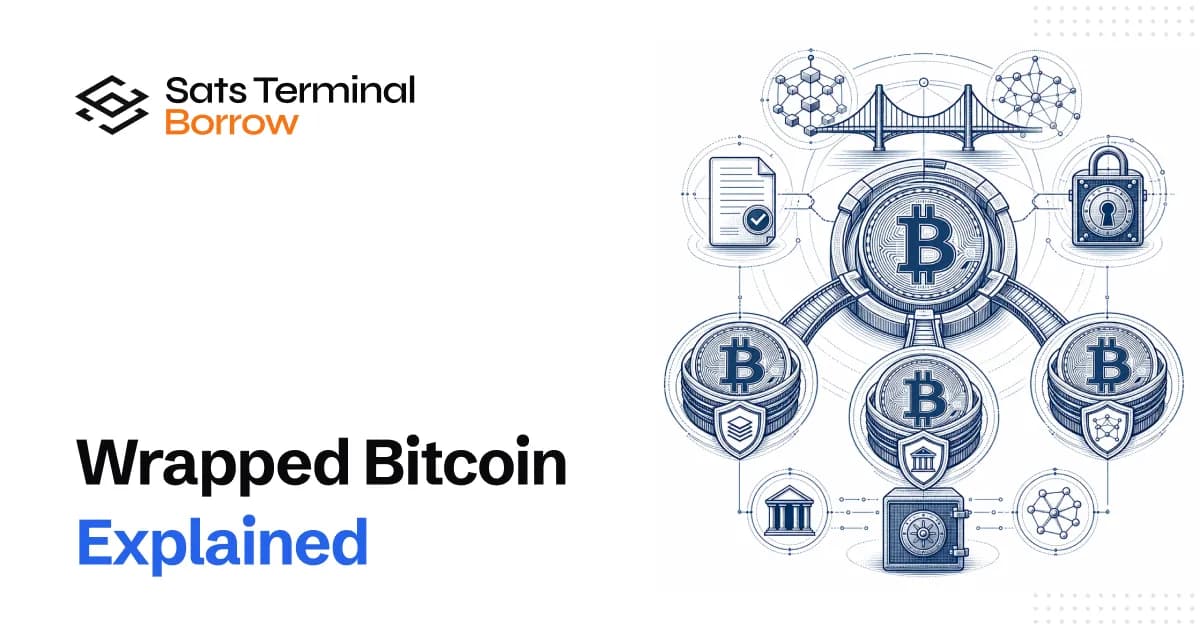
If you want to borrow against your Bitcoin inside Ethereum-style DeFi, there is an inconvenient technical truth standing between you and a loan: native BTC does not live on Ethereum, Base, Arbitrum, or any other EVM chain. To use Bitcoin as collateral in those ecosystems, you first have to convert it into wrapped Bitcoin — a tokenized, 1:1 representation of BTC that an EVM smart contract can actually hold, price, and liquidate. The catch is that there is no single "wrapped Bitcoin." There are several, each with a different issuer, a different custody model, and a meaningfully different risk profile. This guide explains what wrapped BTC is, how wrapping actually works, and how the major variants — wBTC, cbBTC, and tBTC, plus a fast-growing cast of newcomers — stack up specifically through the lens of a borrower in 2026.
This matters more than most people realize. The wrapper you choose quietly determines which lending protocols will accept your collateral, what loan-to-value ratio you can reach, how deep the liquidity is when you need to borrow or get liquidated, and — in a worst case — whether your collateral can be frozen, censored, or depegged. Two borrowers can deposit "the same" Bitcoin and end up with very different positions purely because one used wBTC and the other used cbBTC. Let's unpack why.
Bitcoin and Ethereum are separate blockchains with separate ledgers. Bitcoin's scripting language is intentionally limited; it was never designed to run the rich smart contracts that power lending markets like Aave or Morpho. Ethereum and its layer-2 rollups, by contrast, were built around programmable contracts but have no native awareness of the Bitcoin chain. There is no built-in bridge that lets an Ethereum contract reach over and grab your actual BTC.
Wrapped Bitcoin is the workaround. Someone — a custodian, a bridge, or a decentralized network of nodes — locks real BTC on the Bitcoin network and issues an equivalent amount of an ERC-20 (or SPL, on Solana) token on the destination chain. That token is designed to track BTC's price one-for-one and can be redeemed back for the underlying coin. Because it is a standard token, every DeFi smart contract already knows how to handle it: you can supply it to a lending pool, post it as collateral, and borrow stablecoins against it.
If you want the conceptual deep-dive on the mechanics, our explainer on bridging and wrapping Bitcoin walks through the full lifecycle. The short version: wrapping is what turns "I own Bitcoin" into "I can use Bitcoin as collateral in EVM DeFi." Without it, the only way to borrow against BTC on Ethereum-style rails would not exist.
Rule of thumb: native BTC is for holding and sending; wrapped BTC is for doing — supplying liquidity, posting collateral, and borrowing. The moment your Bitcoin needs to interact with an EVM smart contract, it has to be wrapped first.
What is wBTC? wBTC is the original wrapped Bitcoin, launched in 2019, and for years it was effectively synonymous with "Bitcoin in DeFi." It is an ERC-20 token, each unit backed 1:1 by BTC held in custody. To understand the whole category, it helps to understand the three-role model that wBTC pioneered, because most centralized wrappers are variations on it.
Minting: a merchant sends BTC to the custodian, the custodian confirms receipt and mints an equal amount of wBTC. Redemption (burning): the reverse — a merchant burns wBTC and instructs the custodian to release the underlying BTC to a Bitcoin address. The peg is maintained by this mint/redeem arbitrage: if wBTC trades below BTC, arbitrageurs buy cheap wBTC, redeem it for full-value BTC, and pocket the difference, pushing the price back to parity.
The crucial point for a borrower: with this model, your collateral's integrity ultimately rests on a custodian honoring redemptions. That is a flavor of counterparty risk, and it is the central theme that separates the wrappers we compare below.
You cannot understand the 2026 wrapped-Bitcoin landscape without the story that reshaped it. In August 2024, BitGo announced it would move wBTC custody into a "multi-jurisdictional" joint arrangement with BiT Global, a Hong Kong-based entity in which Tron founder Justin Sun holds a stake. Reserves would be spread across multiple custodians and geographies rather than sitting solely with BitGo in the United States.
The market reaction was swift and consequential, because for a collateral asset, who controls the keys is not a footnote — it is the whole risk model. A cascade of reassessments followed:
Takeaway for borrowers: wBTC still works and remains widely accepted, but the 2024 episode is a live demonstration that a wrapper's risk parameters can change underneath you. If a protocol slashes wBTC's LTV or freezes new borrowing, your existing position can be forced toward deleveraging. Wrapper choice is a risk decision, not just a convenience one.
By 2026, the dust has largely settled: wBTC is still the largest wrapped BTC by market cap (commonly cited in the high single-digit billions of dollars, though the figure moves with BTC's price — check current data before relying on it), but its dominance share has eroded as alternatives matured.
cbBTC is Coinbase Wrapped BTC, launched in September 2024 and now one of the two or three most important Bitcoin representations in DeFi. It is issued directly by Coinbase, with each cbBTC backed 1:1 by BTC held in Coinbase's custody. As of 2026 it is available on Base, Ethereum, Solana, and Arbitrum, with Base and Ethereum holding most of the supply and Solana growing.
The mechanics are deliberately frictionless for Coinbase users. If you send BTC from a Coinbase account to a supported chain, it auto-converts to cbBTC 1:1; deposit cbBTC back into Coinbase and it converts back to BTC. There is no separate merchant network and no minting fee in the Coinbase flow — the exchange itself is the on-ramp and off-ramp. This same plumbing powers Coinbase Borrow, where your BTC is wrapped into cbBTC behind the scenes and supplied to Morpho to source a USDC loan.
The trade-off is the mirror image of wBTC's: cbBTC concentrates trust in a single, large, US-regulated public company instead of a multi-party custody consortium. For some borrowers that is reassuring (one accountable, audited entity); for others it is the very thing to avoid (a single point of censorship and counterparty failure). cbBTC reserves are held by Coinbase Custody; there is no permissionless, self-service redemption for non-Coinbase users — you generally route through a Coinbase account to redeem to native BTC. That makes cbBTC excellent for convenience and protocol acceptance, but it is emphatically not a trust-minimized asset.
tBTC, from Threshold Network, is the most prominent attempt to wrap Bitcoin without a single custodian holding the keys. Instead of one company, tBTC uses threshold cryptography: the signing key that controls deposited BTC is split into shares distributed across a randomly selected group of independent node operators, and a majority must cooperate to move any Bitcoin. No single operator — and no single jurisdiction — can unilaterally seize or freeze the reserves.
How minting works: you send BTC to a unique deposit address generated by the protocol. Once the Bitcoin transaction confirms, Threshold's contracts verify the deposit and you mint an equal amount of tBTC on a supported chain. Redemption reverses it: burn tBTC, and the operator set signs a Bitcoin transaction releasing your BTC. Because it relies on Bitcoin confirmations plus decentralized signing, minting historically took on the order of an hour or two — slower than an exchange swap, which is the price of decentralization. In 2025–2026 Threshold shipped direct, "gasless" minting and direct redemptions, letting users mint tBTC to Ethereum, L2s, and select non-EVM chains in a single step. A mint/redeem fee (reported around 0.2% / 20 basis points after a 2026 governance vote reinstated it) applies — confirm the current schedule before you transact.
tBTC's appeal to borrowers is philosophical and practical: it removes the "a CEO can freeze my collateral" failure mode. The trade-off is liquidity and acceptance. tBTC's supply is materially smaller than wBTC or cbBTC (on the order of a few hundred million dollars in 2026, versus billions), so it tends to have thinner on-chain liquidity and is accepted in fewer lending markets, often at more conservative parameters. For a borrower, thin liquidity matters: it can widen the cost of acquiring the wrapper, and it can make a liquidation more punishing if the market cannot absorb the sale cleanly.
Decentralization is not free. tBTC removes custodian risk but adds smart-contract and operator-set risk, and you pay for it in liquidity depth and protocol acceptance. The "best" wrapper is the one whose risks you actually understand and accept — there is no risk-free option.
The wrapped-BTC field has gotten crowded. A few names a 2026 borrower will increasingly encounter:
The unifying theme: more issuers means more choice, but it also fragments liquidity and forces borrowers to actually evaluate custody models rather than assume "wrapped BTC is wrapped BTC." For a broader look at what assets lending markets accept beyond Bitcoin wrappers, see our sibling guide on what crypto you can use as collateral.
Here is the comparison that matters most for a borrower. Parameters and figures move constantly — treat market-cap and supply numbers as early-2026 ballpark, and verify current terms before you commit collateral.
| Wrapper | Issuer | Custody model | Main chains | Redemption | Decentralization |
|---|---|---|---|---|---|
| wBTC | BitGo + BiT Global (wBTC DAO governance) | Multi-custodian, multi-jurisdiction | Ethereum (+ several L2s/chains) | Via authorized merchants | Federated / permissioned |
| cbBTC | Coinbase | Single regulated custodian (Coinbase Custody) | Base, Ethereum, Solana, Arbitrum | Through a Coinbase account | Centralized |
| tBTC | Threshold Network | Distributed signer set (threshold cryptography) | Ethereum, L2s, select non-EVM | Permissionless burn-and-redeem | Trust-minimized / decentralized |
| FBTC | Function / Antalpha Prime | MPC custody + Security Council | Mantle, Ethereum, BNB Chain | Authorized participants | Federated (institutional) |
| LBTC | Lombard | Validator consortium (Babylon-staked) | Ethereum, Solana, others | Via Security Consortium | Decentralized + yield mechanism |
| cirBTC | Circle | Segregated regulated custody | Ethereum (expanding) | Through Circle Mint | Centralized (regulated) |
| Wrapper | Approx. 2026 size | Transparency | Censorship/freeze risk | Typical DeFi acceptance |
|---|---|---|---|---|
| wBTC | High single-digit $B (largest) | On-chain PoR (wbtc.network) | Possible (custodian-controlled) | Broadest, but under periodic reassessment |
| cbBTC | Several $B (fast-growing) | Coinbase attestation / custody | Yes (issuer can freeze) | Wide: Aave, Morpho, Compound, Spark |
| tBTC | Few hundred $M | Fully on-chain, verifiable | Very low (no single controller) | Selective markets, conservative params |
| FBTC | ~$1.5B | On-chain PoR | Possible (council-controlled) | Institutional/Mantle ecosystem, custom vaults |
| LBTC | Multi-$B (yield token) | Real-time PoR | Low–moderate | Growing; more in yield strategies than plain loans |
| cirBTC | New (2026) | Chainlink Proof of Reserve | Yes (issuer-controlled) | Emerging; institution-focused |
The pattern jumps out: there is a spectrum from convenient and widely accepted but centralized (cbBTC, cirBTC) through federated (wBTC, FBTC) to trust-minimized but thinner (tBTC). Where you land depends on whether you optimize for borrowing power and liquidity or for censorship resistance and self-sovereignty.
This is the part too many guides skip. The wrapper is not a neutral container — it directly shapes the loan you can get. Three concrete ways it does so:
On the DeFi venues an aggregator surfaces, BTC-backed positions commonly support maximum LTVs in the rough range of 70–80% at the protocol level — but you should never borrow to the limit. For deeper treatment of how protocols set these numbers, see understanding collateral and LTV and the practical playbook in optimizing your LTV ratio. Different chains and protocols also behave differently; our sibling piece on the best blockchain for crypto loans covers how Base, Arbitrum, Ethereum, and Solana compare for a wrapped-BTC borrower.
Let's make this concrete with numbers. Assume BTC is trading around $100,000 (prices move — this is just a reference point), and you wrap 1 BTC into a wrapper your chosen market accepts. Suppose the protocol's maximum LTV for that wrapper is 75% and its liquidation threshold is 80%.
Interest accrual: say the variable borrow APR on your USDC is around 6%. On a $40,000 loan held a full year, that's roughly $2,400 in interest — but DeFi rates are variable and recalculated continuously, so the real figure depends on pool utilization day to day. There is no fixed monthly payment; interest simply compounds into your debt until you repay. If BTC rises while you hold the loan, your LTV improves on its own and your liquidation buffer grows.
Notice the wrapper barely changed the math here — but it absolutely changed your options. If you'd wrapped into a thinly-listed token, you might not have found a 75% LTV market at all, or you'd face a steeper liquidation penalty if BTC cracked. The wrapper sets the menu; your draw size sets the risk. For a fuller treatment of staying solvent, read managing liquidation risk and monitoring your loan health. None of this is financial advice — your situation, tax exposure, and risk tolerance are your own.
Is wrapped Bitcoin safe? "Safe" is the wrong frame — the honest answer is that every wrapper trades one set of risks for another, and as a borrower you are exposed to all of them on top of normal loan risk. The major failure modes:
For the broader risk picture of BTC-backed borrowing — not just the wrapper layer — our deep dive on Bitcoin collateral loan risks is worth your time.
Acceptance is the practical gating factor. Here's the rough lay of the land in 2026 — but always confirm in the protocol's live interface, since listings and parameters change through governance.
| Protocol | wBTC | cbBTC | tBTC | Notes |
|---|---|---|---|---|
| Aave V3 | Yes (params periodically reassessed) | Yes (Ethereum + Base) | Selective markets | Parameters set per-asset by Aave governance |
| Morpho (Blue / vaults) | Yes | Yes (broadly) | Some curated vaults | Immutable market params; FBTC in custom vaults |
| Compound V3 | Yes | Yes | Limited | cbBTC widely added as collateral |
| Spark / Sky | Reduced after reassessment | Yes | Listed as substitute | Sky explicitly favored cbBTC/tBTC over wBTC |
| Coinbase Borrow | No | Yes (native) | No | Wraps BTC to cbBTC, routes to Morpho |
This is exactly the kind of fragmentation that makes a lending aggregator useful. Rather than manually checking which wrapper each venue accepts and at what LTV, an aggregator surfaces the best available offers across protocols for the collateral you hold. If you're weighing where to borrow, the comparison in comparing Aave, Morpho, and CeFi is a useful companion, and you can check current chain support in what blockchains Borrow supports.
You generally don't need to run the merchant-minting process yourself. The practical routes:
Tip: when buying a wrapper on a DEX, always check it's the canonical contract address from the issuer's official docs. Scam tokens impersonating "wBTC" or "cbBTC" are common. The official site for each issuer publishes the correct contract per chain.
Once you hold an accepted wrapper, the actual borrowing flow is the same as any BTC-backed loan — deposit, choose your LTV, draw stablecoins. If you're new to that part, our beginner's guide to borrowing against Bitcoin walks it end to end, and the related strategy piece on borrowing USDC/USDT against BTC shows what you can do with the borrowed funds.
The clear direction of travel in 2026 is toward more transparent, more verifiable, and (where possible) less custodian-dependent wrappers. A few threads to watch:
For most borrowers the pragmatic 2026 stance is: prefer wrappers with verifiable reserves and an acceptance footprint on the protocols you actually use, size your loan conservatively regardless of wrapper, and stay aware that parameters can change. If censorship resistance is your top priority, lean toward trust-minimized options and accept thinner liquidity; if borrowing power and convenience matter most, the large centralized wrappers will serve you better.
Common Questions
Wrapped Bitcoin is a token on a chain like Ethereum or Base that is backed 1:1 by real BTC held in reserve. Because native Bitcoin can't run on those chains, wrapping creates a tradeable representation that smart contracts can hold, price, and use as collateral. You can redeem the wrapped token back for actual BTC, which is what keeps its value pegged to Bitcoin.
wBTC is the original wrapper, custodied through a multi-jurisdiction arrangement (BitGo and BiT Global) with a DAO governing key permissions. cbBTC is issued by Coinbase and backed by Coinbase's own custody, with frictionless minting for Coinbase users. wBTC has the broadest acceptance and largest market cap; cbBTC concentrates trust in a single regulated company and powers Coinbase Borrow. Each trades convenience against a different counterparty risk.
It can be, but it adds risks on top of a normal loan: custodian failure, depeg, smart-contract bugs, and possible issuer freezes. Centralized wrappers depend on a company; trust-minimized ones like tBTC depend on code and a signer network. None are risk-free. Use wrappers with verifiable proof of reserves, prefer deep liquidity, and never borrow to the maximum LTV so a depeg or price drop doesn't immediately trigger liquidation.
tBTC is Threshold Network's wrapped Bitcoin. Instead of one custodian, it splits control of the deposited BTC across a randomly selected set of independent node operators using threshold cryptography, so no single party can move or freeze the reserves. That removes the "a CEO can seize my collateral" failure mode. The trade-off is smaller supply, thinner liquidity, and acceptance in fewer lending markets than wBTC or cbBTC.
In August 2024, BitGo moved wBTC custody into a multi-jurisdiction arrangement involving BiT Global, an entity linked to Tron's Justin Sun. Coinbase delisted wBTC, Sky governance voted to offboard it (later softened), and Aave debated cutting its parameters. The episode showed that a custody change can prompt lenders to reduce a wrapper's borrowing power, which is why wrapper choice is a real risk decision for borrowers.
To borrow in EVM-based DeFi (Aave, Morpho, Compound and similar), yes — native BTC can't be used directly, so it must be wrapped first. Some products wrap it for you behind the scenes. CeFi lenders that hold your actual Bitcoin may not require wrapping at all. An aggregator can route you to whichever venue and wrapper gives the best terms for the collateral you hold.
Yes. A wrapper holds its peg only because the market trusts it can be redeemed 1:1 for BTC. A custody scare, redemption freeze, or smart-contract exploit can break that trust and push the token below BTC's price. If this happens to collateral you've posted, your loan-to-value ratio worsens and you could face liquidation even if Bitcoin's own price didn't fall. That's why custody transparency matters even after you borrow.
As of early 2026, wBTC remains the largest by market cap and is accepted nearly everywhere, while cbBTC has grown fast and is broadly listed across Aave, Morpho, Compound, and Spark. Both offer far deeper liquidity than tBTC or newer wrappers, which generally means better LTVs and cleaner liquidations. Figures shift with Bitcoin's price and governance decisions, so verify current supply and acceptance before committing. Wrapped Bitcoin is the unglamorous plumbing that makes BTC-backed borrowing possible in EVM DeFi — and the variant you pick quietly sets your borrowing power, liquidity, and risk surface long before you draw a single dollar. wBTC, cbBTC, and tBTC each occupy a different point on the convenience-versus-decentralization spectrum, and there's no universally "best" choice, only the one whose trade-offs match your priorities. Whichever wrapper you hold, the smart move is to compare what each lending venue will actually offer for it. Borrow by Sats Terminal aggregates BTC-backed loan offers across DeFi protocols and CeFi lenders so you can see the rates, LTVs, and terms for your collateral side by side — making the wrapper-and-venue decision a quick comparison instead of a research project. This article is educational, not financial or tax advice; always verify current protocol terms and consider your own situation before borrowing.