

A practical 2026 guide to borrowing against Ethereum: DeFi venues, LTV and E-Mode, using stETH as collateral, the staking loop, depeg risk, and ETH vs BTC.
 Arkadii Kaminskyi
Arkadii Kaminskyi
Head of Operations at Sats Terminal
Head of Operations at Sats Terminal with 5 years of experience in crypto. Specializes in DeFi, yield farming, and borrowing — has reviewed 50+ crypto products.
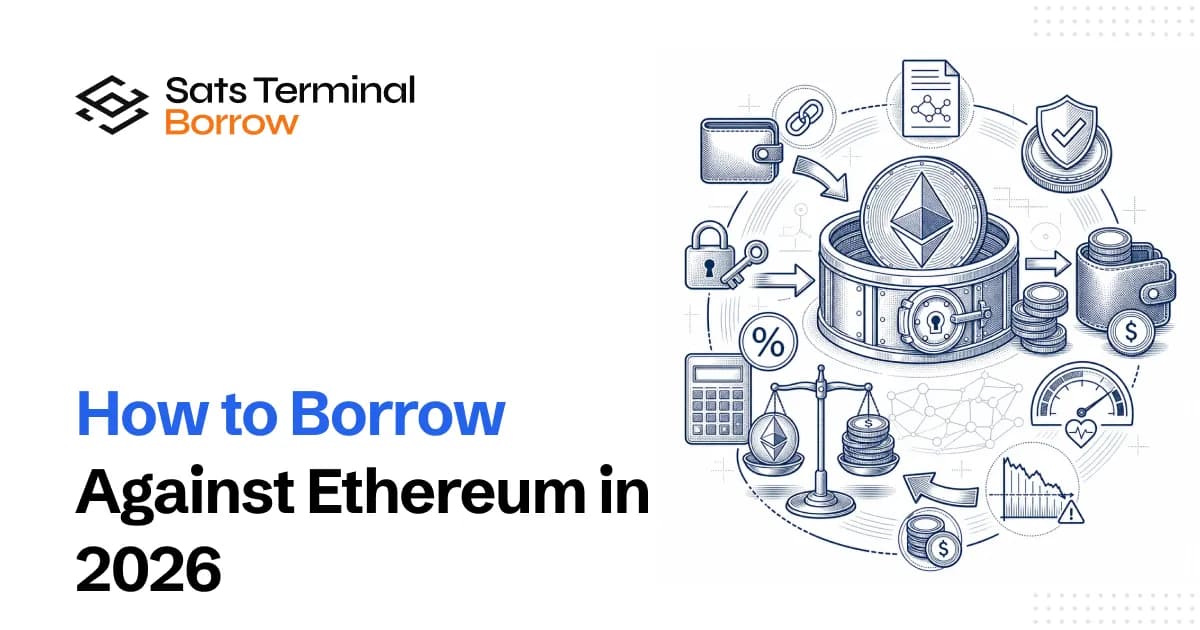
If you hold ether and need dollars without selling, the good news is that Ethereum is arguably the most natural collateral asset in all of crypto. When you borrow against Ethereum, you are working with the native asset of the largest smart-contract chain on earth, which means no wrapping, no bridge, and no synthetic IOU sits between you and the lending market. That is a meaningful structural advantage over Bitcoin, where almost every DeFi venue forces you through a wrapped representation. But ETH also brings its own personality: it is more volatile than BTC, it has a sprawling family of liquid staking tokens that can be used as collateral, and it carries failure modes (depegs, slashing, oracle quirks) that a Bitcoin borrower never has to think about. This guide is a practical, ETH-specific walkthrough of how an eth backed loan actually works in 2026, where to get one, and how to avoid the mistakes that quietly liquidate people.
We will keep the focus tight on Ethereum collateral. If you want the broader primer on the mechanics of crypto-backed credit, the introduction to DeFi lending covers the fundamentals, and the how Bitcoin-backed loans work explainer is a useful contrast point we will return to several times below. Throughout, prices and parameters are stated as early-to-mid 2026 conditions and they change constantly, so treat every number as a starting point you should verify on the live protocol before you act. None of this is financial or tax advice.
The single biggest reason to borrow against eth rather than wrap something else is that ETH lives where the lending happens. Aave, Morpho, Compound, and Spark are all Ethereum-native (or live on Ethereum L2s), and they price, custody, and liquidate ETH directly. Compare that to Bitcoin: to use BTC in Ethereum DeFi you generally need wrapped Bitcoin such as wBTC, cbBTC, or tBTC, which introduces a custodian or a bridge and a fresh layer of counterparty risk. The bridging and wrapping Bitcoin guide goes deep on why that matters. With ETH, that whole problem disappears.
There is a second, subtler edge. Because ETH is the gas token and the deepest-liquidity asset on its own chain, oracle pricing for ETH is robust and liquidation markets for ETH are extremely competitive. Liquidators fight over ETH collateral, which tends to keep liquidation penalties tight and execution clean even during volatile moments. Bitcoin collateral on Ethereum inherits the liquidity of its wrapper, which is thinner.
Where the edge ends is volatility and complexity. As of mid-2026, ETH has been trading in the low-to-mid four figures (roughly the $2,000s after a sharp drawdown from late-2025 highs), and it has historically shown a higher beta than BTC, falling further in risk-off markets. Realized volatility metrics in 2026 have consistently put ETH a few points above BTC, and ETH's worst historical drawdown is deeper than Bitcoin's. For a borrower, higher volatility means your liquidation buffer gets eaten faster, so the conservative loan-to-value ratios that feel paranoid on BTC are merely prudent on ETH.
Rule of thumb: whatever LTV you would comfortably run on a Bitcoin loan, run a notch lower on Ethereum. ETH can move 15-25% in a bad week, and a position that looked safe on Friday can be a liquidation candidate by Monday.
This is the part that makes ETH borrowing genuinely different from Bitcoin borrowing, and it is the heart of this guide. When you borrow against ETH, you are not limited to plain ether. You can post one of several liquid staking tokens (LSTs) as a staked eth collateral loan, and in many cases that is the smarter move because the collateral itself is earning yield while it sits there.
The strategic logic is simple: an LST is ETH plus a yield stream. If you are going to lock up ETH as collateral anyway, posting wstETH instead of plain ETH means your collateral keeps compounding the staking rate (roughly 3-4% as of 2026) while you borrow against it. That yield can partly, and occasionally fully, offset your borrow cost. The catch is that LSTs are not exactly ETH, and that small difference is where most ETH-specific blowups come from. We will dissect that in the depeg section.
The DeFi venue landscape for ETH borrowing in 2026 is mature and competitive. Four protocols matter most for a non-custodial eth backed loan, and they make different tradeoffs. If you want a deeper architectural comparison, the comparing Aave, Morpho, and CeFi piece is the companion read; below is the ETH-collateral-specific view.
| Protocol | Model | Typical ETH collateral LTV* | E-Mode / correlated boost | Best for |
|---|---|---|---|---|
| Aave v3 | Pooled, multi-asset, blue-chip | ~80% LTV, ~82.5% liq. threshold | ETH-correlated E-Mode pushes LTV to ~93%+ | Most borrowers; deepest liquidity |
| Morpho (Blue / Vaults) | Isolated markets + curated vaults | Set per market; LLTVs from ~80% up to mid-90s for LSTs | Per-market by design (e.g., wstETH/ETH) | Custom risk, best LST rates |
| Compound v3 (Comet) | Single-borrowable-asset markets | Collateral factor varies; ETH market borrows ETH | Gradual/partial liquidation engine | ETH-debt shorting, USDC borrow |
| Spark (Sky/Maker) | SparkLend pool, USDS-focused | ETH/stETH/rETH collateral, borrow USDS | ETH-correlated E-Mode available | Borrowing the USDS stablecoin cheaply |
*Parameters as of early-to-mid 2026 and governed by on-chain risk managers; they are adjusted frequently. Always read the live market before depositing.
Aave v3 is the default. With roughly $19B in TVL across many chains as of early 2026, it has the deepest liquidity, the most battle-tested oracles, and the cleanest user experience. ETH (as WETH) typically carries an ~80% max LTV and an ~82.5% liquidation threshold in standard mode, leaving a modest buffer between the two. Its official documentation spells out the current numbers. The killer feature for ETH is E-Mode (Efficiency Mode): when your collateral and your debt are in the same correlated category — say wstETH collateral and ETH debt — Aave recognizes that they move together and raises the borrowable LTV dramatically, often into the low-to-mid 90s. That is what makes leveraged staking viable.
Morpho takes a different approach with isolated markets and curated vaults (Morpho Blue). Each market is a single collateral / single loan pair with its own fixed liquidation LTV, oracle, and interest curve. Because lenders deploy capital into specific, risk-scoped markets, ETH and LST borrowers frequently get sharper rates here than on a big shared pool. The tradeoff is that you must read each market's parameters yourself — there is no one-size Aave default. For the full mechanics, see the sibling how to borrow on Morpho guide; Morpho's docs cover market creation and the LLTV system.
Compound v3 (Comet) reorganized lending into single-borrowable-asset markets: each deployment has one base asset (USDC, ETH, USDT, or USDS) plus a list of collateral assets you can post but not borrow. For an ETH borrower this is excellent when you want to borrow USDC against ETH, or when you want to borrow ETH itself against LST collateral. Its liquidation engine unwinds positions more gradually than the old all-at-once model, which can be gentler in a fast market.
Spark, part of the Sky (formerly Maker) ecosystem, is purpose-built for borrowing the USDS stablecoin. You post ETH, stETH, rETH, or weETH and borrow USDS at a rate pegged near the Sky Savings Rate plus a spread (the SSR has sat around 3.75% with a borrow spread of roughly 100-200 basis points in 2026). If your goal is cheap, predictable stablecoin liquidity against ETH, Spark is worth a quote.
Tip: an aggregator like Borrow by Sats Terminal exists precisely so you do not have to open four tabs and manually compare these venues. It scans DeFi and CeFi offers and surfaces the best terms for your collateral and amount, which matters because ETH rates and LTVs diverge meaningfully across protocols at any given moment.
Here is the move that no Bitcoin borrower can replicate, and it is the reason sophisticated ETH holders pay attention to lending markets. A leveraged staking loop (also called "looping" or "recursive staking") uses an ethereum collateral loan to multiply your exposure to ETH staking yield. It works like this:
The economics: your entire stacked wstETH position earns the staking yield, while you only pay the borrow rate on the ETH you borrowed. As long as staking yield > borrow cost, the spread is positive and leverage amplifies it. A simplified illustration: with a 3.5% staking yield and a 2.5% ETH borrow cost, a roughly 5x looped position can produce a net APY in the high single digits to low double digits on your original capital — far above plain staking. Index Coop and others even package this into single tokens (wstETH leverage products built on Morpho) so you do not have to loop by hand.
The danger is symmetric. Leverage cuts both ways, and three things can flip the trade against you:
Looping is a powerful but advanced strategy. If you are new to managing leveraged collateral, read managing liquidation risk first and start with a single, conservative loop, not a five-deep stack.
A staked eth collateral loan adds a risk that plain ETH simply does not have: the LST can trade below its "true" ETH value in the open market, a depeg. Understanding why this happens, and why it interacts so violently with leverage, is the single most important thing in this guide.
An LST like wstETH has two prices. There is the redemption value — the amount of ETH it is worth based on the underlying staked balance, which only goes up as rewards accrue — and there is the market price — what someone will pay for it right now on a DEX. In calm times these track each other tightly. But the redemption path can be slow (unstaking and withdrawal queues take time), so in a panic, holders who need ETH now dump LSTs into thin liquidity, and the market price falls below the redemption value. That gap is the depeg.
This is not theoretical. In June 2022, amid the Terra collapse and the 3AC/Celsius unwinds, stETH traded as low as roughly 0.94 ETH. Leveraged loopers on Aave — who had borrowed ETH against stETH and re-deposited repeatedly — saw their collateral value fall relative to their ETH debt, triggering a cascade of forced selling that pushed stETH even lower. The structure was self-reinforcing on the way down. More recently, commentators have warned that newer automated stETH yield products could compress a future stress event into hours rather than the days it took in 2022.
How modern protocols mitigate this matters for you as a borrower:
Warning: the combination most likely to liquidate you is high leverage + LST collateral + ETH debt during a depeg. If you loop, keep a wider health-factor cushion than you would with plain ETH collateral, and assume the market can briefly mark your LST below par even when the redemption value is fine.
There is also slashing risk sitting underneath every LST. Validators that misbehave or go offline can be penalized (slashed), which permanently reduces the ETH backing the token. For ordinary LSTs run by large, diversified operator sets this risk is small and well-distributed. For liquid restaking tokens (weETH, ezETH, rsETH), the same ETH is also securing additional services via EigenLayer, which layers on extra slashing surface — which is exactly why lending markets assign LRTs lower LTVs than plain LSTs.
Let us walk through the actual flow of opening a non-custodial eth backed loan, using a deposit-ETH-borrow-USDC position on a protocol like Aave as the model. The steps are similar on Morpho, Compound, and Spark.
One ETH-specific note: keep a little spare ETH outside the protocol for gas. On Ethereum mainnet, managing a position (repaying, adding collateral) costs gas, and you do not want to be unable to top up a sinking health factor because your wallet is dry. Using an L2 deployment of Aave or Compound dramatically reduces this friction.
Numbers make this concrete. Assume ETH trades at $2,400 (a plausible mid-2026 level; ETH has been volatile, so treat this as an illustration, not a forecast). You deposit 10 ETH as collateral.
| Item | Value | Notes |
|---|---|---|
| Collateral | 10 ETH = $24,000 | At $2,400/ETH |
| Max LTV (Aave, standard) | ~80% | Theoretical ceiling — do not borrow here |
| Liquidation threshold | ~82.5% | Where forced liquidation can begin |
| Chosen borrow (conservative) | $9,600 USDC | 40% LTV — a deliberately safe target |
| Starting health factor | ~2.06 | (Collateral × liq. threshold) ÷ debt |
| Liquidation price of ETH | ~$1,164/ETH | Where the position becomes liquidatable |
The liquidation price is the key output. Your $9,600 debt is liquidatable when your collateral value × the liquidation threshold falls to your debt. Solving: liquidation occurs when 10 ETH × price × 0.825 = $9,600, i.e. when ETH ≈ $1,164. That is a ~51% drop from $2,400 — a wide, survivable cushion for a 40% LTV position. If you had instead borrowed near the 80% ceiling ($19,200), your liquidation price jumps to roughly $2,327, only ~3% below the entry price. That position would get liquidated by an ordinary Tuesday in ETH.
Now layer in interest. Say the USDC borrow rate is a variable interest rate of about 6% APR. On $9,600, that is roughly $576 per year, or about $48 per month, accruing into your debt balance. As interest accrues, your debt rises and your health factor slowly drifts down even if ETH's price holds flat — so a long-held loan needs occasional repayment or collateral top-ups. For a deeper treatment of how LTV choices drive risk, see optimizing your LTV ratio and the BTC collateral loan LTV guide, whose math applies equally to ETH.
Rule of thumb: pick your borrow amount by the liquidation price you can stomach, not by the maximum the protocol allows. Ask, "How far can ETH fall before I'm liquidated?" If the answer is less than ~40-50%, you are over-borrowed for an asset as volatile as ether.
Not everyone wants to manage a health factor or pay gas. Centralized (CeFi) lenders offer a custodial alternative: you hand ETH to a company, it lends you fiat or stablecoins, and it manages the position. The tradeoff is the entire custodial vs non-custodial question — you give up self-custody and take on the lender's solvency and rehypothecation risk in exchange for simplicity.
The 2026 CeFi landscape for ETH specifically is narrower than for Bitcoin, and that is worth flagging:
When evaluating any custodial ETH lender, the checklist is the same as for BTC: proof of reserves, clear custody arrangements, transparent rates, and a credible track record. The evaluating crypto lending platforms framework walks through it. And remember that CeFi platforms typically require KYC; if privacy is a priority, the DeFi route is the non-KYC path — explored in the sibling no-KYC crypto loans guide.
| Dimension | DeFi (Aave / Morpho / Spark) | CeFi (Nexo) |
|---|---|---|
| Custody | Self-custody; smart contract holds collateral | Custodial; lender holds your ETH |
| KYC | None | Required |
| Max LTV on ETH | ~80% (higher in E-Mode for correlated) | ~50% |
| LST collateral / staking yield | Yes — wstETH/rETH supported | Limited; check current terms |
| Rate transparency | Fully on-chain, variable | Tiered; varies by loyalty level |
| Main risk | Smart-contract bug, liquidation, depeg | Counterparty insolvency, rehypothecation |
Because Borrow by Sats Terminal is built around Bitcoin-backed loans, it is worth being precise about how ETH borrowing differs from BTC borrowing and when each makes sense. They are genuinely different instruments, not interchangeable.
| Factor | Ethereum collateral | Bitcoin collateral |
|---|---|---|
| Native to lending chain | Yes — no wrapping needed | No — needs wBTC/cbBTC/tBTC for DeFi |
| Volatility | Higher beta; bigger drawdowns | Lower; "harder" collateral |
| Yield on collateral | Yes via LSTs (wstETH, rETH) | Generally none natively |
| Unique failure modes | LST depeg, validator slashing | Bridge/custodian risk of the wrapper |
| Conservative target LTV | ~35-45% | ~40-50% |
| CeFi availability | Narrower (Nexo; Ledn exited ETH) | Broad (Ledn, Nexo, Strike, others) |
Choose ETH collateral when: you are already an ETH holder, you want your collateral to earn staking yield while it backs a loan, you are comfortable in DeFi, and you want to run strategies (looping, ETH-debt positions) that only exist in the Ethereum ecosystem.
Choose BTC collateral when: you prioritize the lowest-volatility, "hardest" collateral; you want the widest menu of CeFi lenders; or you simply hold more BTC than ETH. Bitcoin's lower volatility means a given LTV liquidates at a larger price drop, which many borrowers find easier to sleep on. The managing Bitcoin collateral during volatility guide and the Bitcoin collateral loan risks explainer go deep here.
A worked contrast: $24,000 of BTC at, say, ~$96,000/BTC is about 0.25 BTC; at the same 40% LTV ($9,600 borrowed) on a ~80% liquidation threshold, the BTC liquidation price sits around $48,000 — roughly a 50% drop, similar in percentage terms to our ETH example. But because ETH's realized volatility runs higher, a 50% ETH drop is statistically more likely to actually happen than a 50% BTC drop over the same window. Same headline cushion, different probability of hitting it. That asymmetry is the real reason to keep ETH LTVs a notch lower.
An open ETH loan is a living position, not a set-and-forget transaction. Because ETH moves more than BTC, active management is more important, not less. A practical playbook:
If you are looking for the conceptual backbone behind all of this, the over-collateralization and collateral factor glossary entries explain why crypto loans require more collateral than you borrow, and the understanding collateral and LTV guide ties it together. For comparing whole platforms rather than positions, the best platforms to borrow USD against Bitcoin review and the broader what are crypto loans primer are good background.
In most jurisdictions, borrowing against your ETH is not itself a taxable event — you are taking on debt, not selling, so there is generally no capital gain triggered at the moment you draw the loan. That is one of the main reasons people borrow rather than sell. But the details matter enormously: a forced liquidation is a sale and can trigger a taxable gain, interest deductibility rules vary, and using LSTs can introduce staking-income questions. This is genuinely not tax advice, and the rules differ by country and change over time.
For the ETH-relevant nuances, see the tax implications of crypto borrowing guide and the dedicated sibling post on crypto loan taxes in 2026. On the regulatory side, the regulatory landscape for crypto lending overview tracks how DeFi and CeFi lending are treated. The short version for 2026: DeFi lending remains permissionless and largely outside direct licensing regimes in many places, while CeFi lenders are increasingly licensed and KYC'd — consult a professional for your situation.
Common Questions
It carries real, manageable risks rather than being simply "safe" or "unsafe." The main dangers are liquidation if ETH falls, smart-contract bugs in DeFi, and depeg or slashing risk if you use a staked-ETH token as collateral. You reduce these by borrowing conservatively (well below the max LTV), using audited blue-chip protocols, monitoring your health factor, and keeping spare assets to top up. Done carefully, it is a widely used, mature strategy.
On Aave v3, plain ETH (WETH) typically allows up to about an 80% loan-to-value ratio, with a liquidation threshold near 82.5%, as of early-to-mid 2026. In ETH-correlated E-Mode (for example, wstETH collateral against ETH debt), the borrowable LTV can rise into the low-to-mid 90s. CeFi lenders like Nexo are more conservative at roughly 50%. Parameters change frequently, so verify the live numbers before borrowing.
Yes. wstETH (the non-rebasing form of Lido's stETH), rETH from Rocket Pool, and several liquid restaking tokens are accepted on Aave, Morpho, and Spark. The advantage is that your collateral keeps earning staking yield while it backs the loan, which can partly offset your borrow cost. The tradeoff is added depeg and, for restaking tokens, slashing risk — so lending markets assign them carefully set, sometimes lower, parameters.
It is a strategy where you deposit wstETH, borrow ETH against it, convert that ETH back to wstETH, and repeat — amplifying your staking yield with leverage. It can boost net APY into the high single or low double digits when the staking yield exceeds the borrow rate. But it sharply increases liquidation and depeg risk, and a negative rate spike or a stETH depeg can quickly turn it against you. It is an advanced, actively managed strategy, not passive income.
ETH is native to the chains where DeFi lending happens, so no wrapping or bridge is needed, and you can post yield-bearing staked-ETH tokens as collateral. Bitcoin generally requires a wrapped representation for DeFi and carries no native staking yield. ETH is also more volatile, so prudent borrowers run lower LTVs on it. Bitcoin has broader CeFi lender support; ETH has richer DeFi strategies. They suit different goals.
If you posted stETH or wstETH and its market price falls below its ETH redemption value, your collateral can be marked down relative to your debt, pushing your health factor toward liquidation — especially in a leveraged loop. Many mature markets price these tokens off the redemption exchange rate rather than the spot DEX price, which cushions temporary depegs, but not all do. Keep a wide buffer and check the oracle design of your specific market.
No. Ledn dropped Ethereum support in late 2025 and now accepts only Bitcoin as collateral. For a custodial ETH-backed loan in 2026, Nexo is the more prominent option, though availability varies by region and changes over time. For non-custodial ETH borrowing, the main venues are DeFi protocols such as Aave, Morpho, Compound, and Spark.
In most jurisdictions, taking out a loan against ETH is not itself a taxable event because you are borrowing, not selling — which is a key reason people borrow instead of selling. However, a forced liquidation counts as a sale and can trigger a taxable gain, and rules around interest and staking income vary. This is not tax advice; consult a qualified professional and your local rules before acting. Borrowing against Ethereum rewards the prepared: it gives you dollar liquidity without selling, lets your collateral keep earning through staked-ETH tokens, and opens strategies no Bitcoin holder can run — but it punishes the over-leveraged, because ETH moves hard and its liquid staking tokens add failure modes you have to respect. Borrow well below the maximum, understand the depeg and slashing risks before you loop, and treat the position as something you manage, not something you forget. And whether your collateral is ETH or BTC, the offers across DeFi and CeFi rarely line up — which is exactly why Borrow by Sats Terminal exists: to compare Bitcoin-backed loan rates across protocols and lenders in one place, so you start from the best available terms instead of the first one you happened to find.