

A 2026 execution guide to borrowing on Morpho Blue: isolated markets vs Aave pools, LLTV and liquidation math, MetaMorpho vaults, rates, risks, and a worked BTC example.
 Arkadii Kaminskyi
Arkadii Kaminskyi
Head of Operations at Sats Terminal
Head of Operations at Sats Terminal with 5 years of experience in crypto. Specializes in DeFi, yield farming, and borrowing — has reviewed 50+ crypto products.
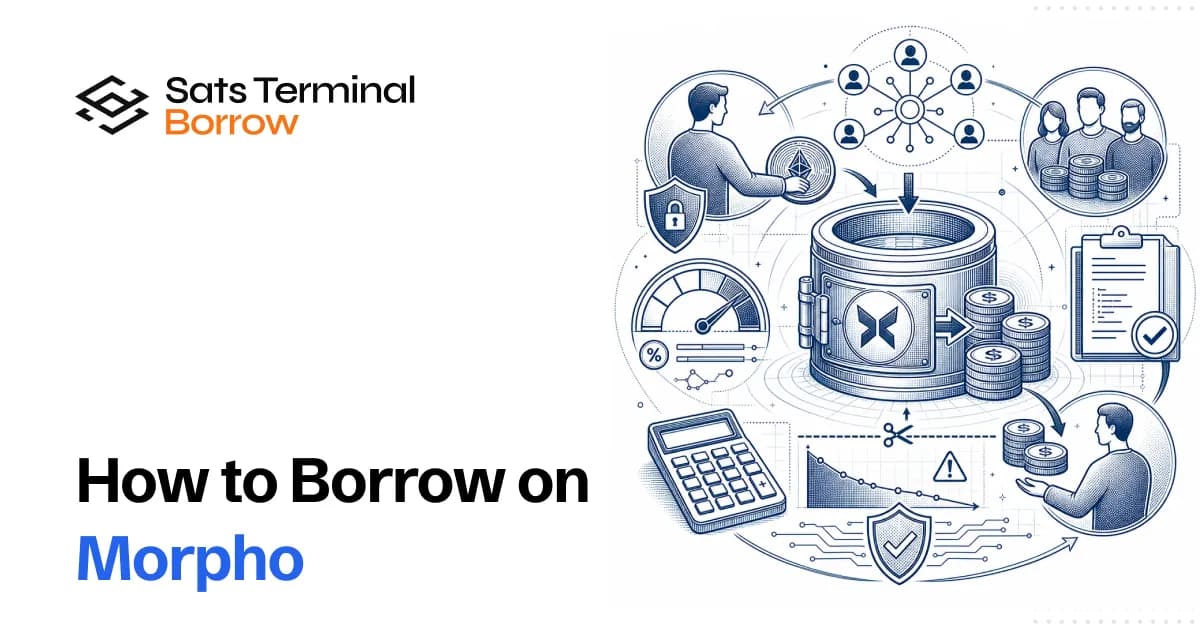
If you have spent any time in DeFi lending, you have probably noticed that the conversation has quietly shifted away from giant shared liquidity pools and toward something leaner and more modular. Learning how to borrow on Morpho is the clearest way to understand that shift, because Morpho Blue takes the messy, governance-heavy machinery of a traditional money market and strips it down to a single, immutable lending primitive. Instead of dumping every borrower and lender into one pool, Morpho splits lending into thousands of small, isolated markets, each with its own collateral, its own loan asset, its own risk ceiling, and its own price feed. This guide walks through that architecture in plain language, shows you the exact mechanics of opening and managing a borrow position, contrasts it honestly with Aave's pooled design, and gives you a worked numeric example so the liquidation math stops feeling abstract. By the end, you should be able to look at a Morpho market, read its parameters, and decide whether borrowing there is a smart move for your Bitcoin or your ETH.
Morpho has grown from an interesting experiment into one of the largest lending venues in crypto. As of early-to-mid 2026, Morpho Blue secures somewhere in the neighborhood of $6 billion or more in total value across Ethereum, Base, and a growing list of other chains, and it quietly powers some of the most visible consumer products in the space, including Coinbase's Bitcoin-backed loans. It is also one of the protocols that Borrow by Sats Terminal aggregates when it scans for the best rate on a BTC-backed loan. Those numbers and integrations move quickly, so treat any figure here as a snapshot and always verify current parameters on docs.morpho.org before you commit real collateral.
The single most useful mental model for Morpho is this: it is infrastructure, not an app. The core contract, known as Morpho Blue, is a deliberately minimal piece of Solidity — famously around 650 lines — that does exactly one thing well. It lets anyone create an isolated lending market by specifying five permanent parameters, and it lets people supply and borrow within those markets. That is the entire base layer. Everything else you see — the polished borrow screens, the curated yield vaults, the Coinbase loan flow — is built on top of that primitive by third parties.
This is a genuinely different philosophy from the protocols most people cut their teeth on. Aave and Compound bundle infrastructure and strategy into the same contracts. Risk parameters, supported assets, interest rate curves, and listing decisions all flow through one governance process and one shared set of pools. Morpho deliberately separates those layers. The infrastructure layer (Blue) is fixed and unopinionated. The strategy layer (vaults and curators) is plural and competitive. If you want a deeper side-by-side, our explainer comparing Aave, Morpho, and CeFi breaks down how that design choice ripples through rates, risk, and user experience.
Because the base contract is so small and immutable, it is also easier to reason about and to audit. Morpho Blue has been reviewed by multiple top-tier firms including Spearbit, Trail of Bits, and Cantina, and the minimal surface area is part of the security argument: there is simply less code that can go wrong. That does not eliminate smart contract risk — no audit ever does — but it changes the shape of the risk, a point we will return to honestly later.
The mental shortcut that helps most: Aave is a bank with one big vault and a board of directors. Morpho is a set of standardized safe-deposit boxes that anyone can install, plus a marketplace of professionals who decide which boxes are worth using. You can interact with the boxes directly, or you can trust a professional to do it for you.
Every Morpho Blue market is defined by exactly five immutable parameters, set once at creation and never changeable afterward. Understanding these five is the entire game, because once you can read them, you can read any market on the protocol. This is the heart of Morpho Blue explained: there is no hidden governance lever that can move these values out from under you after you deposit.
The word that matters most in that list is immutable. On Aave, governance can vote to change a collateral factor, pause an asset, or adjust a liquidation threshold, and that change applies to your existing position. On Morpho Blue, the rules you agreed to when you opened the position are the rules that apply when you close it. No vote can raise your liquidation threshold or swap your oracle. That predictability is the core security property of the design — but it cuts both ways, because if a market was created with a sketchy oracle or an aggressive LLTV, no one can fix it after the fact either.
The single biggest structural difference between Morpho and a protocol like Aave is isolation. On Aave, when you supply ETH and borrow USDC, you are tapping into one large, shared lending pool where many collateral types and many borrowers commingle risk. If governance lists a risky new asset and it goes bad, the contagion can, in theory, affect the whole pool. Aave mitigates this with isolation mode and careful risk management, but the default architecture is shared.
Morpho flips the default. Every market is a sealed compartment. A cbBTC/USDC market and a long-tail-token/USDC market sit side by side but share nothing. If the long-tail market accrues bad debt because its collateral collapsed, that bad debt stays trapped inside that one market. Your cbBTC/USDC position is completely insulated. This is the same principle that makes watertight compartments useful on a ship: a breach in one does not sink the vessel.
| Dimension | Aave (Shared Pool) | Morpho Blue (Isolated Markets) |
|---|---|---|
| Risk model | Many assets share one pool; risk is partially commingled | Each market is fully isolated; bad debt cannot spread |
| Parameters | Set and adjustable by DAO governance | Immutable, fixed at market creation |
| Asset listing | Requires a governance vote and risk review | Permissionless; anyone can deploy a market in minutes |
| Typical max LTV (blue-chip) | Often ~80% for ETH-backed stablecoin loans | Often 86–94.5% for the same collateral, where curated |
| User experience | Curated, simple, fewer choices to make | More choices; vaults abstract the complexity for suppliers |
| Who vets the market | The DAO and its risk service providers | You, or the curator you trust, market by market |
That last row is the crux of the trade-off. On Aave, a centralized-ish governance process does the risk vetting for you, which is convenient but means you inherit whatever the DAO decides. On Morpho, the vetting is pushed to the edges — to you as a direct borrower, or to a professional curator if you go through a vault. More freedom, more responsibility. If you are weighing the broader DeFi-versus-CeFi question rather than just protocol architecture, our piece on comparing DeFi vs CeFi lending zooms out to the custody and counterparty dimensions.
Here is a point of confusion worth clearing up early, because it trips up a lot of newcomers. MetaMorpho vaults (also called Morpho Vaults) are a supply-side product. They are for lenders, not borrowers. When you hear about morpho vaults earning 8% on USDC, that is a depositor experience, not a borrower experience.
A vault is a curated container that accepts passive capital from suppliers and spreads it across many underlying Morpho Blue markets according to a strategy. A curator — firms like Steakhouse, Gauntlet, Block Analitica, and others — decides which markets the vault is allowed to lend into, sets supply caps per market, and rebalances as conditions change. The curator is essentially an active risk manager who earns a fee for choosing good markets and avoiding bad ones. An allocator role then optimizes which enabled markets receive new deposits and which are drawn down first for redemptions.
So where does this leave you as a borrower? In most cases, you do not interact with a vault at all. Borrowers pick a market; suppliers pick a vault. When you borrow USDC against cbBTC, you are borrowing directly from a specific Morpho Blue market. The liquidity sitting in that market may well have been routed there by one or more MetaMorpho vaults, but from your seat, you simply see a market with available liquidity, an LLTV, an oracle, and a current borrow rate. You do not need to know which vaults are feeding it.
Borrower's rule of thumb: If you are taking out a loan, your job is to evaluate the market — its LLTV, its oracle, its liquidity depth, and its rate. Curators and vaults are someone else's risk decision happening upstream of you. Care about them only insofar as they affect how deep and stable your market's liquidity is.
That said, the vault layer matters indirectly. A market that is well-supported by reputable, conservative curators tends to have deeper, stickier liquidity, which means you are less likely to find borrowing capped out or rates spiking from thin supply. It is worth a quick glance at how much liquidity a market has and whether it is backed by serious curators before you settle in.
Now to the part you came for. Borrowing on Morpho follows four core actions that map directly to the contract functions: supplyCollateral, borrow, repay, and withdrawCollateral. Whether you are using the official Morpho app, a front end like Coinbase's, or routing through Borrow by Sats Terminal, the underlying flow is the same.
Start by choosing a market whose collateral asset matches what you hold and whose loan asset matches what you want. If you hold Bitcoin, you will typically be looking at a cbBTC/USDC or wBTC/USDC market. Before anything else, read the market's four critical numbers:
If you are new to reading these, our walkthrough on how to read a crypto loan offer and the glossary entry on loan-to-value ratio are good companions to keep open in another tab.
Once you have chosen a market, you supply your collateral asset into it via supplyCollateral. This is the deposit that secures your future debt. Critically, collateral you post on Morpho does not earn interest the way supplied loan assets do — it sits as a lien against your borrow. If you are bringing Bitcoin, note that you will generally be supplying a tokenized version of it: cbBTC, wBTC, or similar. If wrapping is new to you, the glossary entry on wrapped Bitcoin and our guide to bridging and wrapping Bitcoin explain exactly what that conversion involves and what risks it adds.
With collateral in place, you call borrow to withdraw the loan asset. The maximum you can take out is capped by your collateral value multiplied by the market's LLTV. The smart move is to borrow well below that ceiling. Borrowing right up to the LLTV means a tiny price dip liquidates you instantly. Most experienced borrowers target a starting LTV that leaves a comfortable margin — more on the exact math in the worked example below. Our guide on optimizing your LTV ratio goes deep on choosing that starting point.
Once borrowed, your position has a health factor that you must watch. Interest accrues continuously on your debt, which means your effective LTV creeps upward even if the collateral price stays flat — your debt grows. If your collateral falls in value, your LTV rises faster. When you are ready, you repay the borrowed amount plus accrued interest, which lowers your LTV and raises your health factor, and then you withdrawCollateral to reclaim your assets. You can repay partially at any time; there is no fixed term on standard variable-rate Morpho markets. For an ongoing routine, see monitoring your crypto loan health.
Warning: Because interest compounds into your debt over time, a position that looks safe today can drift into danger over months of inactivity even in a flat market. "Set and forget" is the most common way DeFi borrowers get surprised by a liquidation. Set alerts and check in.
LLTV is the parameter that governs everything about your safety, so it is worth slowing down on. The governance-approved LLTV values on Morpho form a fixed ladder: as of 2026 these include roughly 38.5%, 62.5%, 77.0%, 86.0%, 91.5%, 94.5%, 96.5%, and 98.0%. A market is created at one of these levels. Lower LLTVs suit volatile or long-tail collateral; the highest ones are reserved for tightly correlated pairs (like a liquid staking token against its base asset) where the price relationship barely moves.
The relationship between your position and the LLTV is what determines your health factor. Conceptually, health is the ratio of your maximum allowed debt (collateral value × LLTV) to your actual debt. When health is above 1, you are safe. When it touches 1, you are liquidatable. When a liquidation triggers, a liquidator repays part of your debt and seizes a discounted slice of your collateral as their incentive, the same way a liquidation works on most over-collateralized lenders.
Let's make this concrete. Assume Bitcoin trades around $100,000 in early 2026 (it moves constantly, so treat this as illustrative, not a forecast), and you are using a cbBTC/USDC market with an 86% LLTV — the same level that, as of late 2025, sits behind Coinbase's BTC-backed loans.
Now compare that to a borrower who maxed out. If they borrowed the full $86,000 against the same 1 cbBTC, their liquidation price is $86,000 ÷ 0.86 = $100,000 — exactly today's price. A single tick down liquidates them. This is why the LLTV is a ceiling to respect, not a target to hit. The 50% borrower can sleep; the 86% borrower is one red candle from disaster.
| Starting LTV | USDC borrowed (per 1 BTC at $100k) | Liquidation price (86% LLTV) | Approx. price drop to liquidation |
|---|---|---|---|
| 25% | $25,000 | ~$29,070 | ~71% |
| 40% | $40,000 | ~$46,510 | ~53% |
| 50% | $50,000 | ~$58,140 | ~42% |
| 65% | $65,000 | ~$75,580 | ~24% |
| 80% | $80,000 | ~$93,020 | ~7% |
Two things to absorb from that table. First, the buffer between your borrow size and disaster shrinks fast as you climb. Second, this is before interest. Every month your USDC debt grows by the accrued borrow rate, which pushes your liquidation price upward over time even if Bitcoin never moves. If you want to internalize this risk fully, read managing liquidation risk and the practical playbook in managing Bitcoin collateral during volatility.
Rule of thumb: For volatile collateral like Bitcoin, many seasoned borrowers keep their starting LTV in the 25–50% band even in a high-LLTV market. The LLTV tells you what the protocol allows; your risk tolerance tells you what you should actually do. They are not the same number.
One of the most persistent questions about Morpho is why borrowing and lending rates there are frequently better than on pooled protocols. The answer comes down to two design choices: isolation and the adaptive interest rate model.
In a shared pool, the rate everyone pays is an average shaped by the riskiest assets and the broadest set of borrowers in that pool. In an isolated market, the rate reflects only the supply and demand for that specific collateral-and-loan pair. There is no cross-subsidy. A high-quality, deeply liquid cbBTC/USDC market can clear at a tighter spread between what suppliers earn and what borrowers pay because there is less risk premium being shared around. Historically this has translated to supply APYs running something like 50 to 150 basis points richer than comparable Aave pools, with borrowers benefiting from the mirror image of that efficiency. Those gaps fluctuate, so do not treat them as guaranteed — check live rates.
Morpho's standard interest rate model targets a utilization of around 90% — meaning it wants roughly 90% of supplied assets to be borrowed at any time. It uses two mechanisms together:
The practical upside for you is that rates respond to real conditions rather than to a governance committee's quarterly review. The practical downside is that they are variable — your borrow cost can rise meaningfully if a market gets crowded. If you want to understand the broader forces here, our explainer on how crypto lending rates are determined and the glossary on interest rate mechanics are worth a read. Note that Morpho's newer V2 work is introducing fixed-rate, fixed-term, intent-based loans for borrowers who want rate certainty — a separate model from the variable markets described here, and one that is rolling out through 2026.
It is one thing to describe a protocol and another to see who actually relies on it. Morpho's most visible endorsement is Coinbase. When a Coinbase customer takes out a Bitcoin-backed USDC loan, that loan is not a Coinbase balance-sheet product in the traditional sense — it runs on Morpho markets on the Base chain. Your BTC is converted to cbBTC, deposited into a Morpho smart contract as collateral, and you borrow USDC against it. As of late 2025, Coinbase let customers borrow up to $5 million in USDC this way, at an 86% liquidation threshold (a 133% minimum collateral ratio), with headline rates that have been advertised around 6% — though, as always, verify current terms before relying on a number. That program crossed $1 billion in originations, which tells you the plumbing is battle-tested at serious scale. If you want a focused breakdown of that specific product, see our Coinbase bitcoin loans review for 2026.
Morpho is not a single-chain protocol either. The Morpho stack is deployed across Ethereum, Base, and a widening set of chains including Arbitrum, Optimism, Polygon, Unichain, and others, which matters if you care about gas costs and where your collateral lives. Base in particular has become a center of gravity for Morpho activity, partly because of the Coinbase relationship. Our overview of how multi-chain lending works covers why the chain you borrow on affects fees, liquidity, and bridging.
Morpho is also live on Borrow by Sats Terminal, which is where the aggregator angle comes in. Rather than manually hunting across Morpho markets, Aave pools, and CeFi desks to find the cheapest way to borrow against your Bitcoin, Borrow surfaces offers from all of them in one place and lets you compare. Morpho's efficiency frequently makes it competitive on rate, but the only way to know on any given day is to compare — which is exactly what an aggregator is for. The mechanics of that comparison are explained in how Borrow's rate comparison works.
It helps to place Morpho on the broader map of borrowing options. Each model optimizes for something different, and the right choice depends on what you value — control, simplicity, rate, or hand-holding.
| Feature | Morpho Blue | Aave v3 | CeFi (e.g., Coinbase, Ledn, Nexo) |
|---|---|---|---|
| Custody | Non-custodial (you hold keys) | Non-custodial | Custodial (platform holds collateral) |
| Market structure | Isolated, immutable markets | Shared, governed pools | Opaque, platform-set terms |
| Rate type | Variable (V2 adds fixed/term) | Variable, some stable | Often fixed, platform-quoted |
| Typical BTC LTV ceiling | ~86% LLTV (curated BTC markets) | Varies by listing | Often 50% LTV start; varies widely |
| KYC | None at protocol level | None at protocol level | Required |
| Best for | Self-custody users wanting efficient rates | Users wanting simple, curated DeFi | Users wanting a familiar, supported experience |
The honest framing: Morpho is the most capital-efficient and self-custodial of the three, but it pushes the most responsibility onto you (or onto a curator you trust). Aave is the gentler on-ramp into DeFi with a more curated feel — if you are weighing it, our step-by-step Aave v3 borrowing guide is the companion to this one. CeFi platforms like Coinbase trade self-custody and transparency for familiarity and support, and they front-run Morpho's own plumbing in some cases. For the custody trade-off specifically, see custodial vs non-custodial lending, and for the broader landscape our roundup of the best platforms to borrow USD against Bitcoin covers the major names.
No responsible guide to borrowing on Morpho would skip the risks, and Morpho's are specific enough to deserve their own treatment. The protocol's design choices that make it efficient also create distinct failure modes.
The non-negotiable check: Before you borrow in any Morpho market, look at three things — who provides the oracle, how deep the loan-asset liquidity is, and whether reputable curators support it. If any of those looks sketchy, walk away. Permissionless market creation means anyone can spin up a market, including bad actors with a manipulable oracle. The protocol won't protect you from choosing a bad market; only you can.
Pulling the threads together, here is the field guide I would give a friend opening their first Morpho position.
Done thoughtfully, a Morpho borrow can be one of the most capital-efficient ways to get dollars without selling your Bitcoin — a strategy we cover in depth in getting cash without selling Bitcoin. Done carelessly, it is a fast way to lose collateral. The difference is almost entirely in the buffer you leave and the market you choose.
Common Questions
Morpho Blue's core contract is minimal and has been audited by multiple top firms, and its isolated-market design means a bad market cannot contaminate others. That said, safety depends heavily on which market you choose — particularly its oracle and LLTV. The protocol is robust; an individual market created with a weak oracle is not. Stick to deep, reputable markets and leave a generous collateral buffer.
Morpho Blue is the base lending primitive — the immutable contract where isolated markets live and where borrowing actually happens. MetaMorpho vaults are a supply-side product built on top of it, where curators allocate depositors' capital across multiple Blue markets. Borrowers interact with markets directly; vaults are for lenders who want passive, curated yield rather than picking markets themselves.
Aave uses large shared pools with governance-adjustable parameters, while Morpho uses isolated markets with immutable parameters. On Morpho, risk is compartmentalized and rates are often more efficient, but you (or a curator) must vet each market yourself. Aave is generally simpler and more curated. Morpho frequently offers higher LTVs and tighter rates on blue-chip collateral in exchange for more responsibility.
Yes, indirectly. You supply a tokenized form of Bitcoin — typically cbBTC or wBTC — as collateral in a market like cbBTC/USDC, then borrow a stablecoin against it. This is exactly the mechanism behind Coinbase's Bitcoin-backed loans, which run on Morpho markets on the Base chain. You never post native BTC directly; it is wrapped first.
It depends on the market's LLTV, which is fixed at one of the governance-approved values (roughly 38.5% up to 98% as of 2026). Curated Bitcoin markets often sit around 86% LLTV. But borrowing right up to the LLTV is dangerous — you should target a much lower starting LTV, commonly 25–50% for volatile collateral, to survive price swings without liquidation.
At the protocol level, no — Morpho Blue is permissionless and does not collect identity information. However, the front end you use may impose its own requirements. Coinbase's Morpho-powered loans require full KYC because Coinbase is a regulated entity, whereas interacting with Morpho contracts directly through a self-custody wallet does not. The protocol and the interface are separate layers.
If your health factor reaches 1 — meaning your debt hits the LLTV ceiling relative to your collateral value — a liquidator can repay part of your debt and seize a discounted portion of your collateral as their incentive. You lose that collateral plus an effective penalty, and you keep any borrowed funds you already withdrew. Liquidations are automatic and permissionless, so monitoring your health factor is essential.
Standard Morpho Blue markets use variable rates set by the AdaptiveCurveIRM, which targets around 90% utilization and adjusts continuously based on supply and demand. Your borrow cost can rise if a market becomes crowded. Morpho's V2 work, rolling out through 2026, introduces fixed-rate, fixed-term loans via an intent-based model for borrowers who need predictable costs — a separate product from the variable markets. Morpho rewards borrowers who do their homework. Its isolated, immutable markets and adaptive rates can deliver some of the most efficient borrowing in DeFi, but that efficiency comes bundled with a responsibility most pooled protocols handle for you — vetting the oracle, reading the LLTV, and respecting the buffer between your loan and the liquidation line. Get those right and you have a powerful, non-custodial way to unlock dollars against your Bitcoin without selling a satoshi. When you are ready to put a number on it, let Borrow by Sats Terminal compare live Morpho markets against Aave and CeFi desks side by side, so the cheapest path to your BTC-backed loan is the one you actually take rather than the one you assumed.