

Learn how to borrow on Aave v3 step by step in 2026: supply wBTC, cbBTC or ETH collateral, borrow stablecoins, master the health factor, and avoid liquidation.
 Arkadii Kaminskyi
Arkadii Kaminskyi
Head of Operations at Sats Terminal
Head of Operations at Sats Terminal with 5 years of experience in crypto. Specializes in DeFi, yield farming, and borrowing — has reviewed 50+ crypto products.
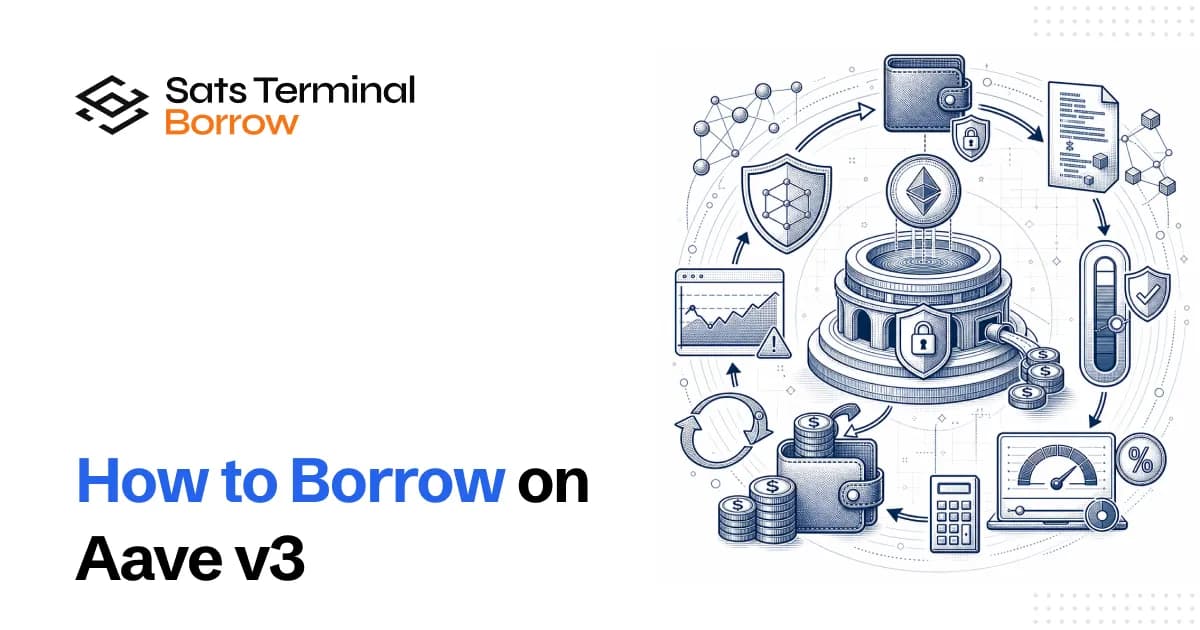
If you hold wBTC, cbBTC, or ETH and want spendable dollars without selling, the most battle-tested route in decentralized finance is still Aave. This guide is a hands-on, click-by-click walkthrough of how to borrow on Aave v3 in 2026 — from connecting a wallet to supplying collateral, enabling it, borrowing a stablecoin, and managing your health factor so you do not get liquidated. We will work real numbers using a Bitcoin reference price around $98,000, explain exactly what triggers a liquidation, and cover the levers (E-Mode, Isolation Mode, the interest-rate curve) that quietly change how much you can borrow and what it costs. None of this is financial advice; Aave is open-source software you interact with directly, and you are responsible for your own position.
One housekeeping note before we start. Aave V4 went live on Ethereum mainnet on March 30, 2026, with a new hub-and-spoke architecture. But as of mid-2026, Aave v3 still holds the overwhelming majority of the protocol's roughly $19B+ in deposits across 15-plus chains, and the v3 borrowing flow described here is what most people will actually use today. The mechanics of supply, borrow, health factor, and liquidation are conceptually the same in both versions, so this knowledge transfers. Where v4 differs materially, we flag it.
Aave is a non-custodial liquidity protocol — a "money market" — where suppliers deposit assets into shared pools and borrowers take over-collateralized loans against those pools. There is no loan officer, no application, and no credit check. Smart contracts hold your collateral, enforce the rules, and pay interest algorithmically. When you supply, you receive an interest-bearing aToken (for example, aUSDC or aWETH) that grows in your wallet as borrowers pay interest. When you borrow, the contract mints a variable-debt token that tracks what you owe.
Two properties make Aave the reference implementation that most other lenders are compared against. First, it is decentralized finance in the literal sense: you keep self-custody of the position through your own wallet, and the protocol cannot freeze your account or rehypothecate your collateral the way some centralized lenders do. Second, it is multi-chain. Aave v3 is deployed on Ethereum mainnet plus a long list of L2s and alt-L1s — Base, Arbitrum, Optimism, Polygon, Avalanche, BNB Chain, Gnosis, Scroll, Linea, zkSync Era, Metis, Celo, and several newer chains. The chain you pick has an outsized effect on your gas costs and on which assets are listed, so it is a real decision, not an afterthought.
If you are brand new to the category and want conceptual grounding before the mechanics, our introduction to DeFi lending and explainer on how Bitcoin-backed loans work are useful primers. If you would rather compare Aave against alternatives first, see comparing Aave, Morpho, and CeFi. This article assumes you have decided to borrow on Aave and want to do it correctly.
Rule of thumb before you touch anything: Aave is over-collateralized lending. You will always lock up more value than you borrow, and the loan never "comes due" on a calendar — it persists as long as your collateral stays healthy and you keep paying interest. The risk is not a missed payment; it is a price move that drops your health factor below 1.
Borrowing on Aave is a sequence of on-chain transactions, so the prerequisites are about wallets and gas, not paperwork.
Bitcoin on Aave is wrapped Bitcoin. Native BTC lives on the Bitcoin blockchain and cannot directly interact with Ethereum smart contracts. To use Bitcoin as collateral on Aave you supply a tokenized representation — wBTC (custodied wrapper) or cbBTC (Coinbase's wrapped BTC). These trade close to BTC's price but carry their own custodial and bridge-trust assumptions on top of Aave's smart-contract risk. If wrapping is a dealbreaker for you, a Bitcoin-native CeFi lender or an aggregator that routes to one may suit you better; weigh the trade-offs in DeFi vs CeFi: how to choose the right Bitcoin loan.
Here is the full flow. We will use a concrete running example throughout: you are depositing 1 wBTC worth ~$98,000 and want to borrow USDC. Treat $98,000 as illustrative — BTC's price moves, and so does everything downstream of it.
Go to the official interface (app.aave.com) and click "Connect." Verify the URL character-by-character — phishing clones of Aave's front end are a perennial problem, and a fake site can drain your wallet through a malicious approval. Bookmark the real one. Once connected, the app auto-detects your network; use the network selector at the top to choose the market (Ethereum, Base, Arbitrum, etc.). Each market is a separate deployment with its own listed assets and rates.
In the "Supply" panel, find your asset (wBTC), enter the amount (1 wBTC), and confirm. The first time you supply a given token you will sign two transactions: an approval (granting the Aave pool contract permission to move that token) and the supply itself. After this confirms, 1 aWBTC appears in your wallet, and your "supplied" balance starts earning a small supply APY. On Ethereum mainnet these two transactions might cost a few dollars to a couple dozen dollars in gas depending on congestion; on Base or Arbitrum it is typically cents to low single-digit dollars.
Supplying and using-as-collateral are two different switches. In your dashboard, toggle "Collateral" on for the supplied wBTC. Only then does it count toward your borrowing power. (Some assets in Isolation Mode, and stablecoins you supply purely to earn yield, may default to off — check the toggle.) The moment collateral is enabled, the app shows your available borrowing power and your health factor.
Open the "Borrow" panel, pick your asset — USDC, USDT, or Aave's native GHO — and enter an amount. The interface shows the resulting health factor in real time and will not let you exceed your max LTV. Borrowing also mints a variable-debt token to your wallet that represents the loan. Confirm the transaction, and the borrowed stablecoin lands in your wallet, free to swap, bridge, or send. There is no fixed repayment schedule; interest simply accrues against your debt balance.
This is the step people skip and regret. Your health factor is the single number that decides whether you are safe. Above 1 you are fine; at 1 or below you are eligible for liquidation. We cover the math in detail next, but the operational habit is simple: after borrowing, note your health factor, decide the minimum value you are willing to tolerate, and check the position whenever the market moves hard. Our guides on monitoring your loan health and managing liquidation risk go deeper on routines and alerting.
| Action | Transactions to sign | What it does | Reversible? |
|---|---|---|---|
| Supply collateral | Approve + Supply (Approve once per token) | Deposits asset, mints aToken, earns supply APY | Yes, via Withdraw |
| Enable as collateral | 1 (toggle) | Counts the asset toward borrowing power | Yes, if health factor allows |
| Borrow | 1 | Mints variable-debt token, sends stablecoin to wallet | Yes, via Repay |
| Repay | Approve + Repay | Burns debt, reduces interest accrual | n/a |
| Withdraw | 1 | Returns collateral if health factor stays > 1 | n/a |
The Aave health factor is the heartbeat of your position. The formula is straightforward:
Health Factor = (Total Collateral Value × Weighted-Average Liquidation Threshold) ÷ Total Borrowed Value
Two parameters drive it, and both are set per-asset by Aave governance:
These exact percentages change — Aave's DAO adjusts risk parameters regularly through governance, and they differ by chain and by asset. Always read the live numbers on the asset's reserve page before you borrow. For the official source of truth, see the Aave documentation and the parameters dashboard.
Let's run the numbers on the 1 wBTC position, assuming a liquidation threshold of 78% for wBTC and that you borrow $50,000 of USDC.
A health factor of 1.53 is comfortable. Now the question that matters: at what Bitcoin price does this get liquidated? Liquidation becomes possible when the health factor reaches 1, i.e. when collateral × threshold = debt. Solving for the BTC price:
Liquidation price = Debt ÷ (Collateral quantity × Liquidation Threshold) = $50,000 ÷ (1 × 0.78) = $64,103
So with $50,000 borrowed against 1 wBTC at a 78% threshold, BTC would need to fall roughly 35% — from $98,000 to about $64,100 — before you are exposed to liquidation. If instead you had borrowed the maximum the LTV allowed (~$71,500), your liquidation price jumps to about $91,700, a mere ~6% drop away. That is the entire argument for borrowing well below your max.
| USDC borrowed against 1 wBTC ($98k) | Health factor (78% threshold) | Approx. BTC liquidation price | Cushion before liquidation |
|---|---|---|---|
| $30,000 | 2.55 | ~$38,460 | ~61% drop |
| $40,000 | 1.91 | ~$51,280 | ~48% drop |
| $50,000 | 1.53 | ~$64,100 | ~35% drop |
| $60,000 | 1.27 | ~$76,920 | ~22% drop |
| $71,500 (near max LTV) | 1.07 | ~$91,670 | ~6% drop |
Practical takeaway from the table: every dollar you borrow pulls your liquidation price closer to spot. Conservative borrowers often target a health factor of 2.0 or higher (roughly 40-50% LTV on a volatile asset like BTC), which leaves room to survive a sharp drawdown without scrambling. Aggressive positions near a health factor of 1.1 can be wiped out by a single bad day.
For a deeper treatment of choosing the right ratio, read optimizing your LTV ratio and how LTV ratios affect your position. The same discipline applies whether your collateral is BTC or ETH — if you are borrowing against Ether specifically, our sibling guide on borrowing against Ethereum walks through ETH-specific parameters.
Aave v3 charges variable interest on most borrows. (Aave deprecated its stable-rate borrowing some time ago after it proved gameable, so in practice you should plan around variable rates.) The rate you pay is not arbitrary — it is a deterministic function of how heavily the pool is being used, known as the utilization rate.
Utilization is simply borrowed ÷ supplied for a given asset. Aave maps utilization to a borrow rate using a two-slope ("kinked") curve:
What this means for you as a borrower: your rate can move while your loan is open. When a stablecoin pool is heavily borrowed, your USDC borrow APR climbs; when demand cools, it falls. As of early-to-mid 2026, stablecoin borrow APRs on Aave v3 have commonly sat in a roughly mid-single-digit to low-double-digit range depending on the asset, chain, and market conditions — but this fluctuates and can spike during demand surges, so check the live rate. To understand the broader forces, see how crypto lending rates are determined and the difference between variable and fixed interest rates.
If a predictable, fixed cost matters more to you than the lowest possible rate, Aave's pure variable model may not be ideal. Some peer-to-peer venues and CeFi lenders offer fixed terms. A rate-comparison layer is the fastest way to see whether a fixed offer beats Aave's variable rate on any given day.
Aave v3 introduced two modes that materially change how much you can borrow against a given asset. Understanding them is the difference between leaving capital on the table and over-leveraging by accident.
E-Mode lets you borrow at a much higher LTV when your collateral and your debt are highly correlated. Governance defines E-Mode "categories" — for example, a stablecoin category (USDC/USDT/DAI/GHO) or an ETH-correlated category (ETH and liquid-staking tokens like wstETH). When both the asset you supply and the asset you borrow sit in the same category, Aave applies the category's elevated parameters. The stablecoin category, for instance, can push LTV up toward ~93-97% because the price relationship between two dollar-pegged assets is tight.
E-Mode is powerful for specific strategies — stablecoin-to-stablecoin borrowing, or borrowing ETH against staked-ETH to loop a staking yield. But it is a double-edged sword: the same high LTV that boosts capital efficiency also shrinks your safety buffer. A "stable" pair can de-peg, and at 95% LTV a small de-peg liquidates you fast. E-Mode is for correlated assets you understand, not a free LTV upgrade for an arbitrary BTC-to-USDC loan.
Isolation Mode is the opposite lever — it constrains riskier collateral. When governance lists a newer or more volatile asset in Isolation Mode, you can use it as collateral but only to borrow a specific basket (usually approved stablecoins), and only up to a protocol-set debt ceiling. While an isolated asset is your collateral, you generally cannot enable other assets as collateral at the same time. This caps the blast radius if that asset implodes — a smart design lesson the protocol learned from earlier DeFi failures. Most blue-chip collateral (ETH, wBTC, cbBTC, major stablecoins) is not isolated, so this mostly matters if you reach for long-tail tokens.
| Mode | Effect on LTV | Best for | Main caution |
|---|---|---|---|
| Standard (cross) | Each asset's normal LTV; multiple collaterals combine | Most BTC/ETH-backed stablecoin loans | None specific — standard rules apply |
| E-Mode | Sharply higher (e.g. ~93-97% for stablecoins) | Correlated-asset strategies, looping | Thin buffer; de-peg risk; liquidates fast |
| Isolation Mode | Restricted; borrow only approved assets, debt-capped | Listing/using newer or volatile assets | Cannot mix with other collateral; capped |
Aave v3's asset list and parameters differ by deployment. wBTC and cbBTC, ETH/WETH, and the major stablecoins (USDC, USDT, GHO, DAI) are listed on the larger markets, but not every asset exists on every chain, and the same asset can carry different LTVs on Ethereum versus Base versus Arbitrum. The chain you choose is therefore both an economic and a practical decision.
For small or mid-sized loans, an L2 like Base or Arbitrum is usually the right call — the gas savings on supply, borrow, repay, and withdraw add up across the loan's lifecycle. If you need to move collateral between chains, understand the bridge risk first; our overview of how multi-chain lending works and cross-chain borrowing covers the trade-offs. You can also see which networks an aggregator routes across in our FAQ on supported blockchains.
When your health factor drops to 1 or below, your position becomes eligible for liquidation. Liquidation is permissionless: independent bots ("liquidators") monitor every position and race to be first to call the liquidation function, because they earn a bonus for doing it. Here is the mechanism, with the specifics that matter.
Aave v3 uses a dynamic close factor. As of early 2026, the rules work roughly like this:
The liquidator repays your debt and seizes an equivalent value of your collateral plus a liquidation bonus — this bonus is, from your side, the liquidation penalty. As of early 2026, blue-chip collateral like ETH and major stablecoins carries a bonus around ~5%, while riskier assets can run 7-10%+. So if a liquidator clears $25,000 of your debt at a 5% bonus, they take roughly $26,250 of your wBTC. You keep the rest of your collateral, but you have permanently lost that penalty — and you sold BTC at a low price, exactly when you did not want to.
Liquidation is not the protocol "calling your loan." It is a market of bots competing to repay your debt in exchange for discounted collateral. They are fast, automated, and unsentimental. The only defense is a buffer you set in advance — once price is falling, gas is spiking and you may not be able to top up in time.
Every health-factor calculation depends on price feeds. Aave reads collateral and debt prices from an oracle (Chainlink on most deployments). If an oracle reports a sharp price drop — correctly or due to a market dislocation — your health factor moves instantly, and liquidators act on that number, not on what you see on your exchange. Oracle behavior is a genuine, if rare, risk vector; it is one reason a fat safety buffer beats shaving every basis point of borrowing power.
Unwinding a position is the reverse of opening it, and there is no prepayment penalty — you can repay any amount, anytime.
A common smart move when you no longer need the loan but do not want to sell crypto to repay: partial repayments over time to raise your health factor, then withdraw the surplus collateral. For sequencing strategies — including when to repay versus let it ride — see repaying crypto loans strategically and our FAQ on how to repay a loan.
GHO is Aave's own decentralized, over-collateralized stablecoin. Instead of borrowing USDC that someone else supplied, you mint GHO directly against your Aave collateral, and the interest you pay flows to the Aave DAO treasury. The key quirk: GHO's borrow rate is set by Aave governance rather than floating on a utilization curve. When GHO trades below $1, governance has historically raised the rate to discourage minting and support the peg; when it holds above $1, the rate gets lowered. As of 2026, GHO is one of the larger CDP-style stablecoins by supply.
For borrowers, GHO can sometimes be cheaper or more predictable than market-rate stablecoins, and stkAAVE holders may get a borrow-rate discount. The trade-off is that you are now exposed to GHO's peg and to governance decisions about its rate. If you want to understand the broader category, our primers on what stablecoins are and stablecoin risks are worth a read before you mint.
Borrowing on Aave is well-engineered, but "non-custodial" does not mean "risk-free." Be honest with yourself about all of these:
For a fuller risk inventory specific to Bitcoin-backed positions, our deep dive on Bitcoin collateral loan risks is the companion piece to this one.
If you remember nothing else, remember these habits. They are what separate borrowers who use Aave for years without incident from those who get liquidated in their first month.
Aave is excellent, but it is not always the cheapest venue on a given day, and its pure-variable rates are not for everyone. Morpho often delivers better rates through its isolated-market and peer-matched model; CeFi lenders offer fixed terms and native-BTC custody but reintroduce counterparty risk. There is no single best answer — the right venue depends on your asset, size, chain, and risk tolerance. Our comparison of Aave, Morpho, and CeFi lays out the decision, and how aggregators find the best rates explains why checking one protocol in isolation can cost you.
This is exactly the gap Borrow by Sats Terminal fills: rather than manually opening Aave, then Morpho, then a CeFi dashboard to compare, you see live BTC-backed offers across DeFi protocols and lenders side by side and pick the best one. If you want to confirm coverage, see which protocols Borrow supports. For the conceptual difference between DeFi and CeFi loans before you commit, borrowing USDC/USDT against BTC is a useful companion read.
Common Questions
Connect a self-custodial wallet to the official Aave app, choose your network, supply an asset like wBTC or ETH, toggle it on as collateral, then open the Borrow panel and borrow a stablecoin such as USDC, USDT, or GHO. Each step is an on-chain transaction that costs gas. After borrowing, monitor your health factor and keep it comfortably above 1 to avoid liquidation.
A health factor above 1 avoids liquidation, but a thin margin is dangerous on volatile collateral. Many borrowers target 2.0 or higher when using BTC or ETH as collateral, which corresponds to roughly 40-50% LTV and lets the position survive a sharp drawdown. The aggressive zone near 1.1 can be liquidated by a single bad day. Pick a target before you borrow and stick to it.
Your liquidation price equals your debt divided by (collateral quantity times the liquidation threshold). For example, $50,000 borrowed against 1 wBTC at a 78% threshold liquidates near $64,100 — about a 35% drop from a $98,000 reference price. Borrowing more raises that price toward spot. Calculate it before borrowing, and remember thresholds change, so verify the live parameter.
Max LTV is the most you can borrow against an asset at the moment you open the loan. The liquidation threshold is higher and marks the point where the position is treated as under-collateralized and can be liquidated. The gap between them is your safety buffer. For wBTC, the LTV might be around 73% with a threshold near 78%, but Aave governance adjusts these, so check current values.
Aave v3 borrowing is variable. Your rate is derived from the pool's utilization via a two-slope curve: it rises gently below an optimal utilization point and steeply above it. Because the rate floats with demand, your cost can change while the loan is open. Aave's stable-rate mode was deprecated, so plan around variable rates or compare against fixed-rate venues elsewhere.
E-Mode (Efficiency Mode) raises your LTV — up toward ~93-97% for stablecoins — when your collateral and debt are highly correlated, such as stablecoin-to-stablecoin or ETH-to-staked-ETH. It boosts capital efficiency but shrinks your safety buffer dramatically, so a small de-peg can liquidate you fast. Use it only for genuinely correlated pairs you understand, never as a generic LTV upgrade for an uncorrelated BTC-to-USDC loan.
For small to mid-sized loans, an L2 like Base, Arbitrum, or Optimism usually wins because gas is cents to a couple dollars per transaction, which makes active management and top-ups affordable. Ethereum mainnet has the deepest liquidity and widest asset list but the highest gas, so it suits larger positions where gas is a small percentage of the loan.
Not native BTC directly — Aave runs on EVM chains, so you supply a tokenized version such as wBTC or cbBTC. These track Bitcoin's price closely but add a custodial wrapper and, if you bridge, a bridge-trust assumption on top of Aave's smart-contract risk. If wrapping is a dealbreaker, a Bitcoin-native CeFi lender or an aggregator that routes to one may fit better. Borrowing on Aave v3 is one of the most transparent ways to turn crypto into spendable dollars without selling — but the protocol hands you the controls and the consequences in equal measure. Get the health factor right, start at a conservative LTV, know your liquidation price cold, and keep a buffer, and Aave can be a durable part of your toolkit. Before you lock in, though, it is worth confirming Aave actually has the best terms for your size and asset right now — rates, LTVs, and parameters shift constantly across protocols and chains. That is the whole point of Borrow by Sats Terminal : a non-custodial aggregator that compares live BTC-backed loan offers across DeFi protocols like Aave and Morpho and CeFi lenders, so you can borrow at the best rate available instead of guessing. This article is educational, not financial advice — verify current parameters on the official Aave docs before you commit.