How no-KYC crypto loans really work in 2026: borrow against Bitcoin privately via permissionless DeFi, the self-custody upside, the risks, and why no KYC never means tax-free.
 Arkadii Kaminskyi
Arkadii Kaminskyi
Head of Operations at Sats Terminal
Head of Operations at Sats Terminal with 5 years of experience in crypto. Specializes in DeFi, yield farming, and borrowing — has reviewed 50+ crypto products.
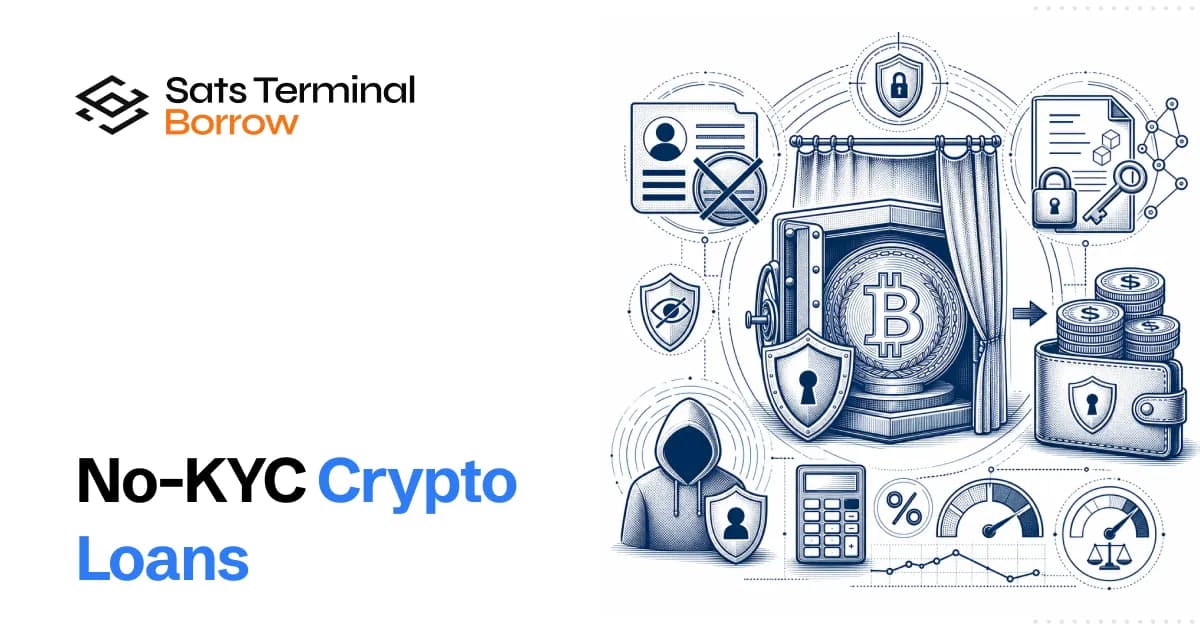
Search for a no kyc crypto loan and you will find two very different worlds wearing the same label. One is real: open, permissionless DeFi lending protocols like Aave, Morpho, Compound and Liquity where you connect a wallet, post collateral, and borrow stablecoins without ever uploading a passport. The other is a minefield of scam ads promising "instant approval, no checks" in exchange for an upfront fee. This guide is about the real thing — how borrowing against Bitcoin without identity verification actually works in 2026, why it is possible at all, what you genuinely gain, and the trade-offs nobody selling you a loan wants to mention. It is an honest explainer, not a pitch for evasion. The most important sentence in this entire article is near the bottom: no KYC does not mean no taxes.
If you are coming here hoping to hide income, get a loan with bad credit, or escape reporting obligations, this is the wrong page and probably the wrong product. But if you hold Bitcoin, value financial privacy and self-custody, and want to understand how permissionless lending works without the marketing gloss, read on. We will cover the mechanics, the regulatory direction, a step-by-step walkthrough, wallet hygiene, and a frank assessment of who this is and is not for.
The first thing to understand is that "no KYC" in DeFi is not a feature someone bolted on. It is a structural consequence of how these protocols are built. A traditional lender — a bank, or a centralized crypto lender like a CeFi desk — is a company. It holds your money, it is a legal counterparty, it is regulated as a financial institution, and it is required by anti-money-laundering law to know who its customers are. A smart contract is none of those things. It is code deployed to a blockchain that executes deterministically when called. It has no front desk, no compliance officer, and no ability to ask who you are.
When you borrow on a protocol like Aave or Morpho, you are not asking a person for permission. You are sending a transaction to a contract that checks one thing: is your collateral worth enough to back the loan you want? If the math works, the contract releases the funds. If it does not, the transaction reverts. There is no application, no credit pull, no employment verification — because there is no one to perform those checks and nothing in the code that requires them. This is what people mean by decentralized finance being permissionless: the only "permission" is having enough collateral.
This is also why these loans are always over-collateralized. A bank can lend you money unsecured because it can sue you, garnish wages, and report you to credit bureaus if you default. A smart contract can do none of that — it does not know who you are and cannot pursue you. Its only protection is your collateral. So instead of trusting you, the protocol holds more value than it lends and liquidates the position automatically if it drops too far. The absence of identity and the requirement for excess collateral are two sides of the same coin. If you want a deeper primer on the model, our introduction to DeFi lending walks through it from scratch.
Rule of thumb: in DeFi, you are not trusted, your collateral is. The protocol does not care who you are because it never has to. That is the entire reason it can be permissionless — and the entire reason it can never offer you an unsecured loan.
A handful of battle-tested lending protocols dominate permissionless borrowing in 2026. None of them ask for your identity at the protocol level:
The point of listing these is not to rank them — that is a different article — but to show that no-KYC borrowing is not an exotic corner of crypto. It is the mainstream architecture of the entire DeFi lending sector, holding tens of billions of dollars. To understand how the two worlds differ, our explainer on custodial vs non-custodial lending is a useful companion, as is our deeper DeFi vs CeFi comparison for Bitcoin loans.
It is easy to assume that anyone seeking a private, no-identity loan must be up to something. That assumption is wrong, and it matters because the privacy and self-custody benefits here are genuine and lawful. There are sound reasons a law-abiding person prefers no kyc crypto lending.
None of these reasons involve hiding from tax authorities or laundering money. They are the same reasons people value cash, encrypted messaging, or a self-directed brokerage account. The privacy is the point, and the privacy is legal.
Important distinction: privacy and anonymity are not the same thing, and neither equals secrecy from the law. A public blockchain is pseudonymous, not anonymous — every transaction is permanently visible to anyone, including the IRS and chain-analysis firms. You can borrow without showing ID and still owe full reporting on the economic activity.
Here is where most "no-KYC loan" content goes quiet. The same properties that make permissionless borrowing attractive also remove every safety net you are used to. If you take a private loan against Bitcoin, you accept a specific bundle of risks. Understand them before you connect a wallet.
There is no customer service line. If you send funds to the wrong contract, approve a malicious token, or get phished, no one is reversing it. There is no chargeback, no fraud department, no account recovery. CeFi lenders have humans you can email when something breaks; a smart contract has a block explorer and a Discord full of strangers. For many people this is the single biggest reason to not go fully permissionless. Being your own bank means being your own everything — including your own mistakes.
The code is the law, which is wonderful until the code has a bug. DeFi has lost billions to exploits: reentrancy attacks, oracle manipulation, flawed upgrade logic, and economic exploits that drained pools in minutes. A protocol can be audited and still fail; an audit reduces risk, it does not eliminate it. When a protocol is drained, there is rarely a bailout. Our guides on smart-contract security and audits and evaluating crypto lending platforms go deeper, but the short version is: only use protocols with long track records, large TVL, multiple audits, and ideally formal verification, and never deposit more than you can afford to lose to a black-swan exploit.
Because there is no human in the loop, there is no human to call you before your position is liquidated. If your loan-to-value ratio crosses the liquidation threshold — say Bitcoin drops sharply overnight — bots liquidate you the moment the oracle price updates, and you pay a liquidation penalty on top. There is no grace period, no "we tried to reach you," no margin-call phone call. Managing this is entirely your job. We cover the discipline in managing liquidation risk and managing Bitcoin collateral during volatility.
This is the trade-off most people miss. The smart contracts are open to anyone, but the website you use to interact with them usually is not. After the 2022 OFAC sanctions on the Tornado Cash mixer, several major DeFi front-ends — including Aave's official interface — integrated address-screening tools (such as TRM Labs' API) to block wallets that had interacted with sanctioned contracts. Hundreds of addresses were affected. The sanctions on Tornado Cash were later lifted in 2025 after a court ruled OFAC had overreached, but the mechanism remains: operators of hosted front-ends apply sanctions and geofencing, even though the underlying protocol cannot.
The nuance that follows is double-edged. Because the protocol itself is just contracts, a technically capable user can bypass a blocked front-end and interact directly. That is why fully on-chain protocols are genuinely hard to KYC-gate — there is no choke point. But for ordinary users relying on the official website, the front-end is the gate, and it does screen. "Permissionless protocol" and "permissionless interface" are not the same claim.
Warning: an interface being open today does not guarantee it will be tomorrow. Front-ends can add geoblocking, sanctions screening, or terms-of-service restrictions at any time in response to regulation. The contracts persist; your convenient access to them may not.
This is the section that protects you from the most expensive mistake in this entire space. Avoiding KYC avoids identity verification. It does not avoid tax law. These are completely separate things, and confusing them can turn a smart financial move into tax fraud.
Start with the good news, which is also where the confusion begins. In most jurisdictions, including the United States, taking a loan is not itself a taxable event — borrowed money is not income, whether you borrow from a bank or from a smart contract. That is the entire appeal of borrowing against Bitcoin instead of selling it: you access liquidity without triggering a capital-gains disposal. We unpack this fully in tax implications of crypto borrowing and the dedicated sibling post on crypto loan taxes in 2026. The use case is legitimate: see avoiding a taxable event with a BTC loan.
But here is what people get catastrophically wrong:
The honest summary: use no-KYC borrowing for privacy and self-custody, not to dodge reporting. The legal duty to declare taxable events survives intact whether or not a third party verified your identity. The official IRS guidance on digital-asset reporting lives at IRS.gov, and you should treat a qualified tax advisor as a required cost of doing this properly.
Permissionless borrowing exists in a tension with a financial system built around AML/KYC obligations. As of 2026, the regulatory picture is a patchwork, and it is moving. Understanding the direction helps you anticipate which front-ends might restrict access and when.
| Regime / Trend | What it targets | Practical effect on no-KYC borrowing |
|---|---|---|
| EU MiCA | Crypto-asset service providers (CASPs) with identifiable operators, governance, fees, or front-ends | The "fully decentralized, no intermediary" exemption is narrow. Protocols with a company, governance token, treasury, or hosted UI face CASP-style obligations; truly contract-only systems sit outside direct scope. |
| Travel Rule | Transfers between regulated providers; identity data must accompany transfers | Pushes KYC to the on/off-ramps (exchanges), not the protocol. Hard to apply to wallet-to-contract interactions, but tightens the fiat edges. |
| US DeFi broker rule | Front-end providers as "brokers" required to collect KYC and report | Repealed in 2025. Pure DeFi front-ends are not currently forced to KYC users or issue 1099-DA — but custodial exchanges still must. |
| Sanctions / OFAC screening | Specific addresses and contracts | Applied at the front-end and infrastructure layer, not the protocol. Can block convenient access; technically savvy users can route around it. |
The throughline is consistent across regions: regulators have largely accepted that fully on-chain protocols are extremely difficult to KYC-gate, because there is no entity to compel and no choke point to squeeze. So the pressure migrates to the edges — the exchanges where dollars enter and exit, the hosted front-ends, and any identifiable governance entity. A protocol that is genuinely just immutable contracts with no operator is the hardest thing in finance to force identity onto. That is precisely why the permissionless model persists. For a structured overview, see our deep dive on the regulatory landscape for crypto lending.
One more direction worth noting: the trend is toward more transparency at the fiat boundary, not less. International information-sharing frameworks and exchange-level reporting are expanding. This reinforces the central message — privacy at the protocol layer is real, but the moment your funds cross into the regulated banking and exchange system, you re-enter the world of identity and reporting. Plan accordingly.
If DeFi is structurally no-KYC, CeFi is structurally the opposite — and for reasons worth understanding rather than resenting. A centralized crypto lender (Nexo, Ledn, a Coinbase-style product, an institutional desk) is a regulated company. It takes custody of your collateral, it is a legal counterparty to your loan, and it touches the fiat banking system to pay you out. Every one of those facts pulls it into AML/KYC obligations:
This is not CeFi being lazy or invasive for its own sake — it is the price of being a regulated, custodial, fiat-connected business. And it buys you real things: customer support, sometimes proof of reserves, fixed-rate products, dispute resolution, and a phone number to call. The trade is identity-for-recourse. Our comparison of DeFi vs CeFi lending and the broader piece on CeFi vs DeFi pros, cons, and platforms lay out the full ledger. There is no universally correct answer — only the right answer for your priorities.
| Dimension | No-KYC DeFi (Aave, Morpho, etc.) | KYC CeFi (Nexo, Ledn, etc.) |
|---|---|---|
| Identity required | None at protocol level | Full KYC (ID, address, sometimes source of funds) |
| Custody | Self-custodial; collateral in a smart contract | Custodial; lender holds your collateral |
| Recourse / support | None — code is final | Human support, dispute resolution |
| Primary risk | Smart-contract bugs, liquidation, your own errors | Counterparty insolvency, rehypothecation, freezes |
| Rates | Algorithmic / market-set, often lower | Set by the company, sometimes fixed |
| Censorship | Resistant at protocol; front-ends may screen | Can freeze, restrict, or offboard you |
| Tax forms | None issued (you self-report) | May issue 1099-DA / equivalents |
Here is the actual workflow for borrowing stablecoins against Bitcoin on a DeFi protocol, with no identity verification. This is descriptive, not a recommendation to act without understanding the risks above. If you want a fuller protocol-specific walkthrough, see our sibling guides on how to borrow on Aave v3 and how to borrow on Morpho Blue, plus the general beginner's guide to borrowing against Bitcoin.
Let's make this concrete. Assume Bitcoin is around $100,000 in early 2026 (it moves constantly — treat this purely as a reference). You deposit 1 wBTC as collateral, worth $100,000. Suppose the protocol's maximum LTV for that BTC asset is, as is typical for BTC collateral, in the neighborhood of 70–78%, with a liquidation threshold a few points higher — say around 78–80% (always check the live parameters dashboard; these are governance-set and change).
If you borrow conservatively at a 50% LTV, you draw $50,000 in USDC against your $100,000 of collateral. Your health buffer is large. For your position to approach the ~80% liquidation threshold, the collateral would need to fall to about $62,500 (because $50,000 / $62,500 = 80%), meaning Bitcoin would have to drop roughly 37.5% from your entry before liquidation risk bites. That is a comfortable cushion.
Now contrast a reckless borrow at 70% LTV — drawing $70,000. Liquidation looms once collateral falls to about $87,500 ($70,000 / $87,500 = 80%), i.e. just a ~12.5% Bitcoin drop. In volatile markets that can happen in a single day. The lesson is structural, not protocol-specific: your borrow amount, not the maximum the protocol allows, determines your liquidation distance. On interest, at an illustrative 6% variable APR, $50,000 borrowed accrues roughly $3,000 over a year (compounding aside) — but DeFi rates float with utilization, so they can spike when a pool is heavily borrowed. For optimizing the trade-off between liquidity and safety, see optimizing your LTV ratio.
Tip: pick your borrow amount by the liquidation price you can stomach, not the maximum the protocol offers. Decide in advance "I will not let my collateral approach $X," size the loan accordingly, and keep dry powder to top up. The protocol's max LTV is a cliff edge, not a target.
If the entire reason you are borrowing without KYC is privacy, then sloppy wallet habits defeat the purpose. A public blockchain is pseudonymous, and a single careless link between your identity and your address can de-anonymize your whole history. None of this is about evasion — it is basic operational hygiene, the on-chain equivalent of not posting your bank statements publicly.
This deserves its own loud section because it is the most common way people lose money in this space, and it has nothing to do with legitimate DeFi. If anyone — a website, a Telegram message, an Instagram ad, a "lender" who DMs you — promises you a loan with no collateral, no credit check, guaranteed approval, but first asks for an upfront "processing," "insurance," "release," or "verification" fee, it is a scam. Full stop.
This is the classic advance-fee loan fraud, and consumer protection agencies have warned about it for decades. The logic that exposes it is simple: a real over-collateralized DeFi loan needs your collateral, not a fee — the smart contract literally cannot ask you for an advance payment, because it just checks your collateral and releases funds. And a real unsecured lender that did underwriting would never demand payment before disbursing, because the whole premise of advance-fee fraud is that you, the borrower, supposedly cannot pay later. Watch for these red flags:
Hard rule: legitimate lenders never require you to pay them before they give you the loan, and legitimate no-KYC DeFi never asks for an advance fee at all — it asks for collateral, which a smart contract holds, not a person. If money has to leave your wallet before a loan arrives, walk away and report it.
Let's close the loop with an honest verdict, because permissionless borrowing is genuinely excellent for some people and genuinely a bad idea for others.
It is a good fit if you:
It is a poor fit if you:
For many borrowers the sensible answer is not "DeFi or CeFi" but "compare both and choose per-loan." That is the whole reason rate-comparison aggregators exist — to surface the best available offer across non-custodial protocols and custodial lenders so you can weigh privacy, rate, and recourse with real numbers in front of you. If you are still deciding, the broader DeFi vs CeFi decision guide and our explainer on how lending aggregators find the best rates are good next reads. And if you simply want to know whether identity verification is required to use our own product, the KYC FAQ answers it directly.
Common Questions
Yes, using a permissionless DeFi protocol to borrow against your own crypto is legal in most jurisdictions, including the United States as of early 2026. What is not legal is using the privacy to evade taxes, launder money, or sidestep sanctions. The protocol not asking for your identity does not exempt you from reporting obligations or other laws. Treat no-KYC as a privacy and self-custody choice, not a legal exemption, and consult a professional for your situation.

