

Learn how to borrow against Solana in 2026: SOL-backed loans on Kamino, MarginFi, Save and Drift, LST yield loops with jitoSOL, LTV, liquidation and risks.
 Arkadii Kaminskyi
Arkadii Kaminskyi
Head of Operations at Sats Terminal
Head of Operations at Sats Terminal with 5 years of experience in crypto. Specializes in DeFi, yield farming, and borrowing — has reviewed 50+ crypto products.
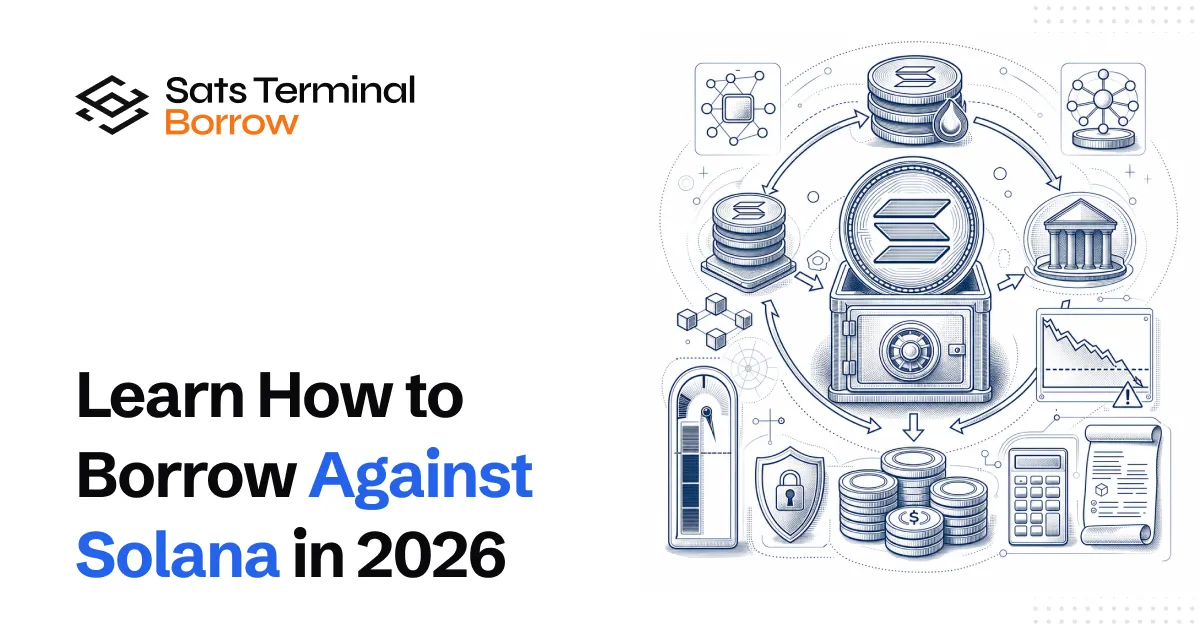
If you hold SOL and need cash, stablecoins, or working capital without selling your stack, you can borrow against Solana the same way Bitcoin and Ethereum holders have for years: by posting your tokens as collateral and drawing a loan against them. The difference is the venue. Solana has its own deep, fast, and unusually cheap on-chain lending ecosystem, and a SOL-backed loan there behaves differently from a comparable BTC or ETH position. This guide walks through exactly how a sol backed loan works in 2026 — which protocols to use, what loan-to-value (LTV) and liquidation parameters to expect, how Solana liquid staking tokens (LSTs) let you offset your borrow cost, and the specific risks that make SOL collateral a higher-variance proposition than the blue-chip alternatives.
This is an educational walkthrough, not financial or tax advice, and on-chain parameters change constantly. Treat every number here as a representative snapshot from early-to-mid 2026 and verify live terms in each protocol's interface before you commit capital.
The core motivation for a solana collateral loan is the same as for any crypto-backed loan: you want liquidity without triggering a sale. Selling SOL realizes a taxable gain in most jurisdictions, ends your exposure to future upside, and severs any staking yield you were earning. Borrowing keeps your SOL on your balance sheet while unlocking spendable dollars or stablecoins against it.
SOL is a particularly interesting collateral asset because of what it is and where it lives:
The flip side is real. SOL is structurally more volatile than BTC or ETH, with sharper drawdowns and faster recoveries, which compresses the safe LTV you can run. Solana also carries a reputational overhang from a string of network outages in 2021–2024. Borrowing against SOL means accepting both the higher volatility and the (now much reduced) chance that the chain itself stalls while you have an open position. We'll quantify both later.
Rule of thumb: the more volatile your collateral, the lower the LTV you should actually run, regardless of the maximum the protocol allows. A 65% max LTV on SOL is not an invitation to borrow at 64%.
Before choosing a venue, it's worth being clear-eyed about what you're posting. A borrow against sol position inherits every characteristic of the underlying token, good and bad.
| Dimension | How SOL stacks up as collateral |
|---|---|
| Liquidity | Excellent. Top-5 asset, deep order books on every major venue, easy for liquidators to clear. |
| Volatility | Higher than BTC and ETH. Larger and faster drawdowns mean a tighter safe LTV. |
| Native yield | Strong advantage. ~5–8% staking yield available via LSTs while collateralized. |
| Transaction cost | Negligible (sub-cent). Cheap to defend a position during volatility. |
| Chain reliability | Historically a concern; materially improved since 2024 with no major confirmed outage in a long stretch. |
| Oracle quality | Mature. Pyth and Switchboard provide robust SOL price feeds; LSTs use specialized price calculations. |
If you only take one thing from this table, make it this: SOL's volatility and its native yield are the two features that distinguish a SOL loan from an ETH-backed loan or a Bitcoin loan. The volatility forces a more conservative position; the yield can fund the cost of holding that position. The rest is plumbing.
For a broader view of which assets make sensible collateral and why, our sibling guide on what crypto you can use as collateral covers the asset-selection logic in depth.
Solana defi lending consolidated around a handful of serious money markets through 2025 and into 2026. Each accepts SOL (and usually the major LSTs) as collateral and lets you borrow stablecoins like USDC against it. Here's how the main venues differ.
Kamino is the largest single Solana DeFi protocol by total value locked — comfortably north of $1 billion in 2026 — and is the default destination for most SOL borrowers. Its core "Main Market" supports SOL, mSOL, jitoSOL, bSOL, USDC, USDT, and a curated set of blue-chip Solana assets, with riskier tokens isolated in separate markets so they can't contaminate the main pool.
Kamino's defining feature for borrowers is its soft liquidation design. Instead of seizing your entire position the instant you cross the threshold, Kamino partially liquidates — settling, for example, around 20% of your debt — to nudge the position back to safety. The liquidation penalty scales with how far underwater you are: a smaller discount near the threshold rising toward roughly 10% as a position deteriorates. This is meaningfully gentler than the all-or-nothing liquidations on some legacy protocols. Always confirm the current penalty schedule in the Kamino docs before relying on it.
MarginFi is a Solana-native money market that supports SOL, USDC, USDT, ETH, the major LSTs (mSOL, jitoSOL, bSOL), and a long tail of Solana assets, each with its own supply cap, borrow cap, and collateral weight. MarginFi's risk engine uses asset-specific weights rather than a single global LTV, which means your effective borrowing power depends on the exact mix of collateral and borrowed assets. It also offers a dedicated LST yield-leverage product for looping jitoSOL or mSOL against borrowed SOL — more on that below.
Save is the rebrand of Solend, Solana's earliest production lending protocol. After the 2024 rebrand it simplified its core product and leaned into isolated lending pools — anyone can spin up a pool with bespoke collateral factors, interest-rate curves, and accepted assets. That makes Save useful for borrowing against assets the bigger lenders haven't whitelisted, at the cost of doing more of your own risk diligence on each isolated pool's parameters. TVL is smaller than Kamino's, so check pool depth before borrowing size.
Drift is primarily a perpetuals exchange, but it runs a spot lending market with a notable architectural twist: a single cross-collateral pool backs all positions across every market, with liquidations flowing first to a backstop AMM and then to a community insurance fund. If you're already trading perps on Drift, its lending market lets your idle SOL or LST collateral earn yield and back a stablecoin borrow without moving funds elsewhere. It accepts JitoSOL and other LSTs as collateral.
| Protocol | Model | SOL / LST support | Standout feature | Best for |
|---|---|---|---|---|
| Kamino | Pooled money market + isolated markets | SOL, mSOL, jitoSOL, bSOL | Soft (partial) liquidations | Most SOL borrowers; largest liquidity |
| MarginFi | Pooled money market, weighted | SOL, mSOL, jitoSOL, bSOL | Asset-weighted risk + LST looping | LST leverage and yield strategies |
| Save | Isolated pools | SOL + long-tail via pools | Permissionless isolated pools | Borrowing against niche collateral |
| Drift | Cross-collateral + perps | SOL, LSTs | Unified collateral across spot + perps | Active traders already on Drift |
For a structured way to compare lending venues — DeFi or otherwise — our explainer on evaluating crypto lending platforms lays out the criteria that matter most. And if you're weighing Solana against other chains for your loan, the sibling post on the best blockchain for crypto loans compares Ethereum, Base, Arbitrum, and Solana head to head.
Mechanically, a Solana lending protocol is an over-collateralized system. You deposit SOL (or an LST), the protocol assigns it a collateral value based on an oracle price, and you may borrow up to a percentage of that value. Three numbers govern your safety:
On Solana specifically, the standard process is: connect a wallet (Phantom, Solflare, or Backpack are the common choices), deposit SOL or an LST into the lending market, then borrow USDC or USDT against it. Because Solana fees are negligible, you can add collateral or make partial repayments freely to manage your health factor — a practical advantage over higher-gas chains where every defensive transaction has a real cost.
Tip: keep a small buffer of unborrowed SOL or USDC in the same wallet. When the market moves against you, the fastest way to rescue a position is to top up collateral or repay a slice of debt — and on Solana that costs cents, so there's no excuse not to.
Parameters are set per-asset by each protocol's risk framework and change through governance, so the figures below are representative ranges as of early-to-mid 2026 — not guarantees. Always read the live values in the app.
| Collateral | Typical max LTV (2026) | Liquidation behavior | Notes |
|---|---|---|---|
| SOL | ~65–80% depending on protocol/market | Partial (soft) liquidation on Kamino; penalty scaling up toward ~10% | Run well below max given SOL volatility |
| jitoSOL / mSOL / bSOL (vs stables) | Similar to SOL, sometimes slightly lower | Standard liquidation; watch LST/SOL price ratio | Adds staking yield to collateral |
| LST vs SOL (correlated loop) | Liquidation LTV as high as ~95% | Only depeg or rate divergence triggers it | Used for yield-leverage loops; keep LTV under ~60% in practice |
Two things stand out. First, the headline "max LTV" on SOL can look generous — Kamino has listed SOL with a maximum LTV as high as 80% in its widely circulating collateral tier — but that ceiling exists for capital efficiency, not safety. Borrowing anywhere near it against a volatile asset is how positions get liquidated in a single bad candle.
Second, the correlated LST-against-SOL loop is a special case. Because jitoSOL and SOL move almost identically, protocols allow a very high liquidation LTV (around 95%) on that specific pairing — the only thing that can break it is an LST depeg or a divergence in borrow rates. That's what makes the staking loop possible, and it's the next thing to understand.
This is the part of SOL borrowing that has no clean Bitcoin equivalent. Solana liquid staking tokens — jitoSOL (Jito), mSOL (Marinade), bSOL (BlazeStake), and newer entrants — represent staked SOL that keeps earning rewards while remaining fully liquid and usable as collateral. As of early 2026, base native staking runs roughly 5–7% APY, and the leading LSTs land in that range or a touch higher.
Why jitoSOL is the popular collateral choice: Jito passes a share of MEV (maximal extractable value) block tips through to holders on top of the base staking yield, which has historically produced a blended APY a notch above vanilla staking — frequently cited in the ~7–8.5% range during 2025–2026. When you use jitoSOL as collateral, that yield accrues to your collateral the entire time it's pledged. Borrowing against jitoSOL therefore has a structural advantage: your collateral is appreciating in SOL terms even as you pay borrow interest.
The "staking loop" (sometimes called multiply or looping) works like this:
Because jitoSOL earns more than the cost to borrow SOL, each loop captures the spread. Kamino's Multiply vaults and MarginFi's LST yield-leverage product automate this. At modest leverage, looped jitoSOL/SOL strategies have historically printed net APYs in the mid-teens; at the higher leverage caps some vaults now permit, headline figures climb further. Those numbers are backward-looking and assume the yield spread and the LST peg both hold — neither is guaranteed.
Warning: the staking loop is a leveraged yield trade, not a free lunch. It magnifies returns when the LST holds its peg and the yield spread stays positive, and it magnifies losses — including liquidation — if the LST depegs, if SOL borrow rates spike above the staking yield, or if the chain congests during a rush for the exits. Treat looping as an advanced strategy.
There's a cleaner, lower-risk version of the same idea that most borrowers should prefer: simply borrow usdc against solana LSTs without looping. Deposit jitoSOL, borrow USDC at a conservative LTV, and let the ~7–8% staking yield on your collateral partially or fully offset your USDC borrow cost. You get spendable stablecoins, you keep your SOL exposure, and the staking yield quietly chips away at your interest bill — no leverage required.
Not everyone wants to manage an on-chain position. Centralized (CeFi) lenders offer a custodial alternative: you send SOL to the platform, they hold it, and they wire you dollars or stablecoins. The trade-off is counterparty risk — you're trusting the lender's solvency and custody — in exchange for a simpler UX and fixed terms. Our breakdown of DeFi versus CeFi lending covers that trade-off in full.
The CeFi landscape for SOL is narrower than for Bitcoin. Several major BTC-focused lenders deliberately don't accept SOL. Others do — platforms that accept a broad basket of collateral assets, including SOL, with fixed terms and LTVs set at origination (commonly in a 50%–90% band depending on the lender and term). When evaluating any CeFi lender, scrutinize three things: whether they engage in rehypothecation (lending out your collateral), whether they publish proof of reserves, and their regulatory standing. The 2022–2023 CeFi blowups were a lesson in counterparty risk that the prudent borrower internalizes permanently.
| Factor | Solana DeFi (Kamino, MarginFi, Save, Drift) | CeFi lenders accepting SOL |
|---|---|---|
| Custody | Non-custodial (you hold keys via smart contract) | Custodial (lender holds your SOL) |
| Rate type | Variable, utilization-driven | Often fixed for the term |
| Liquidation | Automatic, on-chain, transparent | Margin call then liquidation per contract |
| Staking yield on collateral | Yes, if you post an LST | Usually no (varies by lender) |
| Main risk | Smart contract, oracle, LST depeg | Counterparty insolvency, rehypothecation |
| KYC | None on-chain | Typically required |
Here's the practical flow for a non-custodial SOL loan. The exact button labels vary by protocol, but the sequence is universal.
Tip: set yourself a personal "action LTV" well below the protocol's liquidation threshold — say, intervene whenever your LTV climbs past 50% on a SOL position. Treat the liquidation threshold as a cliff edge you never approach, not a target.
Numbers make this concrete. Assume SOL trades at $180 (prices move; this is illustrative) and you deposit 50 SOL as collateral on a protocol where SOL has an 80% maximum LTV and an 80% liquidation threshold for this market. Always confirm the exact threshold in-app; it varies.
Where does liquidation happen? Your debt is fixed at $3,600. Liquidation triggers when your debt reaches the liquidation threshold of your collateral value — i.e., when collateral value falls to debt ÷ threshold:
So with a $3,600 borrow against 50 SOL deposited at $180, SOL would need to fall about 50% — to roughly $90 — before you're at risk of liquidation. That's the cushion a 40% starting LTV buys you. Had you borrowed the full $7,200 (80% LTV), your liquidation price would sit at $180 itself — meaning any downward tick liquidates you. That single comparison is the entire argument for conservative LTV on volatile collateral.
The interest side. Suppose USDC borrow APR is around 7% (variable; utilization-driven). On a $3,600 balance held for a year, that's roughly $252 in interest. Now suppose instead of plain SOL you'd posted 50 jitoSOL earning ~7.5% staking yield on the ~$9,000 collateral value — about $675/year accruing to your collateral. In SOL terms, that yield meaningfully offsets — and in this scenario more than covers — your dollar borrow cost, though the two legs are denominated differently (your yield is in SOL, your interest in USDC), so a falling SOL price still erodes the dollar value of that staking offset. This is the structural edge of LST collateral, with the caveat that it is not a guaranteed dollar hedge.
| Scenario | Collateral | Borrow | Start LTV | Liquidation SOL price |
|---|---|---|---|---|
| Aggressive | 50 SOL @ $180 = $9,000 | $7,200 | 80% | ~$180 (no cushion) |
| Moderate | 50 SOL @ $180 = $9,000 | $4,500 | 50% | ~$112 |
| Conservative | 50 SOL @ $180 = $9,000 | $3,600 | 40% | ~$90 |
For more on choosing where to sit on this curve, see optimizing your LTV ratio and our sibling deep-dive on how much you can borrow, which applies the same math to BTC.
Every crypto-backed loan carries liquidation, oracle, and smart-contract risk. SOL collateral adds a few wrinkles worth calling out specifically.
This is the dominant risk. SOL has historically posted larger and faster drawdowns than BTC or ETH. A 30–40% drop over a few days is well within its normal range during a broad market sell-off. That's precisely why a conservative starting LTV matters so much more here than it does on slower-moving collateral. Our guidance on managing liquidation risk and managing collateral during volatility applies directly, just with tighter tolerances.
If you post jitoSOL, mSOL, or bSOL, you've added a second risk vector: the LST trading below its underlying SOL value. Under normal conditions LSTs track SOL closely, and a 2–3% deviation during stress is unremarkable. But a sharp 5%+ depeg — driven by a liquidity crunch, a validator problem, or a panic unstake rush — can be a liquidation-cascade trigger for everyone using that LST as collateral on Kamino, Save, or elsewhere. The depeg risk is the price you pay for the staking yield. Size positions accordingly and don't assume the peg is a law of physics.
Protocols price your collateral via oracles like Pyth and Switchboard. LSTs often use a derived price (the underlying SOL price times the LST's exchange rate) rather than a raw market price, which protects against thin-market manipulation but introduces its own assumptions. A stale or manipulated oracle reading can trigger an unwarranted liquidation or, conversely, mask a real one. Solana's oracle infrastructure is mature, but it remains a dependency you're trusting.
Solana's outage history is the elephant in the room. The chain suffered several halts and degraded periods between 2021 and early 2024. The honest 2026 update is that reliability improved dramatically: there's been no major confirmed outage for a long stretch, skip rates fell sharply, and the rollout of the independent Firedancer/Frankendancer validator client plus the in-progress Alpenglow consensus upgrade are specifically aimed at client diversity and faster finality. Still, the borrower-relevant question is: what happens to my position if the chain stalls while SOL is crashing? If you can't transact, you can't add collateral or repay — and you could be liquidated the moment the chain resumes. This tail risk is smaller than it was, but it's not zero, and it's a reason to run more conservative LTVs on Solana than you might on Ethereum.
You're trusting the protocol's code. Stick to established, audited venues with substantial TVL and a track record, and read up on smart contract security and audits before depositing meaningful size. New isolated pools with unfamiliar parameters deserve extra scrutiny.
Choosing which asset to borrow against is partly about which you hold and partly about the loan characteristics each offers. Here's the honest comparison.
| Attribute | BTC-backed loan | ETH-backed loan | SOL-backed loan |
|---|---|---|---|
| Collateral volatility | Lowest of the three | Moderate | Highest |
| Typical safe LTV | Can run higher | Mid | Run lower |
| Native yield on collateral | None (BTC doesn't stake) | Yes, via ETH LSTs | Yes, via SOL LSTs (often higher base yield) |
| Transaction / gas cost | N/A on-chain (wrapped to use in DeFi) | Can be high on mainnet | Negligible |
| Where it's borrowed | CeFi + DeFi (often wrapped) | Deep DeFi (Aave, Morpho) | Solana-native DeFi (Kamino, MarginFi) |
| Chain reliability concern | Minimal | Minimal | Improved but historically present |
The short version: BTC is the conservative collateral — lowest volatility, deepest CeFi market, no yield. ETH sits in the middle with strong DeFi venues and staking yield via LSTs. SOL is the high-yield, high-variance option — the cheapest chain to operate on and the richest native staking yield, paid for with higher volatility and a chain-reliability asterisk. Many borrowers split: BTC for the bulk of a long-term position, SOL or ETH where they want the LST yield to subsidize the loan. To go deeper on the chain-level comparison, see the sibling post on the best blockchain for crypto loans, and for the Bitcoin side, our roundup of the best platforms to borrow USD against Bitcoin.
If you're new to the whole category, the fundamentals in what crypto loans are and how they work and our introduction to DeFi lending are worth reading first. And because SOL lending lives on its own chain, the mechanics of moving value between ecosystems in cross-chain borrowing are directly relevant if your collateral and your spending live on different networks.
In most jurisdictions, taking out a loan against your SOL is not itself a taxable event — you haven't sold anything. But the details matter: a liquidation is a sale and can realize a gain or loss, and using an LST may involve a taxable conversion when you mint or redeem it, depending on your local rules. This is not tax advice; rules vary and change. Read our overview of the tax implications of crypto borrowing, confirm current guidance from a primary source like IRS.gov if you're in the U.S., and consult a qualified professional for your situation.
One more practical note: the stablecoin you borrow carries its own risk profile. Understand what backs your USDC or USDT before holding large balances, and skim understanding stablecoin risks so a depeg on the borrow side doesn't blindside you.
Common Questions
Yes. That's the entire point of a SOL-backed loan. You deposit SOL or a Solana LST as collateral on a protocol like Kamino, MarginFi, Save, or Drift, then borrow USDC or USDT against it. Your SOL stays yours and keeps its market exposure; you repay whenever you want to reclaim it. Selling, by contrast, ends your exposure and can trigger a taxable event.
As of early-to-mid 2026, major Solana protocols list SOL with a maximum LTV in roughly the 65–80% range depending on the venue and market, with Kamino placing SOL in a high-LTV collateral tier. That maximum exists for capital efficiency, not safety. Given SOL's volatility, most borrowers should run a starting LTV near 40–50% to leave a real cushion. Always confirm live parameters in the app.
When you post a liquid staking token such as jitoSOL, mSOL, or bSOL as collateral, it keeps earning Solana staking rewards — roughly 5–8% APY, with jitoSOL often higher thanks to its MEV share. That yield accrues to your collateral while it's pledged, partially or fully offsetting the interest you pay on a borrowed stablecoin. The offset is denominated in SOL, though, so a falling SOL price reduces its dollar value.
If the chain stalls, you can't transact — meaning you can't add collateral or repay while you're frozen out, and you could be liquidated when the network resumes if SOL fell in the meantime. Solana's reliability improved substantially since 2024, with no major confirmed outage for a long stretch and upgrades like Firedancer and Alpenglow targeting resilience. The risk is smaller than it was but not zero, which is a reason to run conservative LTVs.
In most jurisdictions, borrowing against your SOL is not a taxable event because you haven't sold anything. However, a liquidation counts as a sale and can realize a gain or loss, and minting or redeeming an LST may be taxable depending on local rules. Tax treatment varies and changes — this isn't tax advice, so verify with a primary source and a qualified professional for your situation.
For most borrowers, Kamino is the default because of its deep liquidity and borrower-friendly soft (partial) liquidations. MarginFi excels if you want LST yield-leverage strategies. Save is useful for borrowing against niche collateral via isolated pools. Drift suits active traders who already use its perps and want unified collateral. Compare live rates and parameters before deciding, since they change frequently.
The loop deposits an LST, borrows SOL, converts it back to more LST, and repeats — leveraging the spread between staking yield and SOL borrow cost. It can amplify returns but also amplifies losses and liquidation risk if the LST depegs or borrow rates spike. Plainly borrowing USDC against an LST at a conservative LTV is far simpler and lower-risk while still capturing the underlying staking yield.
Generally, yes, primarily because SOL is more volatile than BTC, which compresses the safe LTV and raises liquidation risk for the same loan size. SOL also adds chain-reliability and (if you use LSTs) depeg considerations. The offset is SOL's native staking yield and Solana's near-zero transaction costs, which make defending a position cheap. It's a higher-variance, potentially higher-yield trade — manage it with lower leverage. Borrowing against Solana in 2026 is a genuinely mature option: deep liquidity, several battle-tested protocols, near-free transactions, and a native staking yield that no Bitcoin loan can match. The catch is variance — SOL's volatility, LST depeg risk, and the chain's reliability history all argue for running conservative LTVs and treating leverage with respect. If you understand those trade-offs and size your position with a real cushion, a SOL-backed loan can unlock liquidity without forcing you to sell. When you're ready to compare what your collateral can actually fetch, Borrow by Sats Terminal aggregates BTC-backed loan offers across DeFi and CeFi venues so you can see the best available rate before you commit — a useful rate-comparison starting point whether your collateral is Bitcoin or you're weighing it against a SOL position. None of this is financial advice; verify current terms and borrow within your risk tolerance.