

A crypto lending aggregator compares loan offers across DeFi and CeFi so you get the best crypto loan rate. Here's how aggregation works in 2026.
 Arkadii Kaminskyi
Arkadii Kaminskyi
Head of Operations at Sats Terminal
Head of Operations at Sats Terminal with 5 years of experience in crypto. Specializes in DeFi, yield farming, and borrowing — has reviewed 50+ crypto products.
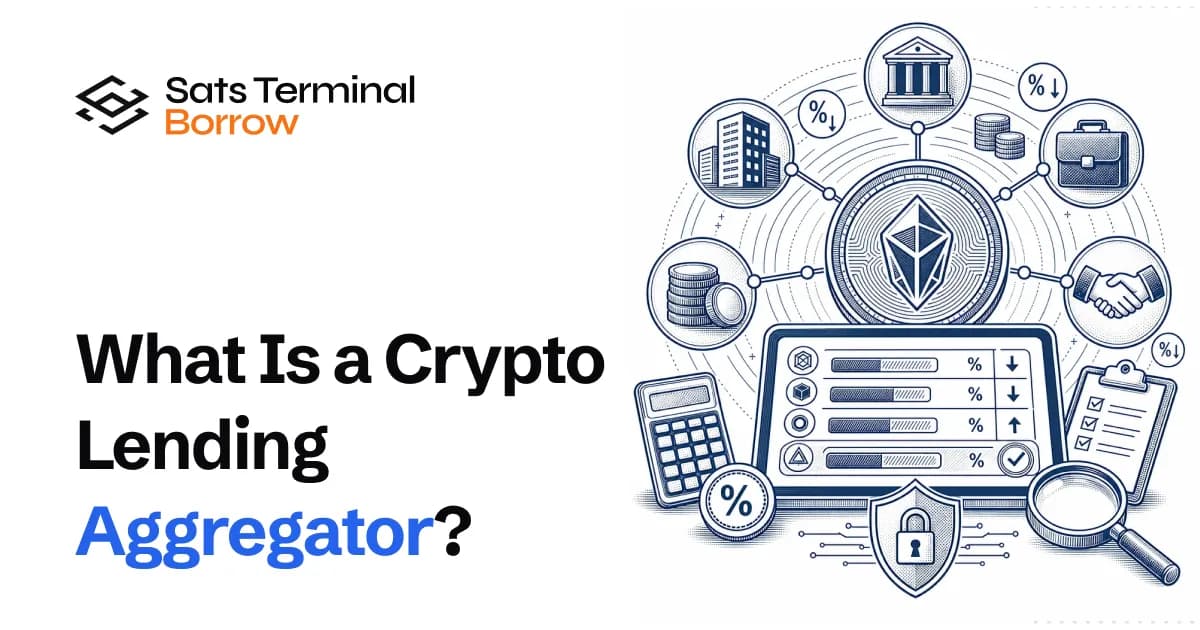
If you have ever opened five browser tabs to compare what Aave, Morpho, a couple of CeFi desks, and your exchange will lend against your Bitcoin, you have already felt the problem that this category exists to solve. A crypto lending aggregator is a layer that sits above individual lenders and protocols, pulls live rates and risk parameters from each one, normalizes them into a single comparable format, and surfaces the best available offer for your specific collateral and loan size, so you do not have to check every venue by hand. This guide explains what that layer actually does, how the routing and rate comparison work under the hood, where aggregators help versus where going direct still makes sense, and how to judge whether a given aggregator is worth trusting in 2026.
This is an educational explainer of the model, not a platform review. By the end you should understand the mechanics well enough to evaluate any aggregator on its merits, find the genuinely cheapest loan for your situation, and avoid the subtle traps that make a "best rate" headline misleading. Borrow by Sats Terminal is one example of this model focused on BTC-backed loans, and we will use it to ground a few points, but the framework here applies to crypto lending aggregation generally.
A crypto lending aggregator is software that compares loan offers across many lenders and protocols at once and helps a borrower obtain the best available rate and terms without manually visiting each venue. Think of it the way a flight-comparison site sits above dozens of airlines: the airlines still operate the flights, but you get one screen that ranks them by price and convenience. The aggregator does not necessarily hold your money or originate the loan itself. It discovers, normalizes, ranks, and often routes you into the underlying market that wins.
In practice a crypto loan aggregator spans two very different worlds. On the DeFi side it reads on-chain lending protocols such as Aave and Morpho, where rates and risk parameters live in public smart contracts and update algorithmically. On the CeFi side it integrates with centralized lenders whose terms are set by a company and exposed through APIs. The aggregator's job is to make these comparable, because a 9.5% fixed CeFi rate and a 6.2% variable DeFi borrow rate are not the same product even when both look like "borrow USDC against BTC."
The category is sometimes called a defi lending aggregator when it focuses purely on on-chain venues, but the most useful tools for a borrower span both. If you are new to the underlying machinery, our explainers on DeFi lending and how DeFi and CeFi lending compare give the background this post assumes.
Rule of thumb: An aggregator answers "where should I borrow?" A protocol or lender answers "lend me money." Confusing the two is the first mistake borrowers make. The aggregator competes on coverage, accuracy, and execution UX, not on holding a balance sheet.
Crypto lending is fragmented along more axes than most borrowers realize, and every axis hides a cost. Before aggregators existed, finding the best deal meant manually reconciling all of these by hand, in tabs, while prices and rates moved underneath you.
Layered on top of fragmentation is the manual-comparison burden: even a careful borrower struggles to hold a dozen moving parameters in their head, and gas plus wallet-switching friction makes "just try each one" expensive in DeFi. The aggregator collapses that work into one normalized view. For a deeper look at the underlying market structure, our piece on comparing Aave, Morpho, and CeFi walks through why these venues diverge.
Under the hood, a crypto lending aggregator runs a pipeline that looks roughly the same whether it is comparing yield or comparing loans. It is worth understanding because the quality of each stage determines whether the "best rate" you see is real.
For DeFi venues the aggregator reads on-chain state directly: current variable borrow rate, supply rate, pool utilization, max LTV, liquidation threshold, liquidation penalty, and the oracle price feed each market uses. Because these live in public contracts on protocols like Aave and Morpho, the data is verifiable rather than self-reported. For CeFi lenders the aggregator consumes an API or published rate sheet covering APR, LTV tiers, minimum and maximum loan size, origination fees, and term length. Good aggregators refresh on a tight cadence because a stale DeFi rate is a wrong rate.
This is the unglamorous step that makes or breaks an aggregator. Venues do not agree on naming, precision, or even what "the same" instrument is. One market quotes a variable APY that compounds per block; another quotes a simple fixed APR; a CeFi desk quotes a monthly rate. Collateral labeled "BTC" might actually be WBTC, cbBTC, or tBTC, which carry different risk and eligibility. The aggregator has to convert everything to a common basis: a comparable annualized cost, a consistent LTV definition, a consistent liquidation-threshold definition, and a clear note of which wrapped asset is involved. Our explainer on WBTC vs cbBTC vs tBTC shows why that last distinction matters more than it sounds.
Once everything is normalized, the aggregator ranks offers for your inputs: collateral type, loan size, desired LTV, and preferred chain or custody model. The ranking should be on total cost and fit, not just headline APR. Some aggregators stop at recommendation, handing you a link to the winning venue. More integrated ones offer execution: they construct the transactions, route your collateral into the chosen market, and let you borrow without leaving the interface. The line between "smart order routing" in trading and "best-rate routing" in lending is genuinely close, the difference being that a loan is a position you hold over time, not a one-shot swap.
Why on-chain coverage matters: Because DeFi parameters live in public smart contracts, an aggregator can verify them rather than trust a marketing page. That verifiability is a real advantage of including DeFi venues in the comparison set, but it also means the aggregator must read the right markets and the right oracles, or the "best" rate is just a precise-looking error.
For Borrow by Sats Terminal specifically, the aggregation focuses on BTC-backed loans across DeFi protocols and CeFi lenders, normalizing them into one non-custodial flow. Our FAQ on how Borrow aggregates lending offers and the deeper guide to how lending aggregators find the best rates describe that pipeline in product terms.
The single most useful thing this post can give you is a correct mental model of cost, because the headline rate is almost never the number you actually pay. "Best crypto loan rates" is a phrase that hides at least four hidden variables. Here is how to find the best crypto loan rate without being fooled by a low APR.
Assume Bitcoin is around $100,000 in early 2026 (prices move, so treat this as illustrative). You hold 1 BTC and want to borrow $40,000 in stablecoins, a 40% LTV. Two offers come back through an aggregator:
On a one-year horizon these tie, which is exactly the point: the lower headline rate is not automatically cheaper. Now shorten the loan to three months. Offer A costs about $950 in interest. Offer B costs about $750 in interest plus the full $800 fee, so about $1,550, far more expensive despite the lower advertised rate. The fee does not amortize on a short loan. A good aggregator surfaces effective cost for your actual term; a weak one just sorts by headline APR and quietly recommends the worse deal. To estimate these yourself, the crypto loan cost calculator guide walks through the arithmetic.
Notice what the example also reveals about safety. Offer B allows up to 60% LTV and liquidates near 70%, while Offer A caps at 50% and liquidates near 65%. At your chosen 40% LTV, Offer A leaves Bitcoin room to fall roughly 38% before liquidation, while Offer B's wider thresholds and lower starting price give a different buffer. Two loans with the same dollar cost can carry meaningfully different liquidation risk, which is why the best aggregators show liquidation price and safety margin next to the rate rather than burying them. Price and risk are two halves of the same decision, and ranking on price alone quietly ignores the half that can cost you your collateral.
Warning: A "0% APR" or teaser rate is a fee structure, not a free loan. Always compute total cost over your expected holding period, including origination fees, spreads, and the gas to enter and exit. The cheapest headline rate and the cheapest loan are frequently not the same offer.
Aggregation is not free of downsides, and a good explainer says so. Whether you should compare crypto loans through an aggregator or go straight to a single venue depends on how much you value discovery and convenience versus control and simplicity.
| Dimension | Using an aggregator | Going direct to one venue |
|---|---|---|
| Best-rate discovery | Strong: compares many venues at once | Weak: you only see one venue's terms |
| Time and effort | Low: one normalized screen | High: manual tab-by-tab comparison |
| Transparency of inputs | Depends on the aggregator's coverage and freshness | You read the source directly |
| Trust assumption | You trust the routing and normalization logic | You trust only the one venue |
| Possible extra fees | Some aggregators take a fee or spread | No aggregator layer to pay |
| Custody | Best-in-class are non-custodial; verify | Varies by venue |
| Execution UX | Unified flow if execution is supported | Each venue's own UX |
Use this as a checklist when you evaluate any crypto loan aggregator, including ours. The goal is to separate a genuine best-rate engine from a thin affiliate skin.
| Criterion | What good looks like | Red flag |
|---|---|---|
| Coverage | Multiple real venues across DeFi and CeFi; named, not vague | "Many partners" with no list |
| Transparency | Shows source venue, rate type, LTV, liquidation params, fees | Only a single blended "rate" |
| Data freshness | Live or near-live on-chain reads | Rates that never seem to move |
| Custody model | Non-custodial execution; you sign from your own wallet | Deposit funds to the aggregator first |
| Supported assets and chains | Clear list; covers your collateral and chain | Unclear which BTC variant is accepted |
| Fee model | Disclosed fee or spread, shown in effective cost | Hidden spread, no fee disclosure |
| Risk surfacing | Liquidation price, health factor, penalties shown upfront | Only the borrow amount and APR |
The difference between custodial and non-custodial matters more than a few basis points of rate. With non-custodial execution you sign transactions from your own wallet and your collateral sits in audited smart contracts you can inspect, rather than on a company's balance sheet that could rehypothecate or fail. The collapses of 2022 were custodial failures, not smart-contract failures. An aggregator that lets you compare and borrow without ever surrendering custody removes an entire category of counterparty risk from the equation.
Confirm the aggregator actually supports your collateral. If you are borrowing against Bitcoin, check which wrapped representation it routes into and whether the chain it uses fits your cost tolerance, since gas on Ethereum mainnet differs sharply from an L2. Borrowers comparing chains can read our breakdown of the best blockchain for crypto loans in 2026.
To make the model concrete, here is how the three borrowing paths compare across the factors that actually decide your experience and cost. This is the lens an aggregator is built to collapse into a single recommendation.
| Factor | Direct to DeFi protocol | Direct to CeFi lender | Through an aggregator |
|---|---|---|---|
| Rate discovery | One protocol's live rate only | One company's rate sheet only | Best of many venues, normalized |
| Rate type | Usually variable, utilization-driven | Usually fixed for the term | Both, surfaced side by side |
| Custody | Non-custodial, self-managed | Custodial (you transfer BTC) | Non-custodial if well designed |
| KYC | Typically none | Usually required | Depends on routed venue |
| Effort to compare | High (manual, per protocol) | High (manual, per lender) | Low (one screen) |
| Risk management tools | You monitor health factor yourself | Lender margin-calls you | Risk surfaced in the flow |
| Best for | Power users who know the protocol | Borrowers who want fixed terms and support | Anyone optimizing for best total cost |
None of these is universally correct. A DeFi-native borrower who already lives in Aave or Morpho may not need an aggregator for a single familiar position. A borrower who wants a fixed-rate, supported, KYC'd loan might go straight to a CeFi desk. The aggregator wins when you genuinely want the cheapest viable offer and do not want to become an expert in seven venues to find it.
A few current facts help calibrate expectations. Treat all numbers as approximate and time-sensitive; rates and parameters change, so confirm current terms at the point of borrowing.
The throughline is that competition has lowered rates and improved UX, but it has also increased fragmentation, which is precisely what makes the aggregator model more useful in 2026 than it was a few years ago. For the bigger picture, see our look at the future of Bitcoin-backed lending and the regulatory landscape.
Here is a practical workflow that puts the whole framework to work, whether or not you use an aggregator.
Tip: Run the comparison at the LTV you will actually borrow at, not the maximum. Borrowing at 40% LTV instead of 60% usually earns a lower rate and a far larger safety buffer. The cheapest, safest loan is often the one where you simply ask for less.
Borrow by Sats Terminal is a non-custodial aggregator focused on Bitcoin-backed loans. It applies the pipeline described above specifically to BTC collateral: it pulls live offers from DeFi protocols such as Aave and Morpho alongside CeFi lenders, normalizes their rates, LTVs, and liquidation parameters into one comparable view, and recommends the best fit for your collateral and loan size, all while you keep self-custody and sign from your own wallet. Because the comparison is grounded in verifiable on-chain parameters where possible, the "best rate" you see is meant to be the best you can actually transact, not a marketing figure.
If you want to see the model in action, the announcement post meet Borrow by Sats Terminal walks through the product, and the FAQ on how Borrow's rate comparison works explains exactly which fields it normalizes. For a survey of the venues borrowers compare today, our roundup of the best platforms to borrow USD against Bitcoin is a useful companion. And if you are weighing this category against borrowing safely in general, the sibling guide on how to borrow against crypto safely is worth a read.
Common Questions
It is a comparison-and-routing layer that checks many lenders and DeFi protocols at once and shows you the best loan offer for your collateral, instead of you visiting each venue by hand. It does not usually originate the loan itself; it discovers and normalizes offers, ranks them by real cost and fit, and often routes you into the winning venue while you keep custody of your assets.
Usually yes for discovery, because it compares far more venues than you would manually and surfaces the cheapest viable offer. But an aggregator can only rank venues it integrates, and some take a fee or spread. Always confirm the recommended offer's effective cost, including origination fees and gas, against any specific venue you already know. The aggregator saves time and reduces blind spots; it is not a guarantee of the global lowest price.
Models vary. Some charge a transparent fee, some earn a small spread on the routed loan, and some have partnership arrangements with the venues they list. None of that is inherently bad if it is disclosed and the loan still nets out cheaper than going direct. The thing to avoid is an undisclosed spread that quietly worsens your effective rate, which is why fee transparency belongs on your evaluation checklist.
The best ones are, but you must verify. Non-custodial means you sign transactions from your own wallet and your collateral sits in audited smart contracts rather than on the aggregator's balance sheet. That removes a major category of counterparty risk. If a tool asks you to deposit funds to it before you can even see a quote, treat that as custodial and weigh the added risk accordingly.
Headline APR is just the interest rate. Effective cost adds every other charge over your actual holding period: origination fees, gas to enter and exit, any spread, and the implicit cost of a tighter liquidation buffer. A loan with a lower headline rate but a 2% origination fee can be more expensive than a higher-rate, zero-fee loan, especially on short terms. Always compare on effective cost, not the advertised number.
Yes, and the most useful ones do. DeFi rates and parameters are read directly from on-chain smart contracts and are verifiable; CeFi terms come through lender APIs or rate sheets. The aggregator normalizes both into a common basis so a fixed CeFi APR and a variable DeFi borrow rate can be compared side by side. Spanning both worlds is what lets a single screen surface the genuinely cheapest viable option.
Taking out a crypto-backed loan is generally not a taxable event in the United States as of early 2026, because pledging collateral is not selling it, so there is no disposal and no capital gain. The aggregator layer does not change that; what matters is the underlying loan. Interest may sometimes be deductible depending on use of funds. This is general information, not tax advice, so confirm with a professional for your situation.
The aggregator layer itself often does not, but whether you complete identity verification depends on the venue it routes you into. DeFi protocols typically require no KYC; most regulated CeFi lenders do. If privacy matters, filter for non-custodial DeFi routes, and remember that regulation such as the EU's MiCA framework is shifting which venues are available in which regions through 2026 and beyond. The crypto lending market in 2026 is cheaper and more competitive than ever, but that competition has scattered the best deals across dozens of incompatible venues, each with its own rates, LTVs, liquidation rules, and fee tricks. A crypto lending aggregator earns its place by turning that mess into one honest, normalized comparison so you can borrow on the best terms you can actually transact, ideally without surrendering custody. The skill is no longer hunting for a single low number; it is reading effective cost and safety margin together. If you want to compare BTC-backed loan offers across DeFi and CeFi in one non-custodial view, that is exactly what Borrow by Sats Terminal is built to do, and it is a reasonable place to put this framework into practice. None of this is financial, legal, or tax advice; always confirm current terms and your own risk tolerance before you borrow.