

A crypto loan no credit check works because over-collateralization makes your Bitcoin the underwriting. See who benefits, the trade-offs, and scam red flags.
 Arkadii Kaminskyi
Arkadii Kaminskyi
Head of Operations at Sats Terminal
Head of Operations at Sats Terminal with 5 years of experience in crypto. Specializes in DeFi, yield farming, and borrowing — has reviewed 50+ crypto products.
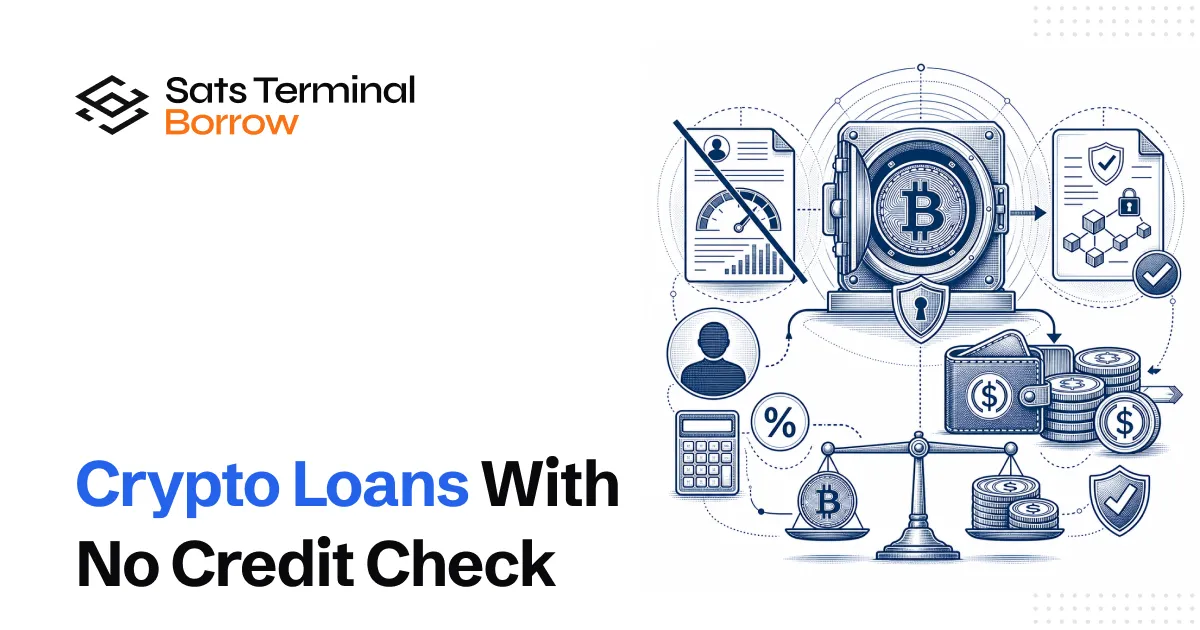
If you have ever been turned down for a loan because your credit file was too thin, too new, or simply non-existent, the idea of a crypto loan no credit check product can sound almost suspicious. It is not. A crypto loan with no credit check — borrowing against Bitcoin and other crypto assets — genuinely skips the credit pull, the income verification, and the bureau inquiry that gate a traditional personal loan. The reason is mechanical rather than promotional: when a loan is secured by an asset worth more than the amount you borrow, the lender does not need to predict whether you will repay. The collateral is the underwriting. This article explains exactly why that works, who it helps, and the real trade-offs you accept in exchange for never showing anyone your FICO score.
We will keep this honest. Skipping the credit check is a genuine feature, but it is not a free lunch. Crypto-backed loans replace one kind of risk (credit risk, the lender's worry that you will not pay) with another kind (liquidation risk, your worry that the collateral will be sold out from under you). They also do not build credit, because the activity is invisible to the bureaus. And because the structure attracts people who have been shut out of mainstream lending, it is also a magnet for scammers who borrow the language of "no credit check, instant approval" to run advance-fee fraud. By the end you will be able to tell the legitimate product from the trap.
Traditional lending is, at its core, a prediction problem. A bank lends you money it may not get back, so it spends enormous effort estimating the probability that you default: it pulls your credit report, scores your payment history, checks your debt-to-income ratio, verifies employment, and prices the loan to compensate for the residual risk. The credit check exists because the loan is unsecured or only loosely secured. The lender's recovery depends on your future behavior, which it cannot observe, so it studies your past behavior as a proxy.
A Bitcoin-backed loan inverts the entire model. Instead of lending against your character, the lender lends against your collateral. You lock up crypto worth substantially more than you borrow, and that locked asset is the lender's recovery mechanism. If you stop paying or the position deteriorates, the protocol or platform sells the collateral and makes itself whole. Because the recovery does not depend on your future income or your willingness to pay, there is nothing for a credit score to predict. The question "will this person repay?" is replaced by the question "is the collateral worth more than the loan, with a safety margin?" That second question is answered by a price oracle in real time, not by a credit bureau.
This is the principle of over-collateralization, and it is the single most important concept for understanding why no credit check is needed. You can dig deeper into the mechanics in our explainer on how Bitcoin-backed loans work, but the short version is this: deposit more value than you take out, and the math protects the lender without anyone needing to know who you are.
The mental model that unlocks everything: a credit-based loan asks "do we trust you to pay us back?" A crypto-backed loan asks "is your collateral worth enough to make repayment irrelevant?" Different question, different machinery, no credit check.
When you open a position on a protocol like Aave or Morpho, or through a CeFi desk like Coinbase or Ledn, the system tracks two numbers continuously: the value of your collateral and the value of your debt. Their ratio is your loan-to-value ratio, or LTV. Each asset has a maximum LTV you are allowed to borrow up to, and a slightly higher liquidation threshold at which the system steps in. As of early 2026, Bitcoin collateral on major venues typically supports a maximum LTV somewhere in the 50% to 75% range depending on the platform, with conservative CeFi desks often anchoring around 50% and on-chain markets sometimes allowing more. Always check current terms, because these parameters are tuned to volatility and change.
The beauty of this design is that underwriting becomes a single, continuously updated computation. There is no application to approve, no document to verify, no human to convince. A smart contract reads the collateral value from an oracle, compares it to your debt, and either lets you borrow or does not. The "decision" takes seconds because there is no judgment involved, only arithmetic.
It is worth being precise, because "no credit check" does not mean "no identity check" everywhere. There are two distinct paths, and they treat your identity very differently even though neither pulls your credit.
On a decentralized protocol such as Aave v3 or Morpho Blue, you interact directly with a smart contract from your own wallet. There is no account, no signup, no name attached. The protocol does not know whether you are a person, a company, or a script. It cannot run a credit check because there is no entity to check and no credit bureau integration in the contract. This is the purest form of a no-KYC crypto loan: you keep self-custody of the position, the rules are enforced by code, and your only "credential" is the collateral in your wallet. If you want a deeper comparison of the two models, see our guide to custodial versus non-custodial lending.
A centralized lender is a regulated company, so it usually performs know-your-customer (KYC) and anti-money-laundering (AML) checks: it verifies your identity, screens you against sanctions lists, and may ask where funds came from. This is identity verification, not a credit check. The crucial distinction many borrowers miss is that completing KYC does not mean the lender is pulling your credit report or scoring your payment history. Coinbase's Bitcoin-backed product, for example, has been described as approving borrowers in seconds without additional credit checks, and CeFi desks broadly market themselves on "no credit checks" even while running standard KYC/AML. You can read more about identity requirements in our FAQ on whether KYC is required to use Borrow.
| Dimension | DeFi protocol (Aave, Morpho) | CeFi desk (Coinbase, Ledn, etc.) |
|---|---|---|
| Credit check | None (no integration possible) | None (collateral-based) |
| Identity / KYC | None — wallet only | Usually required (AML/sanctions) |
| Who holds the BTC | You / the smart contract | The platform (custodial) |
| Approval basis | On-chain collateral value | Collateral value + KYC pass |
| Funding speed | Minutes, anytime | Seconds to hours |
| Counterparty risk | Smart-contract / oracle risk | Platform solvency risk |
So the accurate framing is: DeFi requires no identity and no credit; CeFi may require identity but still requires no credit. If your goal is specifically to avoid a credit inquiry, both routes deliver. If your goal is to avoid any identity disclosure, only the DeFi route does, and you can compare the trade-offs in our overview of DeFi versus CeFi lending.
The "no credit check" feature is not just a convenience. For several large groups of people, it is the difference between being able to access liquidity at all and being locked out. The U.S. Consumer Financial Protection Bureau has estimated that tens of millions of American adults are "credit invisible" (no file with the bureaus) or have files too thin to score. For these people, the entire premise of credit-based lending fails before it starts.
Rule of thumb: the more "non-standard" you look to a traditional underwriter — no file, lumpy income, foreign history, past blemishes — the more a collateral-based loan levels the field. The system stops asking about you and starts asking about your Bitcoin.
An honest guide does not stop at the benefits. The no-credit-check structure carries three real costs that you must understand before you treat it as a free upgrade over a personal loan.
This is the most under-appreciated trade-off. Because no bureau is involved on the way in, no bureau is involved on the way out either. Your on-time payments are not reported to Equifax, Experian, or TransUnion, so a perfectly serviced Bitcoin loan does nothing to lift your FICO score. If part of your goal is to build or rebuild a credit history, a crypto loan is the wrong tool — it is invisible to the very system you are trying to improve. There are early experiments (TransUnion has piloted letting borrowers voluntarily share credit data with on-chain lenders, and various "on-chain credit score" projects exist), but as of 2026 standard crypto-backed loans are not a credit-building product. Use them for liquidity, not for score repair.
In a credit-based loan, the worst case for missing payments is damage to your score and collections. In a collateralized crypto loan, the worst case is liquidation: if your collateral value falls far enough that your LTV breaches the liquidation threshold, the position is sold automatically, often with a liquidation penalty. There is no grace, no phone call, no hardship plan on most DeFi venues. The risk you removed (a lender doubting you) is replaced by a market risk (Bitcoin falling). Our guides on managing liquidation risk and optimizing your LTV ratio exist precisely because this is the danger that bites borrowers who came from the credit world and underestimated it. We also have a sibling piece on exactly what happens if you cannot repay a crypto loan.
This is the obvious-but-decisive limitation. A credit-based loan lets someone with no assets borrow against their future earning power. A crypto loan does the opposite: it only works if you already own the Bitcoin (or ETH, SOL, or other accepted asset). It is a way to unlock liquidity from assets you hold without selling them, not a way to conjure money from nothing. If you do not own crypto, there is no collateral, and therefore no loan. For deciding whether unlocking that liquidity even makes sense versus selling, see our sibling framework on whether you should sell or borrow against your Bitcoin.
Here is the side-by-side that most people are actually searching for. The point is not that one is universally better; it is that they solve different problems.
| Feature | Crypto-backed loan (no credit check) | Personal / credit-based loan |
|---|---|---|
| Approval basis | Collateral value (your BTC) | Credit score, income, DTI |
| Credit pull | None | Hard inquiry (dings score) |
| Builds credit? | No (not reported to bureaus) | Yes, with on-time payments |
| Need to own an asset? | Yes — collateral required | No — unsecured option exists |
| Funding speed | Minutes to same-day | Days to weeks |
| Main risk to you | Liquidation if price falls | Score damage, collections, lawsuits |
| Typical rate basis (early 2026) | ~ low single digits to ~12%+ depending on venue | Score-dependent, often higher for weak credit |
| Works with bad/no credit? | Yes, fully | Often no, or at punitive rates |
Notice the symmetry. The crypto loan wins on access (anyone with collateral, any credit profile, fast) and loses on credit-building and on the requirement to already own the asset. The personal loan wins for asset-light borrowers who want to build credit and loses on speed and on locking out weak-credit applicants. If your credit is poor specifically because you have no file rather than because of defaults, the crypto route is often dramatically cheaper than the subprime personal loans you would otherwise qualify for. For the broader question of how rates get set, our explainer on how crypto lending rates are determined is a good companion.
Numbers make the mechanics concrete. Assume Bitcoin is trading around $100,000 in early 2026 (prices move constantly — treat this as illustrative). You hold 1 BTC and you want cash without selling, and crucially without anyone checking your credit.
That buffer exists because you borrowed conservatively. Watch what happens if you borrow aggressively instead. Suppose you take the maximum and borrow $65,000 (65% LTV). Now liquidation at an 80% threshold triggers when collateral hits $65,000 ÷ 0.80 = $81,250, i.e. a Bitcoin price of $81,250 — only an 18.75% drop. A correction of that size is entirely ordinary for Bitcoin, so the aggressive borrower is far closer to the edge. This is the core lesson: the no-credit-check loan is easy to get, but how much you borrow against the collateral decides your real risk. Our piece on how much you can borrow against your Bitcoin goes deeper on choosing that number.
Interest accrual: say the borrow rate is 8% APR on the $30,000 loan. Over one year that is roughly $2,400 in interest, accruing continuously on most on-chain venues rather than on a fixed monthly schedule. There is no principal due date on many open-ended crypto loans — you can hold the position as long as your health factor stays safe, repaying whenever you choose. None of this touches your credit, in either direction.
Tip: a low starting LTV is the single best protection against the one real downside of a no-credit-check loan. Borrowing 30% instead of 65% of your collateral can mean the difference between surviving a 50% Bitcoin drawdown and being liquidated by an ordinary correction.
Short answer: no. Because there is no application inquiry on the way in and no payment reporting on the way out, a standard crypto-backed loan is invisible to Equifax, Experian, and TransUnion. Specifically:
The honest nuance for 2026: the industry is experimenting at the edges. TransUnion has piloted services letting borrowers voluntarily share their traditional credit data with on-chain lenders, and several "on-chain reputation" projects are trying to build crypto-native credit scoring. But these are opt-in and emerging; the default, mainstream Bitcoin-backed loan still does not report to or read from the bureaus. If you specifically want an activity that builds your score, this is not it — and that cuts both ways, since it also means a rough patch in crypto cannot tank your traditional credit.
The process is short precisely because the underwriting is automated. Here is the path, whether you go DeFi or CeFi.
An aggregator changes step 2 and 3 by surfacing offers across venues so you compare rates and LTVs in one place rather than checking each protocol manually. That is the entire premise of a rate-comparison layer, which we explain in our overview of how lending aggregators find the best rates.
This is the most important section for vulnerable borrowers, so read it carefully. The phrase "no credit check" is also the calling card of advance-fee loan fraud, which specifically targets people with bad or no credit because they are desperate and used to being told no. The U.S. Federal Trade Commission and state attorneys general have warned about this pattern for years, and crypto has given the scam new packaging.
The single clearest signal separates legitimate from fraudulent: a real no-credit-check crypto loan is collateralized — you put up an asset, you do not pay an upfront fee to receive money. The fraudulent version flips this. It promises a loan with no collateral, no credit check, and instant approval, then asks you to send money first — an "insurance fee," "processing fee," "tax," or "collateral deposit" paid by wire, gift card, or crypto. Once you pay, the loan never arrives.
Warning: If an offer combines "no collateral," "no credit check," and "instant guaranteed approval," and then asks you to pay anything upfront, it is fraud — not a crypto loan. A genuine crypto loan is the exact opposite: collateral in, cash out, no advance fee ever. For the broader picture, see our sibling article on whether crypto loans without collateral are real or safe.
It is also worth understanding that a real, fully legitimate crypto loan still carries genuine risk — liquidation, smart-contract bugs, and platform solvency. The difference is that those are disclosed, structural risks of a sound product, not the hidden trap of an advance-fee scheme. For the full risk picture of a legitimate position, our explainer on borrowing against Bitcoin covers the territory.
Once you have ruled out the scams, the remaining decision is matching the product to your priorities. Use this quick guide.
| Your priority | Better fit | Why |
|---|---|---|
| Maximum privacy, no identity | DeFi (Aave / Morpho) | Wallet-only, no KYC, no credit |
| Lowest possible rate | Compare across venues | On-chain rates can dip very low; varies by demand |
| A margin-call window before liquidation | Reputable CeFi desk | Many give notice; most DeFi liquidates instantly |
| Fastest funding with an account | CeFi (one-time KYC) | Seconds-to-same-day once verified |
| No counterparty holding your BTC | DeFi / self-custody | You or the contract holds collateral |
| Bad or no credit, simplest path | Either — both skip credit | Neither pulls your score |
If you are weighing the on-chain protocols specifically, our comparison of Aave, Morpho, and CeFi lays out the rate and risk trade-offs in detail. And whichever venue you pick, the no-credit-check feature is constant — the variables that actually differ are custody, rate, liquidation policy, and whether you disclose identity. None of them is your credit score.
One reason crypto loans are attractive to credit-invisible and self-employed borrowers is that, in the U.S., taking a loan against your Bitcoin is generally not a taxable event in itself — you are borrowing, not selling, so you do not trigger capital gains simply by opening the position (a liquidation that disposes of collateral is a different matter and can be taxable). This is unrelated to the credit-check question but often gets bundled into the same "why would I do this instead of selling?" conversation. We cover the details in our explainer on the tax implications of crypto borrowing and the dedicated blog on whether borrowing against your Bitcoin is a taxable event. None of this is tax advice — rules depend on your jurisdiction and situation, so confirm with a professional and check the current IRS digital-asset guidance.
Common Questions
Yes. Legitimate crypto-backed loans are secured by collateral worth more than the amount borrowed, so the lender's recovery comes from the asset rather than your creditworthiness. There is nothing for a credit score to predict, so no bureau is consulted. DeFi protocols cannot run a credit check at all, and CeFi desks that verify identity for AML purposes still do not pull your credit report. The collateral is the underwriting.
Yes, completely. A crypto loan for bad credit works exactly the same as one for someone with excellent credit, because your credit profile is never part of the decision. A past bankruptcy, missed payments, or a recent default has no bearing on approval. The only requirement is that you already hold acceptable collateral, such as Bitcoin, and that you choose a safe loan-to-value ratio to manage liquidation risk.
No. A standard crypto-backed loan generates no hard inquiry when you apply and is not reported as a tradeline, so it does not change your score, your utilization ratio, or your reported debt. On-time payments are not sent to Equifax, Experian, or TransUnion, so they do not build credit either. A liquidation also does not appear on your credit report — the consequence falls on your collateral, not your file.
Because the loan is over-collateralized. When you deposit more value than you borrow, the lender can recover by selling the collateral if you stop paying, so it does not need to estimate your probability of default. Credit checks exist to predict repayment on unsecured loans; with a fully secured crypto loan there is nothing to predict, which is why the check is unnecessary and the approval is essentially instant arithmetic.
Almost never. A real no-credit-check crypto loan is collateralized — you put up an asset to receive cash. An offer promising no collateral, no credit check, and guaranteed instant approval has no recovery mechanism for the lender, so legitimate businesses do not offer it. If such an offer then asks you to pay an upfront fee by wire, gift card, or crypto, it is advance-fee fraud. Real loans never require payment before disbursing funds.
It depends on the venue. On decentralized protocols like Aave or Morpho you connect a wallet and disclose no identity at all. On centralized desks you usually complete KYC, where the company verifies who you are and screens you against sanctions lists for anti-money-laundering compliance. Importantly, KYC is identity verification, not a credit check — the lender confirms who you are but does not pull your credit history.
No. Because the activity is invisible to the credit bureaus, even years of perfect repayment will not raise your score. If your goal is specifically to build credit, a crypto loan is the wrong tool — consider a secured credit card or credit-builder product that reports to the bureaus instead. Crypto loans are for unlocking liquidity from assets you hold, not for improving your traditional credit file.
Liquidation risk replaces credit risk. Instead of worrying about score damage from missed payments, you worry that a drop in your collateral's value pushes your loan-to-value ratio past the liquidation threshold, at which point the position is sold automatically, often with a penalty. The defense is borrowing conservatively, keeping a low LTV, monitoring your health factor, and adding collateral or repaying when prices fall. The absence of a credit check is not a gimmick — it is a direct consequence of how collateralized lending works, and for the tens of millions of people who are credit-invisible, self-employed, rebuilding, or simply outside the U.S. bureau system, it is the difference between access and exclusion. Just keep the trade-offs honest in your own head: a crypto loan unlocks liquidity without touching your credit, but it does not build credit, it swaps credit risk for liquidation risk, and it requires you to already hold the collateral. Borrow conservatively, watch your health factor, and walk away instantly from anyone asking for an upfront fee. When you are ready to see what your Bitcoin can actually unlock, Borrow by Sats Terminal compares no-credit-check, collateral-backed loan offers across DeFi protocols and CeFi lenders so you can find a competitive rate and a safe LTV in one place — no credit score required, just transparent terms.