

Crypto loan vs HELOC in 2026: compare rates, LTV, fees, speed, taxes, and liquidation vs foreclosure risk, with a worked $80k example to decide which to use.
 Arkadii Kaminskyi
Arkadii Kaminskyi
Head of Operations at Sats Terminal
Head of Operations at Sats Terminal with 5 years of experience in crypto. Specializes in DeFi, yield farming, and borrowing — has reviewed 50+ crypto products.
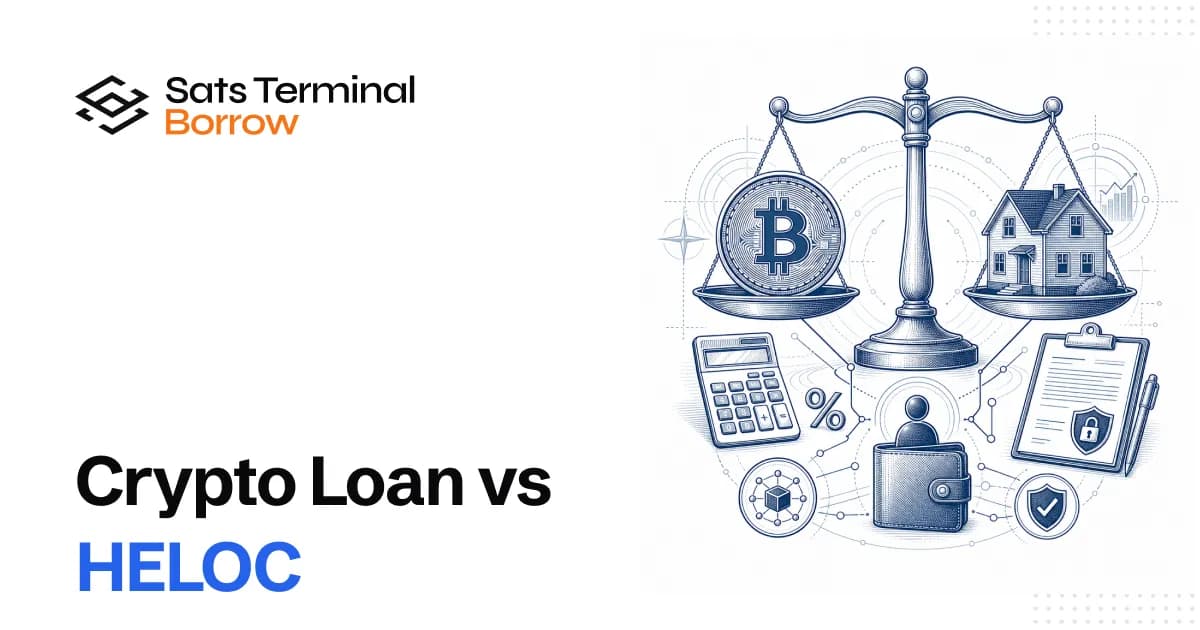
If you own a home and hold Bitcoin, you sit on two of the most powerful collateral assets in modern finance — and a real decision when you need cash. The crypto loan vs HELOC question is not academic for asset-rich borrowers: tap a home equity line of credit and you are putting a bank lien on the roof over your head, secured by a property that took years to build equity in. Borrow against Bitcoin instead and you keep your house untouched, get funded in hours, and skip the credit check — but you accept liquidation risk if BTC drops. This guide is a head-to-head comparison built for the homeowner who also owns crypto: how each product actually works, what is genuinely at stake, the tax angles that quietly change the math, and a worked $80,000 example so you can see which path fits your situation. It is not a platform review and it is not financial advice — terms change constantly, so treat every number here as a starting point you must verify against live offers.
Both a HELOC and a crypto-backed loan let you turn an asset you do not want to sell into spendable cash. They get there in fundamentally different ways, and the differences matter more than the headline interest rate.
A home equity line of credit (HELOC) is a revolving credit line issued by a bank or credit union, secured by your home. It works like a credit card backed by your house: the lender approves a maximum draw amount, and during a draw period — typically five to ten years — you borrow, repay, and re-borrow as needed, paying interest only on what you have drawn. After the draw period ends, you enter a repayment period (commonly up to 20 years) where the balance amortizes and you can no longer pull new funds.
Three structural facts define a HELOC and shape every comparison below:
A crypto-backed loan — the kind you find through a marketplace like Borrow by Sats Terminal — lets you post Bitcoin (or another supported asset) as collateral and borrow stablecoins or dollars against it. There is no credit check because the loan is fully secured by, and usually over-collateralized by, your crypto. The lender — whether a DeFi protocol like Aave or Morpho, or a CeFi desk — holds or locks your BTC and releases it when you repay. Funding happens in minutes to hours rather than weeks.
The structural facts that define a crypto loan are the mirror image of a HELOC:
The clearest way to frame the choice: a HELOC bets your house on your ability to keep paying; a crypto loan bets your Bitcoin on price not crashing past your liquidation point. One failure mode is slow and personal; the other is fast and mechanical. Pick the risk you can actually manage.
Here is the comparison that matters, with current early-2026 figures. Treat all rates and ratios as typical ranges, not guarantees — they vary by lender, region, market conditions, and your specific profile.
| Feature | HELOC (home equity line) | Crypto-backed loan (BTC collateral) |
|---|---|---|
| Approval speed | ~2–6 weeks at banks; ~5 days at digital-first lenders | Minutes to a few hours |
| Credit check | Yes — hard pull, income & debt verification | No — collateral-based only |
| Typical interest rate (early 2026) | ~7%–9% variable APR (prime + margin) | ~9%–16% APR (CeFi/DeFi; variable or fixed) |
| Max borrowing limit | Up to ~80%–85% combined LTV of home value (some 90%+) | ~50%–70% LTV of crypto value (some up to ~80%) |
| Upfront fees / closing costs | 0%–5% of line (appraisal, title, recording); some lenders waive | Often near zero (gas/origination); no appraisal or title |
| Term | Draw 5–10 yrs, then repay up to ~20 yrs | Often open-ended / no fixed maturity |
| What is at stake on default | Your home — foreclosure (second lien) | Your Bitcoin — automated liquidation |
| Speed of the failure mode | Slow: missed payments, notices, months-long process | Fast: oracle-driven, can trigger in minutes |
| Interest tax-deductible? | Sometimes — only if used to buy/build/improve the home, if you itemize | Generally no for personal use; possibly if investment/business use |
| Privacy / KYC | Heavy disclosure; reported to credit bureaus | Light to none (DeFi); varies (CeFi). Not on your credit report |
Two patterns jump out. First, the HELOC usually wins on headline rate and maximum LTV — banks will lend you more, more cheaply, against a house than a protocol will against volatile BTC. Second, the crypto loan crushes the HELOC on speed, privacy, and the absence of a credit check, and it never touches your home. The right answer depends entirely on which of those axes matters most for your specific need.
A 7.5% HELOC looks obviously cheaper than an 11% crypto loan. But the all-in cost depends on fees, how long you borrow, and rate movement.
HELOC variable interest rates track prime, so the 7%–9% you sign up for can drift higher mid-loan. Closing costs can reach up to ~5% of the credit line at some lenders (appraisal, title search, recording, lender fees), though large banks and credit unions increasingly waive them. There may also be annual fees and inactivity fees. Crucially, a HELOC's repayment-period payment shock is real: when the draw period ends, interest-only payments convert to amortizing principal-plus-interest, and the monthly bill can jump sharply.
Crypto loans typically carry higher nominal rates — roughly 9% to 16% APR in early 2026 depending on whether you go CeFi or DeFi, your LTV, and the size of the loan (bigger loans often get better pricing). But there is no appraisal, no title insurance, no multi-week origination, and frequently near-zero upfront cost beyond network/origination fees. For a short-hold need — a few months of bridge financing — a crypto loan's speed and zero closing costs can make it cheaper in absolute dollars even at a higher APR, because you are not amortizing thousands of dollars in closing costs over a tiny borrowing window. Our guide on how crypto lending rates are determined breaks down what drives that 9%–16% spread.
Rule of thumb: The longer you will hold the debt, the more the HELOC's lower rate matters and the more its closing costs amortize away. The shorter the hold, the more the crypto loan's zero-friction speed wins. Roughly: under a year, lean crypto; multiple years, the math often tilts HELOC — assuming you are comfortable putting your house on the line.
Loan-to-value is the single most important number in both products, but it means different things on each side.
Banks size a HELOC using your combined loan-to-value (CLTV) — your first mortgage plus the new HELOC, divided by the appraised home value. Most lenders cap CLTV at 80%–85%, with some stretching to 90% or more for strong borrowers. So if your home appraises at $600,000 and you owe $360,000 on the first mortgage, an 85% CLTV cap means total debt up to $510,000, leaving roughly $150,000 of HELOC headroom. The more equity you have built, the larger the line.
Crypto LTV is the loan divided by the live market value of your BTC. Because Bitcoin can swing 10%–20% in a day, lenders cap LTV far lower — typically 50%–70%, with conservative DeFi markets near 50% and some aggressive products allowing up to ~80%. A 50% LTV means you must post $2 of BTC for every $1 you borrow. That over-collateralization is your liquidation buffer: the gap between your starting LTV and the protocol's liquidation threshold is what keeps a normal dip from wiping out your position. Our piece on optimizing your LTV ratio covers how to pick a safe target.
Counterintuitive but important: a HELOC lets you borrow a higher percentage of your asset's value than a crypto loan — because a house does not gap down 15% overnight. The lower crypto LTV is not the lender being stingy; it is the price of holding volatile collateral. The trade is more conservative leverage in exchange for instant, no-questions access.
This is where asset-rich borrowers need to think hardest. The two products do not just have different rates — they have completely different failure modes.
If you cannot make HELOC payments, the consequence is foreclosure — you can lose your home. Because a HELOC is a second lien, the bank's recovery is subordinate to your first mortgage, but it can still force a sale. The process is slow (missed payments, default notices, a months-long legal process), which gives you time to cure, refinance, or sell on your own terms. The risk is driven by your cash flow: lose income and the danger rises. Rising rates compound it, since a variable-rate payment can climb just as your budget tightens.
If BTC falls and your LTV crosses the liquidation threshold, the position is liquidated automatically. On DeFi protocols an oracle reports the price, and once your LTV exceeds the liquidation LTV, any liquidator can repay your debt and seize collateral plus a liquidation bonus — typically a 5%–15% discount to the liquidator that comes out of your pocket. There is no grace period, no phone call, no underwriting officer to negotiate with. The risk is driven by price, not your income: you could be perfectly able to pay and still get liquidated by a sharp market drop while you sleep. The flip side is that the damage is contained to your collateral — your home, your other accounts, and your credit score are never touched. To understand the trigger math, see how to calculate your liquidation price, and to reduce the danger, our guide on managing liquidation risk.
| Risk dimension | HELOC | Crypto-backed loan |
|---|---|---|
| Trigger | Inability to make payments (cash flow) | Collateral price falling past liquidation LTV |
| Speed | Slow — months of process, time to cure | Fast — automated, can happen in minutes |
| Worst case | Lose your home; credit damage | Lose your posted BTC at a discount |
| Spillover | Reported to credit bureaus; affects future borrowing | Contained to collateral; no credit impact |
| Your control lever | Income stability, refinancing, selling on your terms | Lower LTV, add collateral, repay early |
One subtle point: a HELOC's danger correlates with the broader economy — job loss and rising rates often arrive together in a downturn. A crypto loan's danger correlates with Bitcoin's price, which can move independently of your personal finances. Diversifying which risk you take on can itself be a reason to choose one over the other.
Neither borrowing against your home nor borrowing against your Bitcoin is a taxable event in itself — you are not selling, so you do not trigger capital gains. (That is the entire appeal of borrowing instead of selling appreciated BTC; we cover it in depth in crypto loan taxes 2026.) The difference shows up in whether the interest you pay is deductible. None of the following is tax advice — confirm with a professional and check current IRS guidance.
Under rules made effectively permanent for 2026, HELOC interest is deductible only if you use the funds to buy, build, or substantially improve the home that secures the loan, you itemize on Schedule A, and your total home-acquisition debt stays under the $750,000 cap ($375,000 if married filing separately). Use a HELOC for a kitchen remodel and the interest may be deductible; use it for a car, tuition, or debt consolidation and it is not. Because most taxpayers take the standard deduction, many HELOC borrowers get no deduction at all in practice — the benefit is real but narrower than people assume.
Interest on a crypto-backed loan used for personal spending is generally not deductible. But if you use the proceeds for investment purposes, the interest may qualify as investment interest expense (limited to your net investment income and claimed on Form 4952), and if you use them for a genuine trade or business, the interest may be deductible as a business expense. The deciding factor is use of proceeds, and you need clean records tracing where every dollar went. Our overview of tax implications of crypto borrowing goes deeper.
| Use of funds | HELOC interest deductible? | Crypto loan interest deductible? |
|---|---|---|
| Improve the home securing the loan | Yes (if you itemize, under cap) | No (not home-secured) |
| Investment (buy more assets) | No | Possibly (investment interest, limited) |
| Business / self-employment | No | Possibly (business expense) |
| Personal spending (car, vacation, bills) | No | No |
The practical takeaway: if your reason for borrowing is a home improvement, the HELOC has a potential tax edge that can narrow its effective cost. If your reason is investing or funding a business, the crypto loan can have the deduction advantage. Match the product to the purpose and the after-tax math sometimes flips the headline-rate comparison.
The smartest framing for an asset-rich borrower is often not "which is better" but "which asset do I want to keep untouched, and why."
There is also a third, hybrid mindset many holders adopt: use a crypto loan specifically to avoid touching home equity, preserving the house as untapped reserve capacity for a future emergency or a better-priced first mortgage — or vice versa, using a HELOC to avoid liquidation risk on a BTC stack you are deeply committed to holding. Neither asset has to be sacrificed; the question is which one you would rather encumber. For the broader strategy of living on borrowed dollars instead of selling, see how to live off your Bitcoin without selling it.
Let us make this concrete. Assume you need $80,000 — say, to fund a home addition. You own a home worth $600,000 with a $360,000 first mortgage (so $240,000 of equity), and you also hold 3 BTC. We will use a Bitcoin price of about $100,000 for illustration; real prices move constantly, so treat this as a model, not a forecast.
For this specific need — a multi-year home improvement — the HELOC is cheaper (lower rate, possible deduction) and aligns the borrowing with the asset, at the cost of a second lien on your home and weeks of waiting. The crypto loan costs more in interest and offers no deduction here, but it is instant, touches no home equity, and at a 27% LTV carries a huge buffer before any liquidation risk. If instead the $80,000 were needed tomorrow, or to seed an investment, or by a borrower who could not document income, the crypto loan would pull ahead decisively. The asset you choose to encumber — and the time you have — drives the answer more than the rate.
Buffer beats bravado. In the crypto path above, the borrower could have drawn the full 50%+ LTV and borrowed far more cheaply per dollar of collateral — but chose a low 27% LTV to survive a brutal drawdown. Borrowing less than the maximum is the single most reliable way to keep a crypto loan from becoming a liquidation. The same discipline applies to a HELOC: just because the bank approves $150,000 does not mean you should draw it.
Beyond rate and LTV, a few practical realities separate these products in ways that surprise first-time borrowers.
If your real goal is buying property without selling BTC, note that a third path exists entirely: a Bitcoin-collateralized mortgage. We cover that distinct product in Bitcoin-backed mortgages, and the credit-line mechanics of borrowing against BTC in how a crypto-backed credit line works.
One reason the crypto side of this comparison has improved so much by 2026 is competition. CeFi desks, Aave, and Morpho all price BTC-backed borrowing differently, and the spread between the best and worst offer for the same loan can be several percentage points. Rather than accept the first quote, asset-rich borrowers increasingly shop crypto loan offers the same way they would shop a HELOC across banks. A crypto lending aggregator compares live offers across protocols in one place, which is exactly how Borrow by Sats Terminal narrows the rate gap that historically made crypto loans look uncompetitive against home equity. If you want the conceptual background first, our learn module on getting cash without selling Bitcoin sets the stage.
Strip away the detail and the choice between a bitcoin loan vs home equity comes down to four questions:
For many homeowners who also hold Bitcoin, the most sophisticated move is to keep both options on the table and deploy whichever encumbers the asset they care about least for the specific job. The heloc vs crypto loan decision is rarely permanent — you can repay a crypto loan whenever you like and keep your HELOC as untapped backup, or vice versa. What you should never do is max out either line. This is general information, not financial, legal, or tax advice; rates, LTV caps, and tax rules change, so verify every figure against current offers and a qualified professional before you borrow.
Common Questions
A HELOC usually has a lower headline rate — roughly 7%–9% variable in early 2026 versus 9%–16% for crypto loans — and may carry deductible interest if used on the home. But HELOCs add closing costs (up to ~5%) and weeks of delay. For short holds, a crypto loan's zero-friction, no-closing-cost structure can be cheaper in absolute dollars even at a higher APR. The longer you borrow, the more the HELOC's lower rate matters.
No. A crypto-backed loan is secured only by the Bitcoin (or other crypto) you post as collateral. Your home, bank accounts, and other assets are never at risk, and the loan does not appear on your credit report. The trade-off is that your collateral can be liquidated quickly if Bitcoin's price falls past your liquidation threshold — but that damage is contained entirely to the crypto you pledged.
Neither borrowing against your home equity nor borrowing against your Bitcoin is a taxable event on its own, because you are not selling the asset, so no capital gains are triggered. The tax difference is whether the interest is deductible: HELOC interest can be deductible if used to improve the home, while crypto loan interest is generally non-deductible unless the funds serve an investment or business purpose. Confirm specifics with a tax professional.
Because a house is far less volatile than Bitcoin. HELOCs allow up to ~80%–85% combined LTV (sometimes higher) since home values rarely drop sharply overnight. Crypto loans cap LTV around 50%–70% to leave a buffer against Bitcoin's daily swings. The lower crypto LTV is not the lender being stingy — it is the price of holding liquid, fast-moving collateral that could otherwise fall below the loan value in a crash.
A crypto-backed loan typically funds in minutes to a few hours because there is no credit check, appraisal, or manual underwriting — only your collateral and LTV matter. A traditional HELOC takes about two to six weeks at banks due to appraisal and underwriting, though digital-first lenders using automated valuations can fund in roughly five days. If you need cash urgently, the crypto loan is the clear speed winner.
No. Crypto loans are collateral-based and require no credit check, no income verification, and no appraisal — your Bitcoin secures the loan, so your credit score is irrelevant. A HELOC requires a hard credit pull, income and debt verification, and a property appraisal. This makes crypto loans accessible to self-employed, thin-file, or privacy-focused borrowers who might struggle to qualify for a bank's home equity line.
Yes, and many homeowners do exactly that. Borrowing against Bitcoin keeps your home lien-free, preserves your equity as untapped reserve capacity, and avoids adding a second mortgage that would raise your debt-to-income for a future home purchase. The cost is a higher interest rate and liquidation risk on the BTC you pledge. It is a deliberate choice about which asset you would rather encumber for a given need.
If Bitcoin's price falls and your loan-to-value ratio rises past the liquidation threshold, the position is liquidated automatically — collateral is sold to repay the debt, usually at a 5%–15% discount to the liquidator. There is no grace period as with a HELOC. You can prevent this by borrowing at a low LTV, adding collateral, or repaying early. Keeping a large buffer is the most reliable defense against a sudden drawdown. For asset-rich borrowers, the real win is optionality: a homeowner who also holds Bitcoin can choose, loan by loan, which asset to encumber and which to protect. A HELOC leans on your house and rewards patience and home-related spending; a crypto loan leans on your BTC and rewards speed, privacy, and keeping your home untouched. Neither is universally better — the smart move is matching the product to the purpose, borrowing well below the maximum, and watching the failure mode you have chosen to take on. When you want to see how competitive a Bitcoin-backed loan actually is against your HELOC option, Borrow by Sats Terminal aggregates live BTC-backed loan offers across DeFi protocols and CeFi lenders in one place, so you can compare the real number before deciding which asset to put to work.