

How a bitcoin line of credit works in 2026: draw and repay against BTC, pay interest only on what you use, plus how it compares to a HELOC and a term loan.
 Arkadii Kaminskyi
Arkadii Kaminskyi
Head of Operations at Sats Terminal
Head of Operations at Sats Terminal with 5 years of experience in crypto. Specializes in DeFi, yield farming, and borrowing — has reviewed 50+ crypto products.
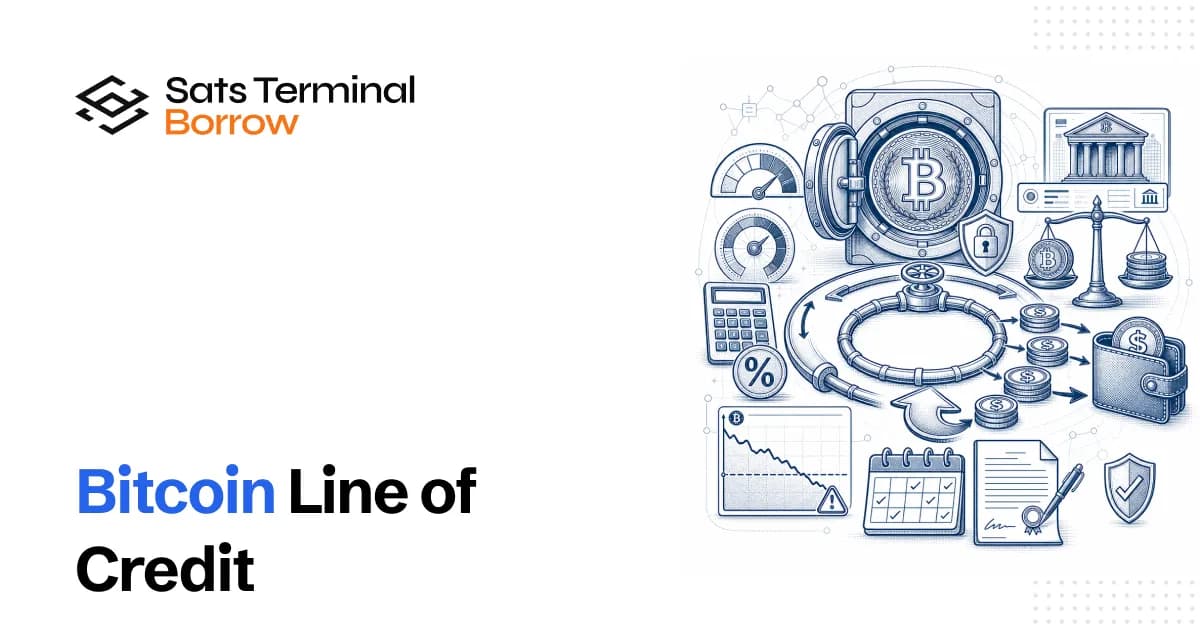
If you have ever held a credit card or a home equity line of credit, you already understand the core appeal of a bitcoin line of credit: instead of taking out one big lump-sum loan and paying interest on the whole thing, you set up a borrowing ceiling backed by your BTC, then draw cash only when you need it, pay interest only on what you have actually drawn, and repay and redraw as many times as you like. There is no fixed installment, no maturity date forcing you to refinance, and no taxable sale of your bitcoin. By 2026, both centralized lenders and DeFi protocols have made this revolving model a mainstream alternative to the rigid, fixed-term bitcoin loan most people picture when they hear "crypto loan." This guide unpacks exactly how a crypto-backed credit line works mechanically, how it differs from a term loan and a HELOC, who offers it, how it is priced, and where the real risks hide.
We are going to stay tightly focused on the revolving model. If you want the broader basics of borrowing against BTC, the companion piece on how to borrow money against bitcoin without selling your BTC covers the fundamentals, and the explainer on bitcoin-collateral stablecoin loans goes deep on borrowing USDC or USDT specifically. Here, the whole point is the line-of-credit structure.
Most bitcoin lending products fall into one of two shapes, and confusing them is the single most common mistake new borrowers make. A term loan hands you a lump sum on day one and starts charging interest on the full principal immediately. You repay it over a fixed schedule — often 12 months — and when it matures you either pay it off or refinance into a new loan, which usually means re-originating, re-pledging collateral, and possibly paying fees again.
A revolving line of credit works differently. You post collateral once, the lender assigns you a credit limit based on your loan-to-value ceiling, and that limit just sits there available to you. You only start paying interest the moment you draw funds, and only on the drawn balance. Repay part of the balance and your available credit refills automatically — no new application, no re-origination. This is the "draw and repay" mechanic, and it is what makes a line of credit so flexible for irregular cash needs.
Here is the distinction laid out side by side:
| Feature | Fixed-Term BTC Loan | BTC Line of Credit (Revolving) |
|---|---|---|
| Disbursement | Full lump sum on day one | Draw any amount up to your limit, when you want |
| Interest charged on | Entire principal from origination | Only the drawn (outstanding) balance |
| Maturity | Fixed (often 12 months), then refinance | Open-ended; no principal maturity date |
| Redraw after repaying | Requires a brand-new loan | Automatic — credit replenishes |
| Best for | A single, known, one-time expense | Recurring, uncertain, or staggered cash needs |
| Idle cost | You pay interest even on cash you don't need yet | An undrawn line typically costs nothing |
That last row is the underrated advantage. With a term loan, if you borrow $50,000 but only need $20,000 right now, you are paying interest on the other $30,000 while it sits in your account. With a revolving crypto loan, the unused $30,000 of your limit costs you nothing until you draw it. You are paying for access, not for idle capital.
Rule of thumb: if you know the exact amount you need and you need it all at once, a term loan may price better. If the amount or timing is uncertain — or you expect to repay and re-borrow over months — an open-term bitcoin loan structured as a line of credit almost always wins on total interest paid.
Mechanically, a crypto line of credit follows the same skeleton across both CeFi and DeFi, even though the custody and rate models differ. Here is the full lifecycle.
The critical phrase is "interest only on the drawn balance." This is what separates a genuine line of credit from a term loan dressed up in flexible-repayment language. Always confirm a product charges interest on the outstanding balance, not on your full approved limit.
Here is something many borrowers miss: a standard borrowing position on Aave or Morpho already behaves like a perpetual, open-ended line of credit — it just is not marketed with that label. There is no maturity date, no fixed installment schedule, and you can repay and re-borrow against the same collateral as often as you want, paying interest only on your outstanding debt. That is the textbook definition of a revolving line.
Aave v3. When you supply wrapped BTC as collateral on Aave, you can borrow stablecoins up to your collateral's borrowing power, and the position simply stays open. There is no due date. You repay whenever you choose, and your available borrowing power refills as you repay or as your collateral appreciates. The catch is the rate: Aave uses a variable interest rate tied to the pool's utilization rate. As of early 2026, USDC borrow rates on Aave have typically sat in a roughly 2%–8% band during normal conditions but can spike sharply when a pool is heavily utilized. To learn the mechanics in detail, the step-by-step Aave v3 borrowing guide walks through the full flow.
Morpho Blue. Morpho takes the isolated-market approach: each market pairs one collateral asset with one loan asset under an immutable liquidation LTV (LLTV) and its own interest-rate model. Your borrow position is, again, open-ended and revolving. Notably, by 2026 a meaningful share of Morpho borrowers — roughly 30% as of spring 2026 according to protocol data — opt into a "pre-liquidation" contract that triggers a gentler partial liquidation at a tighter LTV in exchange for a smaller penalty. For a deeper dive, see the complete Morpho Blue guide and the official Morpho documentation.
What is striking in 2026 is how many "CeFi" credit lines are actually DeFi underneath. Coinbase's bitcoin-backed loans, for instance, route through Morpho: your BTC is converted 1:1 into cbBTC, deposited to a Morpho smart contract, and USDC is disbursed to your Coinbase account. You can draw up to a 75% LTV, with liquidation at an 86% LLTV, and reported USDC rates have been around 6% — competitive precisely because the rails are on-chain. The Morpho guide and the broader comparison in comparing Aave, Morpho, and CeFi explain how these layers fit together.
Tip: If you are comfortable with a non-custodial DeFi position and self-custody, an Aave or Morpho borrow is arguably the purest perpetual line of credit available — no application, no underwriting beyond your collateral, and you control the keys. The trade-off is variable rates and the responsibility of managing liquidation risk yourself. Read up on self-custody before going this route.
On the centralized side, several lenders now offer products that are genuinely revolving, and several others market "flexible" loans that are really fixed-term underneath. The distinction matters, so here is where the major players stood as of early-to-mid 2026. Treat every number below as a hedged snapshot — rates, LTV ceilings, and minimums change frequently, so always verify current terms on the provider's own site before committing.
| Provider | True revolving line? | Typical APR (2026) | Max LTV | Custody model | Notable limit |
|---|---|---|---|---|---|
| Strike | Yes — no maturity on principal | ~7.49%–10.5% | Varies; margin-call based | Custodial (qualified custodians) | Line up to ~$250k; draw from $1 |
| Nexo | Yes — credit line, no fixed schedule | ~1.9%–18.9% by tier/LTV | ~50% on BTC | Custodial | $50 min stablecoin draw |
| Figure | Partly — Prime line up to 75% LTV; BTC HELOC has a draw period | ~9%–10% at 50% LTV | Up to ~75% (Prime) | Custodial / escrow | Portfolio-wide borrowing power |
| Coinbase (via Morpho) | Yes — open-ended on-chain position | ~6% USDC | Up to 75% draw, 86% liquidation | On-chain (cbBTC in smart contract) | Up to $5M against BTC |
| Ledn | No — fixed 12-month term | ~9.25%–11.9% | ~50% | Custodial | Tiered rates by size |
| Unchained | No — fixed 3–60 month terms | ~14%–16.2% | ~40%–50% | Collaborative custody (2-of-3 multisig) | ~$150k minimum |
| SALT | Mostly fixed-term (6–36 months) | ~8.95%–18.87% | 30% / 50% / 70% | Custodial | Interest-only payment option |
A few of these deserve a closer look because they illustrate distinct flavors of the line-of-credit model.
Strike's bitcoin-backed line of credit is about as close to a textbook revolving line as CeFi gets. You establish a credit line backed by your bitcoin, then draw and repay cash as many times as you want with no maturity date on the principal. You can draw as little as $1 at a time, you pay interest only on what you have drawn, and the APR is flat (it may be re-set quarterly). As of 2026, pricing has ranged from roughly 10.5% APR for smaller lines down toward 7.49% for very large balances, with a line maximum around $250,000 and state-specific minimums. Strike also offers a separate fixed-term loan for borrowers who want a lump sum repaid over 12 months — a clean illustration of the two models living side by side at one provider.
Nexo's product is structured as an instant credit line: you borrow against BTC, ETH, and other assets with no fixed repayment schedule, paying interest only on the amount you draw. Its headline feature — and its catch — is loyalty-tier pricing. Rates can dip as low as the low single digits for top-tier users with very low LTV, but base-tier users at higher LTV can pay close to 18.9%. BTC typically carries around a 50% LTV ceiling, the minimum stablecoin draw is small (around $50), and there are no fixed installments — though that means interest compounds into your balance and quietly pushes your LTV upward if you never pay it down. If you are weighing Nexo specifically, the dedicated Nexo review for 2026 goes through the safety and rate details.
Figure is interesting because it bridges crypto and traditional home lending. Its crypto-backed loan lets you borrow USD or stablecoins against BTC, ETH, or SOL, with starting rates around 9%–10% at 50% LTV, and its "Democratized Prime" tier extends borrowing power up to roughly 75% LTV across an entire crypto portfolio with no term limits. Separately, Figure has pushed into bitcoin-backed HELOCs and a true line-of-credit structure with a multi-year draw period — conceptually the closest thing in the market to "a HELOC, but for your bitcoin." That makes the HELOC comparison below more than just an analogy.
Unchained is the outlier worth understanding precisely because it is not a revolving line — its loans run fixed 3-to-60-month terms — yet it is the platform many security-minded bitcoiners prefer. The reason is its 2-of-3 collaborative-custody multisig: you hold one key, Unchained holds one, and a backup keyholder holds the third, so the lender physically cannot move or rehypothecate your collateral unilaterally. That security comes at a price — rates around 14%–16.2% and a high minimum (about $150,000). It is a reminder that "best line of credit" depends heavily on what you are optimizing for: flexibility, rate, or custody.
Pricing a revolving line is more nuanced than pricing a term loan, because the lender is committing to keep credit available even when you are not using it. Three pricing models dominate in 2026.
Because rate structures differ so much, comparing a single headline APR across providers is misleading. A "1.9% from" rate that only applies to a maxed-out loyalty tier at minimal LTV is not the rate most people get. The honest way to compare is to model your expected draw amount, LTV, and holding period — which is exactly what a rate-comparison aggregator is built to do. For the fixed-vs-variable trade-off in depth, read variable vs. fixed interest rates.
Warning: On no-fixed-schedule credit lines, unpaid interest typically capitalizes — it gets added to your outstanding balance. That quietly raises your LTV over time even if BTC's price is flat. A line that "requires no payments" is not a line that costs nothing; it is a line whose cost compounds silently. Pay down accrued interest periodically to keep your health factor from drifting toward the liquidation zone.
The liquidation mechanics of a line of credit are the same as any over-collateralized crypto loan, but the revolving structure adds a wrinkle: because your limit and your drawn balance move independently, you have to watch two numbers, not one.
Your credit limit is set by your maximum borrowing LTV against your collateral's current value. Your current LTV is your drawn balance divided by collateral value. As long as your drawn balance stays well below the limit, and your current LTV stays comfortably under the liquidation threshold, you are healthy. Trouble comes when BTC falls: collateral value drops, which (a) shrinks your available credit and (b) pushes your current LTV up toward the liquidation line.
Liquidation thresholds vary by platform. On Coinbase's Morpho-based product, the liquidation LLTV sits at 86%. Ledn liquidates around 80% LTV. Many CeFi lenders issue a margin call first, giving you a window to add collateral or repay before forced liquidation. DeFi protocols generally do not call you — liquidation is automatic and permissionless the instant your position crosses the threshold. To manage this proactively, see managing liquidation risk and optimizing your LTV ratio.
Let us walk through a realistic scenario. Assume BTC trades at $100,000 (prices move; this is just a reference point for the math). You post 2 BTC = $200,000 of collateral on a platform that allows a 50% maximum borrowing LTV with a liquidation threshold of 70%.
The lesson: drawing less of your available line is not "leaving money on the table" — it is buying a larger liquidation buffer for free. The companion glossary entry on liquidation and the article on how LTV ratios affect your position expand on this trade-off.
The closest traditional-finance analogue to a btc backed line of credit is a home equity line of credit. The structural parallels are real — both are revolving, secured, draw-and-repay facilities — but the differences are where it gets interesting.
| Dimension | HELOC (home equity) | Bitcoin Line of Credit |
|---|---|---|
| Collateral | Your home's equity | Your BTC |
| Structure | Revolving: draw period (5–10 yrs) then repayment period (often ~20 yrs) | Revolving, frequently open-ended with no separate repayment period |
| Underwriting | Credit score, income, appraisal, debt-to-income | Collateral only — no credit check, no income docs |
| Speed to fund | Weeks (appraisal, closing) | Minutes to a few days |
| Collateral volatility | Slow-moving home prices | Highly volatile; daily swings can trigger liquidation |
| Forced sale risk | Foreclosure (slow, legal process) | Automatic liquidation (fast, often no grace period in DeFi) |
| Rate type | Usually variable, tied to prime rate | Variable, flat-resetting, or tiered depending on provider |
| What you can lose | Your house | Your bitcoin |
Two contrasts dominate. First, speed and underwriting: a HELOC is a slow, paperwork-heavy product gated on your credit and income; a bitcoin line is fast and gated only on collateral. Second, collateral volatility: a home's value rarely drops 30% in a week, but bitcoin can. The HELOC's biggest risk — foreclosure — unfolds over months with legal protections. The bitcoin line's biggest risk — liquidation — can happen in minutes, sometimes with no human in the loop. That speed cuts both ways: you get money fast, but you can lose collateral fast too.
The Figure-style bitcoin HELOC blurs this line further, importing the HELOC's draw-period structure onto crypto collateral. If that model matures, the comparison will get even more direct. For the real-estate angle specifically, see the companion post on bitcoin-backed mortgages.
A revolving line is not strictly better than a term loan — it is a different tool. Here is an honest accounting.
The line-of-credit model is purpose-built for situations where a term loan would be clumsy. Some of the strongest fits in 2026:
For more on extracting cash without selling, the foundational guide on getting cash without selling bitcoin pairs well with this article.
A line of credit's flexibility can mask its dangers. Be clear-eyed about these.
Rule of thumb: size your draw so you could survive a 50% bitcoin drawdown without being liquidated. With a 70% liquidation threshold, that roughly means keeping your drawn LTV near or below 35% in calm markets. The undrawn portion of your line is your friend — leaving it untouched is what keeps you solvent through a crash.
With so many products labeled "credit line," "flexible loan," and "open-term," pick based on what actually matters to you:
Because the "best" answer depends on your numbers, the smartest first move is to compare live offers across protocols and lenders rather than anchoring on one platform's marketing rate. That is the entire reason a rate-comparison aggregator exists. The FAQ on what bitcoin-backed loans are and the guide to comparing DeFi vs. CeFi lending are good next reads.
Common Questions
A bitcoin line of credit is a revolving loan secured by your BTC. You post bitcoin as collateral, the lender sets a credit limit based on your loan-to-value ceiling, and you draw cash or stablecoins as needed. You pay interest only on the amount drawn, can repay and redraw freely, and there is typically no fixed maturity date — making it function much like a HELOC, but backed by bitcoin instead of home equity.
A regular bitcoin loan is usually a fixed-term loan: you get a lump sum up front, pay interest on the full principal, and repay on a set schedule. A crypto line of credit is revolving: you draw only what you need, pay interest only on the drawn balance, and redraw after repaying without a new application. The line stays open with no maturity date, whereas a term loan must be repaid or refinanced when it matures.
On a genuine line of credit, you pay interest only on your drawn (outstanding) balance, not your full approved limit. The undrawn portion typically costs nothing until you use it. This is the core advantage over a term loan. Always confirm a product charges interest on the outstanding balance — some loans marketed as "flexible" still charge interest on the full principal from day one.
As of 2026, Strike, Nexo, Coinbase (via Morpho), and Figure's Prime tier offer genuine revolving draw-and-repay structures. DeFi positions on Aave and Morpho also behave as perpetual, open-ended credit lines. By contrast, Ledn, Unchained, and most SALT products are fixed-term loans rather than revolving lines. Terms change often, so verify the current structure and rate directly with each provider before borrowing.
Yes. If bitcoin's price falls enough that your loan-to-value crosses the platform's liquidation threshold, your collateral can be sold to repay the debt — often automatically and quickly, especially in DeFi. Drawing only a small portion of your available line gives you a larger safety buffer. Many CeFi lenders issue a margin call first, but DeFi protocols generally liquidate the instant your position becomes unhealthy.
Generally, borrowing against your bitcoin is not itself a sale, so drawing on a line typically does not trigger capital-gains tax the way selling BTC would. However, tax treatment varies by jurisdiction and situation, and edge cases exist — for example, a forced liquidation of collateral is a disposal. This is not tax advice. Review the dedicated guide on crypto loan taxes and consult a qualified professional about your circumstances.
A conservative approach keeps your drawn LTV low enough to survive a major bitcoin drawdown. If your liquidation threshold is around 70%, keeping drawn LTV near or below 35% in calm markets roughly means you could withstand a 50% price drop before liquidation risk. Lower LTV means a larger buffer and often a better rate. The undrawn portion of your line is effectively free insurance — leaving it untouched protects you in a crash.
Functionally, yes. A borrow position on Aave or Morpho has no maturity date, lets you repay and re-borrow against the same collateral freely, and charges interest only on your outstanding debt — the defining traits of a revolving line. The differences are that DeFi rates are variable and utilization-driven, liquidation is automatic and permissionless, and you typically self-custody, so you manage the risk yourself rather than relying on a lender's margin-call process. A bitcoin line of credit turns your BTC into standing, reusable liquidity rather than a one-time loan — you pay for access, not idle capital, and you keep your bitcoin and its upside. But that flexibility demands discipline: variable rates can rise, interest can capitalize silently, and liquidation can arrive fast. The honest move before you open any line is to compare your specific draw size, LTV, and holding period across both DeFi protocols and CeFi lenders, because the "best" rate is entirely situational. That is exactly what Borrow by Sats Terminal is built for — aggregating live BTC-backed loan offers across Aave, Morpho, and major lenders so you can see your real, personalized terms in one place rather than trusting any single platform's headline rate.