

A 2026 guide to bitcoin mortgages: buy real estate without selling your BTC via crypto mortgage lenders like Milo, or BTC-backed down-payment loans.
 Arkadii Kaminskyi
Arkadii Kaminskyi
Head of Operations at Sats Terminal
Head of Operations at Sats Terminal with 5 years of experience in crypto. Specializes in DeFi, yield farming, and borrowing — has reviewed 50+ crypto products.
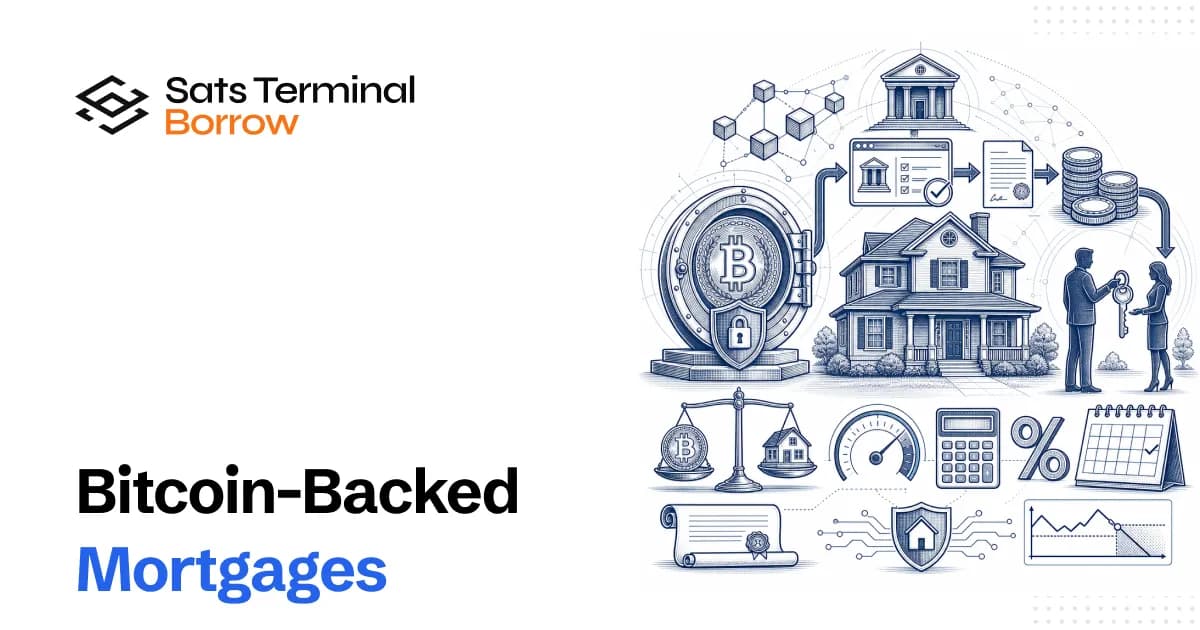
For years, the cruel irony of being a long-term Bitcoin holder was that you could be sitting on a small fortune and still struggle to buy a house. Sell your coins for a down payment and you trigger a capital gains bill plus the permanent loss of an asset you believe will keep appreciating. Keep your coins and your wealth stays trapped, invisible to a mortgage underwriter who only speaks the language of W-2s and bank statements. A bitcoin mortgage is the financial product designed to break that deadlock: it lets you put your BTC to work as collateral or as qualifying assets so you can buy real estate without selling a single satoshi. In 2026, this is no longer a fringe experiment. Dedicated crypto-mortgage lenders have originated hundreds of millions in loans, and a March 2026 partnership between Better and Coinbase put the first crypto-backed conforming mortgage onto Fannie Mae rails. This guide walks through the two practical paths to property using your Bitcoin, the honest risks of pledging a volatile asset against a home, and exactly who should and should not do it.
One thing up front: this article is educational, not financial, tax, or legal advice. The terms, rates, and regulatory rules described here move fast, and the specific numbers we cite should be treated as illustrative ranges as of early-to-mid 2026. Always confirm current terms directly with the lender and run your own situation past a qualified mortgage broker and tax professional before you act.
When people say "buy a house with bitcoin," they usually imagine handing a seller a wallet address. That almost never happens, and it is rarely the smart move even when it can. The interesting strategies keep your BTC and turn it into purchasing power indirectly. There are two fundamentally different mechanisms, and confusing them is the single most common mistake first-time crypto borrowers make.
Path A wraps everything into one product and can get you to closing with the smallest amount of cash out of pocket. Path B is more flexible, often cheaper to enter, and keeps your real estate financing and your crypto financing in separate boxes — which can be a feature, not a bug. We will dig into each, then put them side by side. If you are still fuzzy on the underlying mechanics of pledging coins for cash, the primer on how bitcoin-backed loans work is worth ten minutes before you go further.
Rule of thumb: a crypto mortgage (Path A) finances the home and is secured against the home and/or your crypto. A crypto loan (Path B) finances cash and is secured only against your crypto. Don't conflate them — the liquidation consequences are very different, and only one of them puts your house directly in the chain of collateral.
This is the category most people picture when they hear "bitcoin backed mortgage." A handful of lenders have built underwriting, custody, and servicing specifically for borrowers whose net worth lives on-chain. The headline appeal is that you can finance a property without liquidating your stack — and in some structures, without bringing a traditional cash down payment at all.
Miami-based Milo is the lender that effectively created this category, and as of 2026 it has surpassed $100 million in total crypto-mortgage originations, including a single transaction reported above $10 million. Its flagship is a 30-year crypto mortgage where you pledge Bitcoin or Ethereum as collateral and, in exchange, can finance up to 100% of a U.S. property's value — meaning no cash down payment in the conventional sense. Instead of a 20% cash deposit, you "deposit" crypto.
Here is the part that trips people up: Milo's structure is effectively dual-collateral. The home itself secures the mortgage (like any normal mortgage), and your pledged crypto sits in institutional custody as additional security. Because the lender holds two forms of collateral, it does not need the 2:1 over-collateralization that a pure crypto-cash loan demands; the pledge can be closer to 1x the property value in crypto. Your coins are held by regulated custodians — Milo has cited names like BitGo and Coinbase — not by Milo directly, and not in your own wallet during the loan.
This is the section to read twice, because it is where a crypto mortgage stops feeling like a normal mortgage. Because your BTC is pledged, a deep enough drawdown can trigger a margin call — a demand to top up collateral or pay down principal — and, if ignored, liquidation of some of your coins.
Milo's published mechanics tie the trigger to how far your collateral falls from its value at closing. As a representative example for its higher-LTV programs, a margin call has been described as kicking in when collateral drops on the order of ~56% to 69% from the original pledged value, with liquidation territory a bit beyond that (roughly ~60% to 71% down). On lower-LTV structures the bands tighten. When a margin call fires, you typically get a notification and a 72-hour window to either add crypto collateral or make a principal payment to restore your position. Milo has stated that, thanks to its 1x-property-value collateral design, it had not issued a margin call or liquidated a client as of its public statements — but "hasn't happened yet" is a track record, not a guarantee. Verify your exact thresholds in your closing documents, because they are program- and profile-specific.
Warning: in a crypto mortgage, the worst case is not just "I lose my crypto." If a brutal drawdown forces liquidations and you cannot keep the underlying mortgage current, the home is still on the line as the mortgage's primary collateral. You are stacking the volatility of Bitcoin on top of the immovability of real estate. Respect that combination.
The most consequential 2026 development came on March 26, 2026, when Better Home & Finance, powered by Coinbase, launched what is billed as the first token-backed, conforming mortgage — meaning it rides on the same Fannie Mae backing as an ordinary 30-year. The structure is clever: you get a standard conforming mortgage on the home, plus a separate loan secured by the BTC or USDC you pledge from your Coinbase account, and that second loan funds your cash down payment. Your crypto stays in Coinbase custody for the life of the loan.
Two features stand out. First, the company has stated the token-backed product is structured to be free of market-driven margin calls and top-ups — if BTC falls, the mortgage terms don't change and market movement alone won't force liquidation. That is a meaningfully different risk profile from a classic margin-called crypto loan. Second, pledged USDC can earn rewards that help offset payments, and Coinbase One members have been offered closing-cost credits. Pricing runs higher than a vanilla conforming loan — figures of roughly half a point to one and a half points above a standard 30-year have been cited, depending on borrower profile. As always, confirm the live rate sheet.
Figure and similar fintech lenders have explored crypto-collateralized and asset-based lending products, but availability has historically been state-limited and subject to rollout constraints — so treat any specific program as "verify before you count on it." Separately, platforms like Ledn (reviewed here) are not mortgage lenders, but their straight bitcoin-backed loans are routinely used for real-estate purposes — bridge liquidity, a down payment, or a "buy now, refinance later" play. That is really Path B, which we turn to next.
The second path keeps things modular. You don't apply for a mortgage that touches your crypto at all. Instead, you take a BTC-collateralized loan in stablecoins (USDC/USDT) or fiat, withdraw the proceeds, and then deploy that cash however your home purchase requires — as a down payment on a conventional mortgage, as bridge funding, or even as part of an all-cash offer that you later refinance.
The mechanics are the same as any over-collateralized crypto loan. You post BTC worth more than you borrow, the lender sets a loan-to-value ratio, and you receive spendable cash. CeFi desks (Ledn, Nexo, and others) commonly cap origination around ~50% LTV on BTC; DeFi venues like Aave and Morpho let you choose a lower, safer LTV against wrapped BTC. For the full walkthrough, see how to borrow money against bitcoin without selling your BTC and the deeper dive on how LTV ratios affect your position.
There's a real-world wrinkle. If you borrow stablecoins against BTC and try to use that as a down payment on a conventional mortgage, lenders scrutinize "sourced and seasoned" funds. Borrowed money used as a down payment can complicate underwriting, and crypto-sourced funds may need to be converted to dollars and parked in a bank account long enough to season. This is precisely the friction the new Fannie Mae framework and the Better/Coinbase product are designed to reduce. If you go the DIY Path B route, talk to your loan officer early about how borrowed crypto proceeds will be documented — surprises here can derail a closing.
The regulatory backdrop changed materially in 2025–2026, and it is the reason "buy a house with bitcoin" went from punchline to product. In a June 2025 directive, the Federal Housing Finance Agency (FHFA), under Director William Pulte, ordered Fannie Mae and Freddie Mac to develop proposals for recognizing cryptocurrency as a mortgage asset without requiring conversion to U.S. dollars. Implementation rolled through 2026.
Crucially, this is about crypto as reserves, not direct collateral on the loan. In agency-mortgage language, "reserves" are the financial cushion that proves you can keep paying after closing. The new framework lets verified crypto strengthen that cushion so you qualify more easily — while you keep the coins. Several constraints matter:
Key takeaway: as of 2026, "Fannie Mae accepts crypto" does not mean you can wire Bitcoin to your title company. It means verified, exchange-held crypto can count — at a deep discount — toward the reserves that help you qualify for an otherwise normal mortgage. Read every program's fine print to see whether it uses crypto as reserves, as collateral, or both.
Here is how the main routes stack up. Figures are illustrative ranges as of early-to-mid 2026 and will vary by lender, state, and market conditions — verify current terms before deciding.
| Approach | What secures it | Cash down needed | Typical rate band | Margin-call risk? | Capital-gains hit? |
|---|---|---|---|---|---|
| Path A — Milo crypto mortgage | Home + pledged BTC/ETH (dual) | Often $0 (up to 100% financed) | ~7–9% | Yes — collateral-drop triggers | No (you don't sell) |
| Path A — Better + Coinbase | Conforming mortgage + separate crypto-backed loan | Funded by the crypto-backed loan | ~0.5–1.5 pts above standard 30-yr | Stated as no market-driven margin calls | No (you don't sell) |
| Path B — BTC loan, then buy | Only your BTC (home untouched) | You provide proceeds as down payment | ~9–12% CeFi; variable DeFi | Yes — standard crypto LTV liquidation | No (you don't sell) |
| Traditional mortgage (sell BTC) | Home | Usually ~3–20%+ | Standard agency rate | No | Yes — selling is a taxable event |
| HELOC (on existing home) | Existing home equity | N/A (draws on equity) | Often variable, prime-linked | No (not crypto-based) | No (but requires owning a home already) |
It is worth being explicit about how a crypto home loan compares to the two financing tools most buyers already know.
Versus a traditional mortgage (after selling BTC). The traditional route is cheaper on rate and simpler operationally, but it forces a sale. Selling appreciated Bitcoin to fund a purchase is a taxable disposal — you realize capital gains and surrender future upside. If you've held since well under today's prices, that tax drag alone can dwarf the rate premium on a crypto mortgage. The crypto route preserves your position and your basis at the cost of higher interest and liquidation risk. This is the classic "buy, borrow, (don't) sell" logic; for the tax mechanics specifically, see our sibling deep-dive on crypto loan taxes in 2026 and the learn module on tax implications of crypto borrowing.
Versus a HELOC. A HELOC is fantastic — if you already own a home with equity. Drawing on a HELOC isn't a taxable event and rates are typically lower than crypto borrowing. But a HELOC can't help a first-time buyer with no property, and it doesn't let you keep Bitcoin upside the way a BTC-backed strategy can. Some borrowers run both: a HELOC on an existing property for cheap liquidity, and a separate BTC loan to avoid selling. The right tool depends entirely on what you already own.
| Factor | Crypto mortgage / BTC loan | Traditional mortgage | HELOC |
|---|---|---|---|
| Requires selling BTC? | No | Yes (to fund from crypto) | No |
| Triggers capital gains? | No (borrowing ≠ selling) | Yes | No |
| Works for first-time buyers? | Yes | Yes | No (needs existing equity) |
| Interest rate | Higher / premium | Lowest | Low, often variable |
| Keeps BTC upside? | Yes | No | Yes (if you don't sell) |
| Liquidation risk on a BTC crash? | Yes (unless no-margin-call product) | No | No |
Let's make this concrete. Numbers are illustrative; Bitcoin's price moves, so treat the reference price as a snapshot, not a forecast.
The setup. Maria wants to buy a $500,000 home. She holds 12 BTC, and we'll use a reference price of $100,000 per BTC, so her stack is worth $1,200,000. She bought most of it years ago around $20,000, so selling would realize roughly $960,000 of long-term gains. At a blended long-term capital gains plus state rate of, say, ~25%, selling enough BTC to fund even a 20% ($100,000) down payment plus closing would cost her tens of thousands in tax — and permanently shrink her stack.
Path A — Milo-style crypto mortgage. Maria finances the full $500,000 by pledging roughly 1x the property value in crypto — about 5 BTC ($500,000) into institutional custody — and brings no cash down. At an illustrative 8.5% on a 30-year structure, her interest in year one is roughly $42,500 (interest-only-style math; an amortizing payment differs). She keeps all 12 BTC economically — 5 pledged, 7 free — and pays zero capital gains tax because she never sold. The trade-off: if BTC falls far enough from the $100,000 pledge price, she faces a margin call within a 72-hour window, and her home sits behind the mortgage as primary collateral.
Path B — BTC loan for the down payment. Alternatively, Maria takes a conventional $400,000 mortgage and needs a $100,000 down payment. She borrows $100,000 in USDC against her BTC at 50% LTV, posting 2 BTC ($200,000) as collateral. Her liquidation buffer: at 50% LTV with, say, an 80% liquidation threshold, BTC would need to fall from $100,000 to about $62,500 — a ~37% drop — before liquidation risk bites on that loan. Critically, her house is never pledged to the crypto lender. She services two loans (the mortgage and the BTC loan), but a crypto crash threatens only the 2 pledged BTC, not the home.
Notice the structural difference: in Path A a Bitcoin crash can force a margin call that ultimately endangers the home; in Path B a crash only threatens the specific coins pledged for the cash loan, leaving the mortgage untouched. If you can't stomach your house being downstream of BTC volatility, Path B's separation of concerns is the more conservative choice.
To stress-test either plan, model your liquidation price before you sign. Our walkthrough on optimizing your LTV ratio and the practical guide to managing Bitcoin collateral during volatility show how a lower starting LTV buys you a much deeper price cushion.
The pitch — "keep your Bitcoin and buy a home" — is genuinely powerful. But pledging a famously volatile asset against the most illiquid, emotionally loaded purchase most people ever make creates risks that don't exist in a plain mortgage. Be brutally honest with yourself about these.
If you've decided a bitcoin mortgage fits, here's the practical landscape you'll navigate. Specifics vary by lender and change frequently — confirm before you apply.
| Dimension | Dedicated crypto mortgage (Path A) | BTC loan + conventional mortgage (Path B) |
|---|---|---|
| Typical LTV / pledge | Up to 100% financed; ~1x property value pledged in crypto | ~50% LTV at CeFi; lower (safer) configurable in DeFi |
| Eligible assets | BTC, ETH (some USDC programs) | BTC (and others depending on venue) |
| Custody of crypto | Institutional custodian (e.g., BitGo, Coinbase) | CeFi custodian or DeFi smart contract |
| Income docs | Often asset-based, light on W-2/DTI | Mortgage half needs full income docs |
| Jurisdiction | State-limited (FL common); expanding | Crypto loan widely available; mortgage per normal rules |
| Self-custody coins accepted? | No — must be in lender's custody | No for the loan collateral; coins move to custodian/contract |
This is a sharp tool. It's brilliant for a specific borrower and dangerous for another. Here's the honest sorting.
Good fit if you:
Probably not a fit if you:
Tip: if you do this, size it so a 50% Bitcoin drawdown is uncomfortable but survivable — not catastrophic. Borrow well below the maximum, keep a cash reserve for margin calls, and never pledge coins you literally cannot afford to see partially liquidated. The borrowers who get hurt are the ones who max out at the top of a cycle.
Because this market is young, pricing and structures vary widely between lenders, and the "headline rate" rarely tells the whole story. A few practical moves:
For the foundational concepts behind any of this, the beginner's guide to borrowing against Bitcoin and the overview of getting cash without selling Bitcoin are good companions. And if you're weighing a flexible draw-as-you-go structure instead of a lump-sum loan, our sibling piece on the bitcoin line of credit covers that mechanism.
Common Questions
Yes, indirectly. You don't hand BTC to a seller — you either pledge it as collateral for a dedicated crypto mortgage (Path A) or take a stablecoin/cash loan against it and use the proceeds toward the purchase (Path B). Either way you keep your coins and avoid triggering capital gains. The trade-off is higher interest and exposure to margin-call risk if Bitcoin falls sharply.
A bitcoin mortgage finances a property and is secured against the home and/or your pledged crypto. A crypto loan finances cash and is secured only against your crypto. With a mortgage, a severe BTC crash can ultimately endanger the home; with a standalone crypto loan, only the pledged coins are at risk. Don't conflate the two — the consequences in a downturn differ significantly.
Sort of. Following a 2025 FHFA directive, verified crypto held on U.S.-regulated exchanges can count toward mortgage reserves without being sold — but only at a steep volatility haircut (often cited around 50–60%), and self-custodied coins are currently excluded. It strengthens your qualification rather than funding the down payment directly. Products like Better's Coinbase-powered mortgage layer a separate crypto-backed loan to fund the down payment.
Dedicated crypto mortgages like Milo's can finance up to 100% of the property value while you pledge roughly 1x that value in crypto, thanks to their dual-collateral design. A standalone bitcoin-backed cash loan typically caps around 50% LTV at CeFi lenders, and you can configure a lower, safer LTV in DeFi. Lower LTV means a deeper price cushion before liquidation — always confirm current terms.
It depends on the structure. In a dual-collateral crypto mortgage, a deep crash can trigger a margin call and forced liquidation of your pledged crypto, and if you can't keep the mortgage current, the home is the loan's primary collateral. In a Path B setup, your house is never pledged to the crypto lender, so a crash only threatens the specific coins you posted for the cash loan, not the property.
Under current U.S. tax treatment, taking a loan against your Bitcoin is generally not a taxable event because you haven't sold — that's the core appeal versus selling for a down payment. However, a forced liquidation of your collateral is a taxable sale, and tax rules can change. This isn't tax advice; consult a qualified professional and see our dedicated post on crypto loan taxes for the details.
As of 2026, Milo offers a 30-year crypto mortgage using BTC/ETH collateral, and Better, powered by Coinbase, launched a crypto-backed conforming mortgage on Fannie Mae rails. Figure and others have explored the space with state-limited availability. Platforms like Ledn and Nexo aren't mortgage lenders but provide BTC-backed loans you can apply toward a purchase. Availability varies by state and changes often — verify directly.
If you already own a home with equity, a HELOC is usually cheaper and doesn't trigger taxes. But it can't help a first-time buyer with no property, and it doesn't let you keep Bitcoin upside. A BTC-backed loan works without existing equity and preserves your stack, at the cost of a higher rate and liquidation risk. Some borrowers use both. The right choice depends on what you already own. Buying real estate with Bitcoin in 2026 is finally a real, mainstream option rather than a thought experiment — but it rewards the disciplined and punishes the reckless. The genuine win is keeping a long-held, appreciating asset while still putting down roots, and avoiding the tax hit of selling. The genuine danger is stacking Bitcoin's volatility on top of a home you can't liquidate in a hurry. Pick your path deliberately, size your borrowing conservatively, and confirm every rate and threshold against live terms. If you're going the Path B route — borrowing against BTC to fund a purchase or down payment — Borrow by Sats Terminal can help you compare BTC-backed loan offers across DeFi protocols and CeFi lenders in one place, so you lock in the best LTV and rate before that money ever reaches escrow.