A BTC backed loan offers deeper liquidity, higher LTVs, and broader lender coverage than generic crypto loans. Compare BTC, ETH, LST, altcoin.
 Arkadii Kaminskyi
Arkadii Kaminskyi
Head of Operations at Sats Terminal
Head of Operations at Sats Terminal with 5 years of experience in crypto. Specializes in DeFi, yield farming, and borrowing — has reviewed 50+ crypto products.
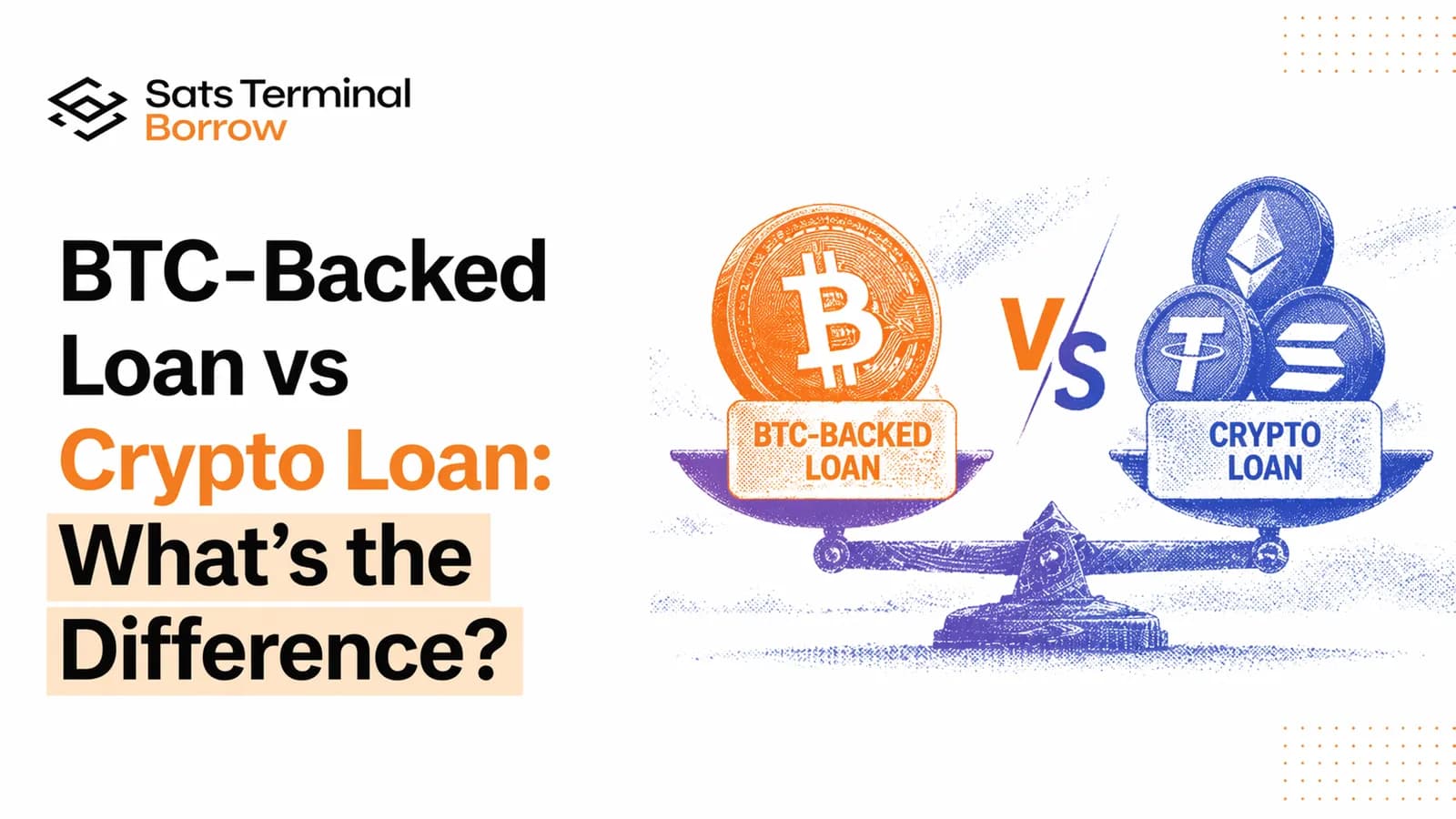
Every crypto loan is not created equal. When a borrower searches for a BTC backed loan, the terms they can access, the lenders willing to underwrite the position, and the risk profile behind that collateral look meaningfully different from a loan secured by ETH, a liquid staking token, or an altcoin. Bitcoin is the largest, deepest, and most widely accepted collateral asset in crypto lending. That status changes everything downstream: loan-to-value ceilings, liquidation buffers, borrow rates, available venues, and even the wrapping mechanics required to put BTC to work on chains where smart contracts live. This comparison unpacks how a BTC-backed loan actually differs from a generic crypto loan, where the tradeoffs lie, and how a Bitcoin-first aggregator like Borrow by Sats Terminal approaches the category.
The phrase "crypto loan" is a broad umbrella. It covers any loan where the collateral posted by the borrower is a digital asset — Bitcoin, Ether, Solana, a liquid staking token, a governance token, a stablecoin, or a long tail of altcoins. A BTC-backed loan is a specific subcategory of crypto loan where the collateral is Bitcoin itself, usually wrapped or bridged into a smart-contract-compatible form such as wBTC, BTCB, or cbBTC when the loan is originated on a chain outside the Bitcoin base layer.
The distinction matters because lenders price and size loans based on the collateral's risk profile. Bitcoin has the longest market history, the deepest spot and derivative liquidity, and the broadest institutional acceptance of any crypto asset. That creates a different underwriting reality than a loan collateralized by, say, a mid-cap altcoin where the liquidation venue may be a single thin order book on one decentralized exchange.
To anchor the terminology before going further, it helps to review how crypto lending actually works and the definition of collateral inside an over-collateralized loan. The rest of this article assumes you are familiar with those basics and focuses specifically on what changes when the collateral is Bitcoin rather than something else.
A generic crypto loan can be collateralized by almost any supported asset on a given venue. Aave v3, for example, accepts dozens of collateral assets across its deployments, from blue-chip tokens like ETH and wBTC to LSTs such as wstETH, cbETH, and weETH, down to smaller-cap tokens on niche markets. Morpho Blue takes this further by allowing isolated markets where lender-curators define the collateral pair, loan asset, oracle, and risk parameters per market. In CeFi, a crypto loan might be collateralized by a basket of assets held by the custodian.
Because the collateral universe is wide, a "crypto loan" tells you almost nothing about the rate, LTV, liquidation penalty, or risk. Those parameters are set asset by asset.
A BTC-backed loan narrows the collateral to Bitcoin. Some venues accept native BTC directly and manage the wrap or bridge for the user. Others require the borrower to deposit already-wrapped BTC. The borrower can typically receive stablecoins — USDC is the dominant choice, with USDT supported on certain chains and protocols — or, less commonly, another crypto asset. For a detailed walkthrough of how these loans are structured, see how Bitcoin-backed loans work.
Three structural features separate BTC from other crypto collateral types, and those features drive every downstream difference in LTV, rates, and lender coverage.
Bitcoin has the deepest spot liquidity of any crypto asset. Average daily spot volume across major venues regularly sits in the tens of billions of dollars, with derivatives markets adding a multiple on top. When a loan is liquidated, the liquidator needs to sell the collateral quickly without moving the market against itself. The deeper the liquidity, the less slippage, the lower the liquidation bonus that needs to be priced in, and the higher the LTV a lender is willing to offer.
ETH is in a similar tier of liquidity, with a smaller — but still enormous — book. LSTs introduce a second layer of risk because the liquidator is selling a staked derivative, not the underlying ETH. Altcoins drop off sharply. A token with $50 million of daily volume cannot be liquidated at the same size or speed as BTC without substantial price impact.
Bitcoin is volatile, but it is less volatile on average than most other crypto assets. Historical realized volatility for BTC has trended lower over time as the market has matured. ETH is typically more volatile than BTC. Most altcoins are materially more volatile still. Higher volatility means a larger liquidation buffer is required to keep a loan solvent through short-term drawdowns, which compresses the safe LTV a lender can extend.
Wrapped Bitcoin has become a de facto standard across EVM chains. wBTC, BTCB (BSC), and cbBTC (BASE and Ethereum) are listed on essentially every meaningful lending venue, and price oracles for BTC are the best-maintained and most redundant in DeFi. That universality means a BTC-backed loan has far more lender options than a loan secured by a specific altcoin that may only trade against one market on one chain. For the terminology, see wrapped Bitcoin and Bitcoin in the glossary.
The following table sets the four major collateral categories side by side. Figures are expressed as typical ranges observed across Aave v3, Morpho Blue, and major CeFi lenders as of early 2025, and they will vary by chain, venue, and market. Always read the current parameters on the venue itself before borrowing.
| Parameter | BTC-backed | ETH-backed | LST-backed (wstETH, cbETH, weETH) | Altcoin-backed |
|---|---|---|---|---|
| Typical max LTV | 70–80% | 75–83% | 70–78% | 40–65% |
| Typical liquidation threshold | 75–85% | 78–86% | 75–82% | 50–70% |
| Stablecoin borrow rate (variable) | Typically mid — driven by pool utilization | Typically mid — similar to BTC markets | Often lower net, after staking yield offsets | Typically higher — thinner utilization ranges |
| Lender coverage | Broadest — every major DeFi and CeFi venue | Very broad — most DeFi and CeFi venues | Good — most major DeFi venues, fewer CeFi | Limited — select chains, isolated markets |
| Oracle redundancy | High — Chainlink + multiple feeds | High — Chainlink + multiple feeds | Moderate — LST-specific oracles and exchange rates | Variable — sometimes a single feed |
| Wrap / bridge requirement | Yes — to wBTC, BTCB, or cbBTC | Usually no — ETH is native to most lending chains | Already ERC-20; no wrap needed | Depends on chain; sometimes requires bridging |
| Yield on collateral while posted | None natively | None (unless wrapped as LST) | Staking yield continues to accrue | Usually none |
| Realized volatility profile | Lowest among crypto collateral | Slightly higher than BTC | Tracks ETH plus staking-rate risk | Substantially higher |
| Liquidation penalty / bonus | Typically 5–8% | Typically 5–8% | Typically 6–9% | Typically 8–15% |
| Cross-chain availability | Every major EVM chain | Every major EVM chain | Depends on LST bridge support | Often limited to one chain |
The takeaway from this table is that BTC and ETH sit in a similar tier of safety and flexibility for collateral, with LSTs close behind but subject to an extra layer of staking and peg risk. Altcoins are categorically different: lower LTV, higher rates, thinner coverage, and wider liquidation penalties. That is why a borrower choosing between "a BTC loan" and "a generic crypto loan" is almost never comparing like-for-like on terms.
The table summarized the headline numbers. The underlying dynamics are worth understanding because they explain why parameters end up where they do and how a borrower should read them.
A lender's maximum LTV is the largest loan-to-collateral ratio at which a new borrow can be opened. The liquidation threshold — a higher number — is the ratio at which the position becomes eligible for liquidation. The buffer between the two is the room the borrower has before liquidators can act. Lenders set both parameters based on historical volatility, liquidity depth, and oracle reliability. BTC scores well on all three, so Aave v3 typically allows 70–80% max LTV on wBTC markets with liquidation thresholds around 75–85%. For altcoins on the same protocol, those numbers compress to 40–65% and 50–70%. For a deeper walkthrough of the mechanics, see understanding collateral and LTV.
Most DeFi lending markets use variable rates that adjust with pool utilization. When utilization is high, the rate rises; when it is low, the rate falls. BTC-collateralized loans borrowing USDC on Aave v3 typically draw from the same USDC pool as ETH-collateralized loans, so the raw borrow APR for a given loan asset does not vary by collateral. What does vary is the net economics across collateral types. If an LST is earning 3–4% staking yield while posted as collateral, the net cost of the loan drops by that amount. BTC, posted as wBTC, does not generate yield while collateralized on Aave v3, so the cost of the loan equals the gross borrow APR.
Morpho Blue changes this dynamic because each market is isolated. A Morpho wBTC/USDC market may have different utilization and therefore a different rate than a generic pool. Some Morpho markets also offer fixed terms. For the pros and cons of each rate structure, see fixed vs variable Bitcoin loans.
On a BTC-backed loan, a liquidation is typically executed by a third-party liquidator who repays part of the debt in exchange for a discounted claim on the collateral. The discount — often 5–8% on BTC markets — is the liquidation bonus that incentivizes liquidators to act quickly. On altcoin markets, that bonus widens because the liquidator takes more risk selling into thinner books. Borrowers should understand that liquidation is not a penalty imposed by the protocol so much as a mechanical response to the collateral value dropping below the threshold. The full breakdown of how these flows function is covered in how crypto lending works.
Collateral type determines which lenders will accept the loan. Bitcoin wins on breadth.
Every major DeFi lending venue supports wBTC. Aave v3 lists it across Ethereum, Arbitrum, Polygon, Optimism, and BASE. Morpho Blue hosts wBTC-collateralized markets across several deployments. BASE has meaningful cbBTC liquidity. BSC uses BTCB as the dominant wrap. On the CeFi side, effectively every licensed institutional or retail crypto lender supports BTC collateral — it is the anchor product of the category.
That breadth is what makes aggregation useful. A borrower posting BTC can realistically compare four to six offers from different chains and venues and choose the best combination of rate, LTV, liquidation buffer, and custody model. For a look at the protocol set specifically, see comparing Aave, Morpho, and CeFi and the FAQ on which protocols Borrow supports.
ETH coverage mirrors BTC on DeFi. Most major protocols list ETH or wETH. CeFi coverage is also broad but varies more by jurisdiction and platform. Borrowers often find that the deepest stablecoin markets on any given chain are ETH-collateralized simply because ETH is the native asset of most EVM chains and therefore the path of least resistance.
LST coverage is concentrated in DeFi. Aave v3 and Morpho Blue both list wstETH, cbETH, and weETH in major markets. CeFi lenders have been slower to accept LSTs as collateral because staking derivatives introduce operational complexity — validator risk, exchange rate oracles, and redemption queues — that traditional custodians are still building toward.
Altcoin coverage is the most fragmented. A token might be accepted as collateral on a single protocol, on one chain, with conservative parameters. Morpho Blue's isolated markets help here because a curator can stand up a market for a specific altcoin with parameters matched to its risk. But a borrower who wants to shop multiple venues for the same altcoin collateral will often find that the "market" is a single lender.
Bitcoin lives on its own chain. Smart contract lending lives mostly on EVM chains. Every BTC-backed DeFi loan therefore crosses a chain boundary, and the mechanics of that crossing are one of the few places where BTC is operationally harder than native-chain collateral like ETH.
Three wrapped BTC formats dominate on the venues Borrow aggregates:
Each wrap is a bearer token backed one-to-one by BTC held in custody by the issuer. Borrowers should know the custody model of the specific wrap they are using. The wrapped Bitcoin glossary entry covers the details.
Because BTC has to be wrapped and often bridged into a chain that supports the target lender, the user experience historically required manual steps across multiple tools: buy wBTC on an exchange, bridge to the right chain, approve the lending protocol, supply collateral, borrow. Each step is a point of friction and a potential user error. Borrow's automated collateral preparation collapses those steps behind a single user approval, which is where the aggregator model materially improves outcomes for BTC borrowers specifically. For more on this, see what you need to know about crypto lending safety and the FAQ on what Bitcoin-backed loans are.
Given the parameter advantages and the coverage breadth, there are several situations where a BTC-backed loan is the correct choice over a generic crypto loan.
Selling BTC in a jurisdiction with capital gains tax triggers a taxable event. Borrowing against BTC, in many jurisdictions, does not. Long-term holders with appreciated positions often prefer a loan to unlock liquidity without realizing the gain. This is not tax advice — specifics vary by jurisdiction and individual situation, and borrowers should consult a tax professional — but the mechanical principle is a core reason BTC-backed loans exist as a product category. For a broader look at the comparison, see crypto lending vs traditional bank loans.
A large position (six or seven figures of USD value) benefits from BTC's liquidity profile more than almost any other collateral. The ability to liquidate a large loan smoothly without extreme slippage is one reason professional desks and institutional treasurers default to BTC as their collateral of choice.
BTC's lender coverage is simply broader. A borrower using BTC as collateral can realistically compare DeFi and CeFi offers across six or more venues. An altcoin borrower might have one real choice. The ability to compare is the essence of aggregation, and it is especially valuable for BTC precisely because the choice set is large.
The combination of lower realized volatility, deeper liquidity, and tighter liquidation bonuses means BTC-backed loans tend to offer the most forgiving liquidation profile at a given LTV. Borrowers who are sensitive to drawdown risk often size their BTC loans at 30–40% LTV and carry a thick buffer. Doing the same on an altcoin position would still leave the loan closer to the liquidation threshold.
BTC is not always the right collateral. There are legitimate reasons to post something else.
A borrower who already holds ETH or an LST and wants to avoid a tax event on conversion should just post that asset directly. Wrapping into BTC to borrow would trigger a conversion — likely a taxable event — and introduce unnecessary friction. The whole point of using crypto as collateral is to avoid selling the asset. Post what you hold.
Liquid staking tokens earn yield while posted as collateral. If the LST yield is 3–4% and the stablecoin borrow rate is 6%, the net cost of the loan is only 2–3%. That can beat a BTC-collateralized loan on a pure cost-of-capital basis. The tradeoff is peg risk and the extra oracle complexity.
Some niche borrow assets are only available in markets paired with specific collateral types. Morpho Blue's isolated markets sometimes offer unusual pairings that don't exist elsewhere. In those cases, posting the matching collateral is the only way to access the market.
On rare occasions, a specific chain may have deeper liquidity or better rates for a non-BTC collateral pair. A borrower already operating on that chain may prefer to use the native collateral rather than bridging. The framework for thinking about this tradeoff is the cost of bridging and wrapping against the incremental rate or LTV advantage of the local collateral. The Aave, Morpho, and CeFi comparison goes deeper into when each venue makes sense.
Borrow by Sats Terminal is a Bitcoin-first aggregator. The product is built around one specific job: helping a BTC holder get the best available loan terms without having to manually shop every lender, wrap their own BTC, bridge it to the right chain, and interact with multiple protocols. It does not issue loans — it is an aggregator. Loans are underwritten by the supported lenders: Aave v3, Morpho Blue, and a set of CeFi providers that Borrow labels clearly in the offer comparison.
When a borrower specifies how much BTC they want to post or how much stablecoin they want to borrow, Borrow surveys the supported venues and returns a set of offers with the key terms for each: interest rate, max LTV, liquidation price, fees, and whether the lender is custodial or non-custodial. The borrower can compare those offers side by side and select one. This process replaces a workflow that, done manually, would take hours — open wallet, bridge, wrap, compare protocol UIs, approve each one — and compresses it into a single unified flow.
A borrower deposits native BTC to a unique address generated by Borrow. The system monitors confirmations on the Bitcoin network in real time. Once confirmed, Borrow handles the wrapping into wBTC, BTCB, or cbBTC as required by the selected lender, bridges it to the correct chain, supplies it as collateral, and issues the stablecoin borrow — each step user-approved, never custodial on Borrow's side. The stablecoins arrive in the user's self-custodial Privy wallet, which is created automatically at signup with no seed phrase to manage and no KYC requirement.
Borrow does not attempt to be a universal lending aggregator across every possible collateral type. It focuses on BTC. That focus lets the product optimize the parts of the BTC loan flow that are hardest — the wrap, the bridge, the cross-chain delivery of stablecoins — rather than spreading effort thinly across dozens of collateral types. A generic crypto loan aggregator would have to cover a much wider surface, and the BTC-specific operations would get less attention. For a closer look at how aggregators find the best rates across lenders, see how lending aggregators find best rates.
Common Questions
Not always. The borrow rate on a stablecoin loan is driven by pool utilization and does not usually change based on the collateral posted — Aave v3's USDC pool charges the same borrow APR whether your collateral is wBTC, ETH, or wstETH. Where costs diverge is in the yield on the collateral itself. LSTs earn staking yield while posted, which offsets the loan cost and can make the net economics better than BTC. BTC wins on LTV generosity and liquidation buffer, not on raw APR. The right comparison is total cost over your expected holding period, not headline rate.

