

Crypto loan vs margin trading compared for 2026: liquidation speed, costs, custody, taxes, and a worked 2x BTC example to help you pick the right tool.
 Arkadii Kaminskyi
Arkadii Kaminskyi
Head of Operations at Sats Terminal
Head of Operations at Sats Terminal with 5 years of experience in crypto. Specializes in DeFi, yield farming, and borrowing — has reviewed 50+ crypto products.
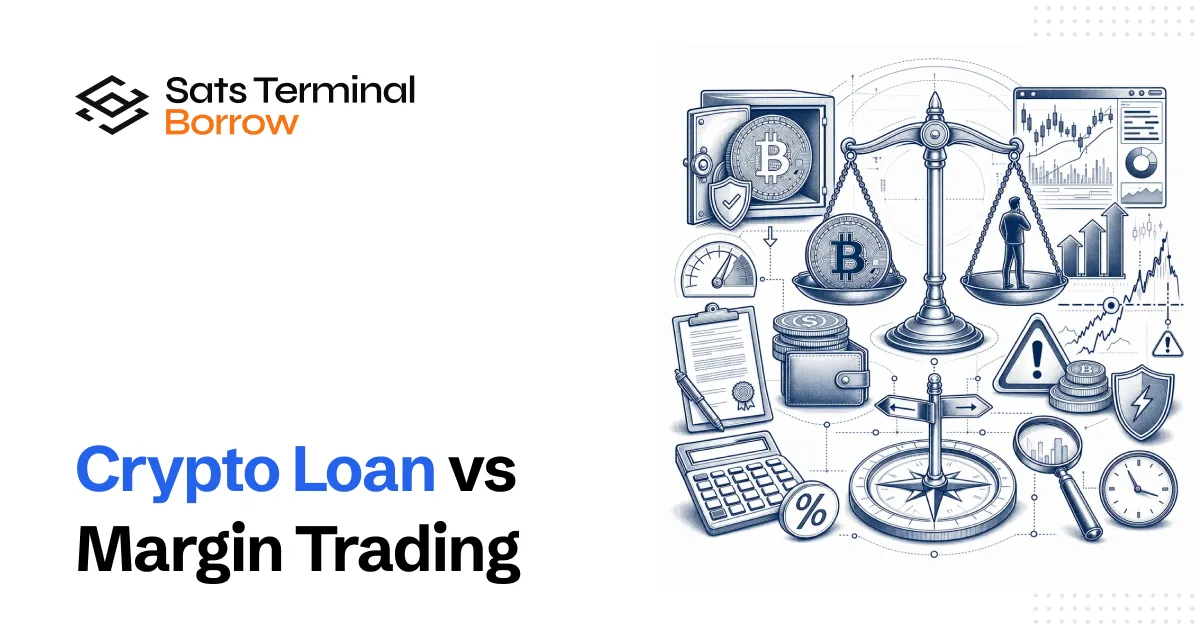
If you hold Bitcoin or another major crypto asset and you want cash, exposure, or both, you will eventually run into the same fork in the road: do you take a loan against your coins, or do you open a leveraged trade? The crypto loan vs margin trading decision sounds like a single question, but it is really two very different financial tools wearing similar marketing. One lets you keep your stack and walk away with spendable dollars. The other hands you borrowed buying power that lives and dies with one specific position. Confuse them, and you can end up liquidated at the worst possible moment, with a surprise tax bill on top. This guide breaks down the mechanics, the math, and the use cases so you can pick the right instrument for what you are actually trying to do in 2026 — not what an exchange's funnel wants you to do.
We will define each tool precisely, compare them across the dimensions that matter (liquidation speed, cost structure, custody, term, and tax), walk through real numbers, and finish with a clear decision framework. None of this is financial or tax advice; protocol parameters and lender terms move constantly, so always confirm current numbers before you commit capital.
The cleanest way to think about the difference between borrowing vs leverage crypto is to ask what the borrowed money is for and what is securing it.
A crypto-backed loan is a liquidity tool. You lock collateral — usually Bitcoin or a wrapped version of it — and a lender (a DeFi protocol like Aave or Morpho, or a CeFi desk) advances you stablecoins or cash. That money is yours to do anything with: pay a tax bill, cover payroll, buy a car, fund a renovation, or yes, buy more crypto if you choose. The loan and the collateral are separate things. Your BTC sits as collateral; the cash goes wherever you point it. You control the timing, the term, and when you repay. For a primer on the mechanics, see what crypto loans are and how they work.
Margin trading is a leverage tool. An exchange or broker lends you funds to amplify one specific trade. Crucially, the position you open is the collateral. There is no separation: borrow to go long BTC, and your long BTC position both is the bet and backs the loan. The borrowed money does not leave the exchange and cannot be spent on anything else. Its sole purpose is to magnify gains — and losses — on that trade.
Rule of thumb: a crypto loan answers "how do I get dollars without selling?" Margin answers "how do I get more exposure than my cash allows?" If your real goal is the first, leverage is the wrong tool — and vice versa.
That single difference — spendable cash secured by a separate asset versus locked exposure secured by itself — cascades into everything else: how fast you get liquidated, what you pay, who holds your keys, and how the IRS treats it. Let's take them one at a time.
When you take a Bitcoin-backed loan, you over-collateralize. You pledge more value than you borrow, because the lender needs a buffer against price swings. The loan-to-value ratio (LTV) expresses how much you borrow relative to your collateral. Borrow $40,000 against $100,000 of BTC and your LTV is 40%.
As of early 2026, typical Bitcoin-backed loan LTVs run from around 40% on conservative CeFi products up to roughly 70–82% on DeFi protocols for wrapped BTC. DeFi borrowing costs for stablecoins on Morpho and Aave have frequently sat in the low-single-digits to high-single-digits range, while CeFi desks commonly quote somewhere around 8–14% APR depending on LTV and loan size. These numbers move with utilization and market demand, so treat them as ranges and check current terms. For a deeper look at how borrowing capacity is set, see how much you can borrow against your Bitcoin.
Margin trading comes in two broad flavors in 2026: spot margin and derivatives (perpetual futures). Both let you control a position larger than your cash, but the plumbing differs.
Spot margin: The exchange lends you actual assets or stablecoins so you can buy (or short-sell) more than your balance. Major venues commonly cap spot margin around 3x–10x. You pay interest on the borrowed amount, accruing continuously.
Perpetual futures ("perps"): The dominant form of crypto leverage today. You never own the underlying; you trade a contract that tracks the spot price, posting a small margin deposit. Headline leverage can reach 50x–100x on the biggest pairs (lower on altcoins), though using anything close to that is a fast track to liquidation. Instead of a normal interest charge, perps use a funding rate — more on that shortly.
The defining feature of all margin is that the position is the collateral. Your margin deposit backs the trade, and if the trade loses enough value, the exchange seizes and closes it automatically. There is no separate asset to lean on (unless you are in cross margin, which we'll cover). This is what makes margin fundamentally different from a collateralized loan, and it is the heart of the margin trading vs crypto loan distinction.
Warning: leverage cuts both ways and rounds down. A 2x long needs only a ~50% drop to wipe your margin; a 10x long needs only ~10%; a 50x long needs only ~2%. The asset doesn't even have to be wrong long-term — a brief wick can liquidate you and you eat the loss permanently.
Here is the comparison that drives the decision. Read it as "which property do I need," not "which is better" — neither is universally superior.
| Dimension | Crypto-Backed Loan | Margin Trading |
|---|---|---|
| Primary purpose | Liquidity / spending — get dollars without selling | Speculation — amplify a specific directional bet |
| What backs it | A separate asset (your BTC) held as collateral | The trade itself; the position is the collateral |
| What you can do with funds | Anything — spend off-platform, any purpose | Only that trade; funds stay on the exchange |
| Liquidation trigger | Collateral value breaches LTV / health factor < 1 | Position equity falls below maintenance margin |
| Liquidation speed | Slower; often a grace window or margin-call notice in CeFi | Near-instant, fully automated, no warning at high leverage |
| Cost structure | Loan APR (fixed or variable) on the borrowed amount | Margin interest or perpetual funding rate, paid periodically |
| Typical effective cost (2026) | ~3–14% APR depending on DeFi vs CeFi and LTV | Funding often ~10–30%+ annualized; spikes far higher when crowded |
| Term / flexibility | Open-ended or fixed term; you choose when to repay | No term; held until you close or get liquidated |
| Custody | Non-custodial (DeFi) or custodial (CeFi) — you can choose | Always custodial; exchange holds margin and can liquidate |
| Tax at origination (US) | Not a taxable event — borrowing isn't a sale | N/A at open; every close/liquidation is a taxable disposal |
| Best for | Long-term holders needing cash or patient leverage | Active traders with a defined edge and tight risk rules |
The two rows people underweight are liquidation speed and tax. We'll return to both, because they are where the leverage vs collateralized loan trade-off does the most damage to people who picked the wrong tool.
Both tools can liquidate you, but the mechanism and speed are not comparable. This is the single most important section of this whole comparison.
On a DeFi protocol like Aave, every position carries a health factor. It is calculated as your collateral value multiplied by the weighted liquidation threshold, divided by your debt. When the health factor falls below 1, your position becomes eligible for liquidation: a liquidator repays part of your debt and takes an equivalent slice of collateral plus a bonus (often a liquidation penalty in the 5–10% range, though Aave v4 introduced a Dutch-auction model where deeper underwater positions pay larger bonuses). Importantly, partial liquidation is common — protocols may only sell enough collateral to restore health, not your entire stack.
On a CeFi desk, liquidation is usually preceded by a margin call: an alert and often a grace window (hours to a day or two) to add collateral or repay before any forced sale. This human-friendly buffer is one of the underrated advantages of collateralized borrowing. To dig into defense tactics, read our guide to managing liquidation risk and how to optimize your LTV ratio.
Margin liquidation keys off maintenance margin — the minimum equity your position must maintain. As the trade moves against you, your equity shrinks. The instant it crosses the maintenance threshold, the exchange's liquidation engine closes the position at the best available market price, "without regard for how low that price might be." At high leverage there is effectively no warning. In thin or fast markets, you can be filled well below your theoretical liquidation price, deepening the loss — a phenomenon traders call slippage on liquidation.
The cruel twist of margin: the very trade you opened can trigger your own liquidation. Open a leveraged long, the market dips, your position loses equity, and that loss is the thing that liquidates you. With a loan, the trade you do off-platform with the borrowed cash has zero bearing on your collateral.
Put plainly: a margin position is a self-referential bet that can blow itself up. A collateralized loan only liquidates if the collateral asset falls — and you control how much buffer you keep. For a fuller treatment of what forced sale means and how to recover, see what happens if you can't repay a crypto loan.
People assume margin is "cheaper" because they only see a small headline interest number, but the real cost depends on how you trade and how the funding mechanism behaves.
A crypto-backed loan charges an APR on the amount you borrowed. It can be a fixed rate (common in CeFi, predictable) or a variable rate (common in DeFi, driven by the pool's utilization rate). You know roughly what you'll pay, and interest accrues only on the outstanding balance. Repay early and you stop paying. See how crypto lending rates are determined and our take on variable vs fixed rates.
Perpetual futures don't charge ordinary interest. Instead, longs and shorts pay each other a funding rate, exchanged periodically (commonly every 8 hours, hourly on some venues) to keep the perp price tethered to spot. The base interest component is often ~0.01% per 8-hour interval — roughly 11% annualized — but the dominant driver is the premium between perp and spot.
For anything beyond a short tactical trade, funding-rate drag often makes leverage more expensive than a plain crypto loan — sometimes dramatically so during euphoric markets. If you intend to hold exposure for months, the loan is frequently the cheaper levered path, not the dearer one.
Custody is a real differentiator that rarely makes it into the comparison.
For self-custody purists, this alone often settles the debate: non-custodial borrowing keeps the keys (and the upside) in your hands, while margin requires surrendering your assets to a trading venue.
Within margin trading itself, there are two risk modes — and understanding them clarifies where a collateralized loan sits on the spectrum.
| Mode | What backs the position | Risk profile |
|---|---|---|
| Isolated margin | Only the margin you allocate to that one trade | Loss capped at that allocation; rest of account is safe. Discipline-forcing — the right default for most retail traders. |
| Cross margin | Your entire account balance backs all positions | One bad trade can drain everything; profits on other trades can rescue a loser. For advanced hedging/arbitrage only. |
| Collateralized loan | A dedicated, separate asset you pledge; borrowed funds leave the platform | No position-level wipeout; you only risk the pledged collateral, and only if it falls — not because of a trade. |
Notice the progression. Isolated margin ring-fences risk to one allocation. Cross margin pools all your funds as shared collateral — powerful but dangerous. A collateralized loan goes further still: the thing securing the debt is a separate, named asset, and the money you borrow isn't even on the trading venue. That structural separation is exactly why long-term holders gravitate to loans — there is no single trade that can take down the whole position.
Numbers make this concrete. Say you're bullish and you have 1 BTC, with BTC trading at $100,000 (a round 2026 reference — prices move, so adjust for live quotes). You want more Bitcoin exposure. Here are the two paths to roughly 2x exposure.
You deposit your 1 BTC ($100,000) as margin and open a 2x long. You now control ~$200,000 of BTC exposure — your own $100,000 plus $100,000 borrowed.
You pledge your 1 BTC ($100,000) as collateral and borrow $50,000 in USDC at 50% LTV. You use the $50,000 to buy 0.5 BTC on the spot market. You now hold 1.5 BTC of exposure (1 pledged + 0.5 freshly bought) — about 1.5x, and you can push toward 2x by borrowing more, accepting a higher LTV.
The takeaway: both paths give you levered Bitcoin exposure, but the loan version separates your bet from your liquidation risk, gives you predictable cost, defers taxes, and survives volatility that would vaporize a margin position. The margin version offers tighter, faster leverage and is simpler to open — but it is fragile, custodial, and tax-inefficient for anything but short holds. For a different framing of the same instinct, see should you sell or borrow against your Bitcoin.
For US holders, the tax gap between these tools is enormous and frequently decides the matter. This is general information, not tax advice — consult a professional for your situation.
If you are a long-term holder sitting on large unrealized gains, a loan lets you access liquidity without crystallizing those gains today. Margin trading does the opposite — it manufactures taxable events with nearly every position you close.
Every leverage tool has a way it kills you. Knowing the failure mode is how you avoid it.
| Risk | Crypto-Backed Loan | Margin / Perps |
|---|---|---|
| Forced liquidation | Only if collateral falls past threshold; often with a warning window and partial sale | Instant when equity hits maintenance margin; total at high leverage |
| Self-inflicted blow-up | No — your off-platform activity can't liquidate collateral | Yes — the trade you opened can liquidate itself |
| Cost runaway | Limited; APR is bounded and predictable | Funding can spike to triple-digit annualized in manias |
| Counterparty / custody | Choose non-custodial DeFi or vetted CeFi | Always exchange-custodial; freezes and insolvency risk |
| Slippage on exit | Lower; liquidations are usually orderly and partial | Severe in thin markets; fills far below theoretical price |
| Tax surprise | Only if collateral is liquidated | Built in — every close is a disposal |
The honest summary: margin can deliver bigger, faster returns to a disciplined trader with a real edge — and it can vaporize an account in minutes. A loan is slower, steadier, and far more forgiving, but it is not a magic money button: over-borrow at high LTV and you can still be liquidated. The risks are real on both sides; the difference is that the loan's risks are largely under your control, while margin hands a lot of control to the market and the exchange. For the full risk picture on the lending side, read the risks every Bitcoin borrower must understand.
Here's the decision framework, stripped to its essentials. The right answer in the crypto loan or margin debate depends almost entirely on your goal and time horizon.
If you find yourself wanting to use margin to "get cash" or to "hold BTC exposure for the next bull cycle," stop — you want a loan. And if you're using a loan to chase a 48-hour scalp, you've over-engineered a trade. Match the tool to the job. To weigh venues for the loan side, compare Aave, Morpho, and CeFi and consider how an aggregator can surface the best rate.
Step back and the pattern is clear. The HODLer thesis is that Bitcoin appreciates over years. Margin trading is structurally hostile to that thesis: it forces a short time horizon (funding drag), demands constant attention, taxes you on every exit, and can liquidate you on a routine 15–20% correction that a long-term holder would happily ride through. Margin is a tool for traders, not holders.
A collateralized loan, by contrast, is built for patience. You keep the asset and its long-run upside. You access dollars or build extra exposure without selling. You control the LTV buffer, so a normal drawdown doesn't touch you. And you defer taxes until you actually choose to sell. For someone whose core position is "I'm holding for the cycle," the loan aligns with the strategy while margin fights it. That's why, across nearly every long-horizon use case — from diversifying without selling to dollar-cost averaging to tax-efficient rebalancing — the loan wins on fit, even when margin offers more raw leverage.
If you wouldn't be comfortable being liquidated by a routine 20% dip, you shouldn't be in a margin position at meaningful leverage. A conservative loan at 30–40% LTV survives that dip without a flinch.
Whichever tool you pick, the people who survive treat risk management as non-negotiable.
Common Questions
A crypto loan gives you spendable cash or stablecoins secured by a separate asset you pledge as collateral, and you can use the money for anything. Margin trading lends you funds to amplify one specific trade, where the position itself is the collateral. The loan is for liquidity; margin is for leverage on a single bet. They serve fundamentally different goals.
Margin liquidates far faster. A margin position closes the instant your equity hits the maintenance margin, automatically and often without warning at high leverage. A crypto-backed loan only liquidates if your collateral falls past its threshold, and CeFi lenders typically give a margin-call window while DeFi positions can be partially liquidated. You generally have more time and more control with a loan.
In the US, borrowing against your crypto is generally not a taxable event because no sale or transfer of ownership occurs — the same treatment as a home-equity or securities-backed loan. The catch: if your collateral is liquidated, that forced sale is taxable, and you'll owe capital gains whenever you eventually sell the asset. Margin trade closes, by contrast, are taxable disposals. This isn't tax advice; consult a professional.
Yes, indirectly. You can borrow stablecoins against your BTC and use them to buy more crypto, creating leveraged exposure. The difference is that your liquidation risk tracks only your collateral , your cost is a predictable APR rather than a volatile funding rate, and you keep the newly bought asset in your own wallet. It's a slower, more durable form of leverage suited to longer horizons.
Funding rates are periodic payments between long and short traders on perpetual futures, exchanged (commonly every 8 hours) to keep the perp price near spot. When a market is crowded with longs, longs pay shorts, and in euphoric conditions that cost can compound to well over 20–30% annualized — sometimes far higher. Over a multi-month hold, funding drag often makes margin pricier than a plain crypto loan.
Isolated margin is safer for most people because it caps your loss to the margin you allocate to one trade, leaving the rest of your account untouched. Cross margin uses your whole balance to back all positions, so one bad trade can drain everything, though profits elsewhere can rescue a loser. Cross margin is best reserved for advanced hedging or arbitrage strategies, not casual retail trading.
Loans align with a buy-and-hold thesis: you keep your BTC and its long-run upside, access liquidity without selling, defer taxes, control your LTV buffer, and can ride out ordinary corrections. Margin forces a short horizon through funding costs, demands active management, taxes every exit, and can liquidate you on a routine dip. For holders, the loan fits the strategy while margin fights it.
With a Bitcoin-backed loan in 2026, LTVs commonly range from around 40% on conservative CeFi products to roughly 70–82% on DeFi protocols for wrapped BTC, so you borrow a fraction of your collateral's value. Margin offers higher headline multiples — spot margin around 3x–10x and perps up to 50x–100x — but that leverage is far riskier and applies only to the trade, not as spendable cash. Always check current terms. Neither tool is "better" — they solve different problems. If you want dollars in hand, durable exposure, predictable costs, and tax deferral while you hold for the cycle, a crypto-backed loan is almost always the right call. If you're an active trader with a defined edge, a short horizon, and the discipline to manage risk, margin can be a precise instrument — used carefully. The mistake is reaching for leverage when you really needed liquidity. When you've decided a loan fits, Borrow by Sats Terminal compares live BTC-backed loan offers across DeFi protocols and CeFi lenders in one place, so you can find the lowest rate and the LTV that lets you sleep at night — without selling a single satoshi.